
Catch can flow discussion

Disclaimer: Links on this page pointing to Amazon, eBay and other sites may include affiliate code. If you click them and make a purchase, we may earn a small commission.

OP
OP
iamdub

iamdub

Full Access Member
Joined
Apr 23, 2016
Posts
20,821
Reaction score
45,011
Location
Li'l Weezyana
I don’t but I can. Lemme get my bath robe!

4586720.jpg
 

George B

¯\_(ツ)_/¯
Joined
Feb 5, 2020
Posts
7,880
Reaction score
18,982
Location
Oconomowoc, Wisconsin 53066
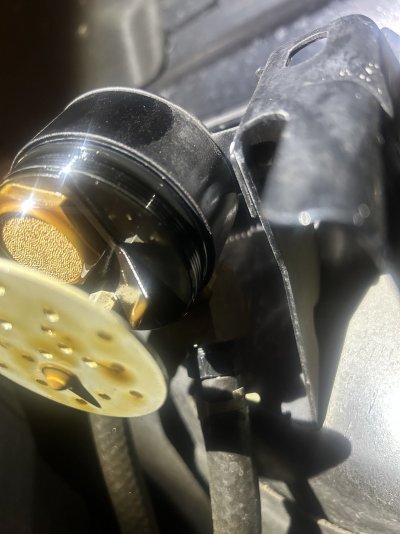
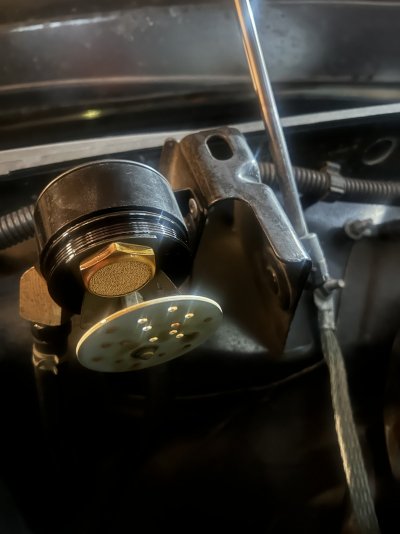
@iamdub it’s hard to get a good picture. Mine doesn’t have the inlet or the outlet labeled but as you and I discussed, I’m coming out of the valve cover into the port that has the little brass filter and then it leaves the can through the unfiltered port to the intake.

I did notice my hose running to the Intake is collapsed and flat so I’ll have to replace that tomorrow
 

Attachments

  • IMG_8672.jpeg
    IMG_8672.jpeg
    230.8 KB · Views: 27
  • IMG_8671.jpeg
    IMG_8671.jpeg
    170.5 KB · Views: 28
OP
OP
iamdub

iamdub

Full Access Member
Joined
Apr 23, 2016
Posts
20,821
Reaction score
45,011
Location
Li'l Weezyana
@iamdub it’s hard to get a good picture. Mine doesn’t have the inlet or the outlet labeled but as you and I discussed, I’m coming out of the valve cover into the port that has the little brass filter and then it leaves the can through the unfiltered port to the intake.

Thanks for checking that! You should've stuck a scouring pad on there while you had it open!


I might just see if I can remove or paint over the labels on this one so I'd feel better about "hooking it up backwards" :yaoface2:


I did notice my hose running to the Intake is collapsed and flat so I’ll have to replace that tomorrow

What hose did you use? Is it fuel rated? The wrong hose can dissolve and get soft from the inside out. It'd be best to keep particles of rubber out of your engine. :oops:
 

Just Fishing

Can't fix stupid
Joined
Aug 30, 2020
Posts
4,488
Reaction score
10,082
Location
Utah
My main experience would be with the drying of compressed air via my garage air system.

To get the water to seperate from freshly compressed air.

I have an overly complex drying setup that uses mostly distance from the air compressor to cool the air.

That alone catches a bit of water.

From there it's about using gravity to help that water separate.

So i have a series of vertical pathways, looks like a cage going up and down.

That serves to also further cool and give that water even more surface to stick to and separate from the air.

Place for the water to settle at the bottom of each rise, and of course a manual drain.

Then finally you want to spin that air via the air drier, filter, and regulator.

I get very little water in that final drier, even when running the compressor hard with something like my basting cabinet.

With our cars, we have basically the same idea, hot air mixing with oil splash and going out through the pcv.

It doesn't appear to be nearly as difficult to separate the two, but i went with the same basic idea.

Try to cool the air, make the oil fight a little gravity, and did my best to try and force the air to spin.

I took a cheap amazon catch can that had a design that had caps that are held on by a bunch of screws.

If i had to screw my top or bottom on, it might fk with my overly complex baffle system... lol

I made a chamber at the bottom, the inlet/valve cover side has a little aluminum tube to force the air to the bottom of the can.

Then the first baffle to help screen the air.

Then the second chamber where i made an aluminum fan or sorts.

Idea being that it forces a little spin to the air.

I doubt in practice it does exactly that, probably just more surface area for the oil to stick to..

Then the final chamber full of the scrubber mesh, mostly to force the air through and to give that oil somewhere to stick.

In my setup, i have my catch can mounted in the front of the engine bay, in the space where the second battery would go.

I also added a second catch can in series to see how well the first one works.

The second can never catches any oil, just water...

And that water never shows up unless it's winter/cold outside.
 

Just Fishing

Can't fix stupid
Joined
Aug 30, 2020
Posts
4,488
Reaction score
10,082
Location
Utah
I'll also note that my catch can in the tahoe, i doubt that I'll ever make another one like that with the little fan chamber.

In the jeep i went with a square catch can, the inlet tube, bottom chamber, and then full of stainless scrubbers!

My boat doesn't have a pcv nor does it use the intake to vacuum the crank case.
Just open vents on both sides of the valve covers.

It will get a different style of a catch can later, mostly to keep the engine area clean, and to prevent that oil stank.
 
OP
OP
iamdub

iamdub

Full Access Member
Joined
Apr 23, 2016
Posts
20,821
Reaction score
45,011
Location
Li'l Weezyana
It is fuel rated hose but it must be kind of thin walled.

I've had "meh" luck with fuel/vapor rated hoses, mostly the bulk stuff bought by-the-foot at the chain stores. Probably a source quality thing. It seems to be sure, you have to get fuel submersion rated. Kinda ridiculous for PCV, though. I like to nab factory PCV hoses off cars at the salvage yard. Cheap and guaranteed to last for 100K+ miles.
 
OP
OP
iamdub

iamdub

Full Access Member
Joined
Apr 23, 2016
Posts
20,821
Reaction score
45,011
Location
Li'l Weezyana
My main experience would be with the drying of compressed air via my garage air system.

To get the water to seperate from freshly compressed air.

I have an overly complex drying setup that uses mostly distance from the air compressor to cool the air.

That alone catches a bit of water.

From there it's about using gravity to help that water separate.

So i have a series of vertical pathways, looks like a cage going up and down.

That serves to also further cool and give that water even more surface to stick to and separate from the air.

Place for the water to settle at the bottom of each rise, and of course a manual drain.

Then finally you want to spin that air via the air drier, filter, and regulator.

I get very little water in that final drier, even when running the compressor hard with something like my basting cabinet.

With our cars, we have basically the same idea, hot air mixing with oil splash and going out through the pcv.

It doesn't appear to be nearly as difficult to separate the two, but i went with the same basic idea.

Try to cool the air, make the oil fight a little gravity, and did my best to try and force the air to spin.

I took a cheap amazon catch can that had a design that had caps that are held on by a bunch of screws.

If i had to screw my top or bottom on, it might fk with my overly complex baffle system... lol

I made a chamber at the bottom, the inlet/valve cover side has a little aluminum tube to force the air to the bottom of the can.

Then the first baffle to help screen the air.

Then the second chamber where i made an aluminum fan or sorts.

Idea being that it forces a little spin to the air.

I doubt in practice it does exactly that, probably just more surface area for the oil to stick to..

Then the final chamber full of the scrubber mesh, mostly to force the air through and to give that oil somewhere to stick.

In my setup, i have my catch can mounted in the front of the engine bay, in the space where the second battery would go.

I also added a second catch can in series to see how well the first one works.

The second can never catches any oil, just water...

And that water never shows up unless it's winter/cold outside.


I'll just stick a Tornado in my catch can. It'll add filtering horsepower and MPG to the PCV system!

710KI105_L_d58d9a06-f680-4c78-8237-3068ef577cc1.jpg


I actually do have one of these. Found it on the ground at LKQ. Brought it home for the novelty.
 

George B

¯\_(ツ)_/¯
Joined
Feb 5, 2020
Posts
7,880
Reaction score
18,982
Location
Oconomowoc, Wisconsin 53066
I've had "meh" luck with fuel/vapor rated hoses, mostly the bulk stuff bought by-the-foot at the chain stores. Probably a source quality thing. It seems to be sure, you have to get fuel submersion rated. Kinda ridiculous for PCV, though. I like to nab factory PCV hoses off cars at the salvage yard. Cheap and guaranteed to last for 100K+ miles.
I replaced that section with a piece of SAE 30R6 hose that was made in the USA and increased the radius. If that doesn’t do it I will hard pipe it in SS tube.
 

L8T BURB

Full Access Member
Joined
Jul 3, 2023
Posts
149
Reaction score
371
Location
Kentucky
I'm intrigued by catch cans and what they can do, why they exist, etc. Generally speaking, I like to challenge things with questions, only in an attempt to gain a better understanding of something that's new (to me).

With that said, has anyone ever sent their catch can gatherings to Blackstone or any similar oil analysis company to be evaluated? I've seen some online say they believe the catch can gatherings are mostly fuel, with only a very small part of it being oil. That being why most people report the can gatherings look quite thin.

Thoughts? As stated before, I truly am intrigued by these things, but I'm thinking if some of those who have the catch cans would be willing to send their catch can gatherings for analysis then we could better position ourselves to either have more trust in these, or possibly push them off as unnecessary add-ons.
 
OP
OP
iamdub

iamdub

Full Access Member
Joined
Apr 23, 2016
Posts
20,821
Reaction score
45,011
Location
Li'l Weezyana
I'm intrigued by catch cans and what they can do, why they exist, etc. Generally speaking, I like to challenge things with questions, only in an attempt to gain a better understanding of something that's new (to me).

With that said, has anyone ever sent their catch can gatherings to Blackstone or any similar oil analysis company to be evaluated? I've seen some online say they believe the catch can gatherings are mostly fuel, with only a very small part of it being oil. That being why most people report the can gatherings look quite thin.

It's just oil that gets blown from inside the engine. If there's fuel in it, then the oil circulating through the engine has fuel in it. If there's fuel in the oil beyond a certain, acceptable amount, then the engine is worn, damaged or not running properly. The only way I'd see the oil in the catch can being any different than what's in the crankcase is from something (fuel or moisture) being introduced into the PCV system from the top end, like just under the valve cover. If the oil in the catch can is thinned from being mixed with fuel, then it's likely thinned with fuel in the crankcase.


Thoughts? As stated before, I truly am intrigued by these things, but I'm thinking if some of those who have the catch cans would be willing to send their catch can gatherings for analysis then we could better position ourselves to either have more trust in these, or possibly push them off as unnecessary add-ons.

They have been proven time and again to be, at the very least, a "better safe than sorry" addition. They don't need to be proven any further to garner trust. They can do no harm if installed and later found to not be needed. If anything, it's a monitoring device if you just so happen to have an engine that moves no oil through the PCV system.

There are instances where they collect a bunch of moisture. Aside from the engine consuming moisture due to an internal coolant leak, this is environmental due to ambient temperatures, humidity and drive cycles. All this means to me is that's moisture (and oil) not being dumped into your engine and you should get a larger catch can or drain yours more often if it fills up. Regardless, its still doing its job of keeping stuff out of the engine's induction side.
 

L8T BURB

Full Access Member
Joined
Jul 3, 2023
Posts
149
Reaction score
371
Location
Kentucky
It's just oil that gets blown from inside the engine. If there's fuel in it, then the oil circulating through the engine has fuel in it. If there's fuel in the oil beyond a certain, acceptable amount, then the engine is worn, damaged or not running properly. The only way I'd see the oil in the catch can being any different than what's in the crankcase is from something (fuel or moisture) being introduced into the PCV system from the top end, like just under the valve cover. If the oil in the catch can is thinned from being mixed with fuel, then it's likely thinned with fuel in the crankcase.


They have been proven time and again to be, at the very least, a "better safe than sorry" addition. They don't need to be proven any further to garner trust. They can do no harm if installed and later found to not be needed. If anything, it's a monitoring device if you just so happen to have an engine that moves no oil through the PCV system.

There are instances where they collect a bunch of moisture. Aside from the engine consuming moisture due to an internal coolant leak, this is environmental due to ambient temperatures, humidity and drive cycles. All this means to me is that's moisture (and oil) not being dumped into your engine and you should get a larger catch can or drain yours more often if it fills up. Regardless, its still doing its job of keeping stuff out of the engine's induction side.
Awesome explanation! Thanks!!
 

Big Mama

Full Access Member
Joined
Jul 21, 2015
Posts
3,881
Reaction score
2,499
Location
Virginia
Great topic. Other than Joe’s post I didn’t see much about how much “oil” is being seen between oil changes. And, is that a good measure of if it actually working well given the different configurations. I also have the Amazon can but it’s a fancy anodized blue and has a dipstick.

 
OP
OP
iamdub

iamdub

Full Access Member
Joined
Apr 23, 2016
Posts
20,821
Reaction score
45,011
Location
Li'l Weezyana
Great topic. Other than Joe’s post I didn’t see much about how much “oil” is being seen between oil changes. And, is that a good measure of if it actually working well given the different configurations. I also have the Amazon can but it’s a fancy anodized blue and has a dipstick.

If it doesn't catch much, then either it's not working so well or your engine isn't passing much oil. I'd check the can's outlet hose for oil to see if the oil is just passing through the can. It'd have to be a really crappy design to not catch anything. Like, no filter and just some poorly-designed baffles. If you're filling the can frequently, that's bittersweet. It means your can is keeping a lot of oil from being burned. But it also means you need to take action to keep the oil inside the engine in the first place. There, again, it's at least a monitoring device and worth the $25 or more invested to have answers.

ed5b6ef1-e95e-4df5-815f-8f0e044c4276_text.gif


Mine seemed to work pretty well. I forget the exact amounts (I'm sure it's documented in my thread somewhere), but I consistently drained something like two ounces at every 5K mile OCI. A while later, I saw Amazon listings for catch cans having "high efficiency stainless steel filtration media" that were really just those scouring pads. I added one at my next oil change. From then on, I consistently drained three ounces.

Side note: This was with AFM disabled and mine already had the updated valve cover. Since deleting AFM, which included blocking off everything to make the block like a Gen 3, I've drained 1.5-2 ounces every time. The cam, the much more frequent 6K spins, much more sustained WOT, etc. all would have positive and negative effects on the engine's vacuum and PCV pressures. So, if I drove mine like @donjetman drives his, I'd probably have less than an ounce.
 

Big Mama

Full Access Member
Joined
Jul 21, 2015
Posts
3,881
Reaction score
2,499
Location
Virginia
Good points. I’ll measure it this time. She’s due for an oil change. After I pull the scrubber out there’s enough to coat the bottom of the can. I’d guess an ounce or so. Big Mama doesn’t have AFM so it sounds like she’s doing ok. For giggles I’ll add one to the Sierra I got in January. It has AFM and is also a 6.2.
 

MWD_CTSV

Full Access Member
Joined
Jan 21, 2023
Posts
108
Reaction score
199
I bought the JLT and the install seemed backwards to me so I checked the instructions for any indication of inlet filter. So in the end I switched the sides so the filter was on the intake side.

JLT is likely correct that the best filter placement is on the valve cover side. However, even with my backwards install, it still collects oil quite well.
 
OP
OP
iamdub

iamdub

Full Access Member
Joined
Apr 23, 2016
Posts
20,821
Reaction score
45,011
Location
Li'l Weezyana
So far, it seems the consensus is to have the inlet hit the filter. That's what the "big brands", which I'd be inclined to believe have put more R&D into their products than the Chi-clones, seem to agree on. But that's not to say that having it reversed won't work, either.

I'm gonna stick to my assessment that make a whole lot of difference, assuming you have proper coalescing media. But, where it would matter is if you're trying to keep something in the engine (like oil) and just catch what makes it through versus trying to vacate and capture something (like moisture). If just oil, inlet goes directly to filter. If moisture, inlet goes to reservoir.
 

Forum statistics

Threads
137,686
Posts
1,989,603
Members
102,687
Latest member
JohanZ
Back
Top