OP
OP


Disclaimer: Links on this page pointing to Amazon, eBay and other sites may include affiliate code. If you click them and make a purchase, we may earn a small commission.

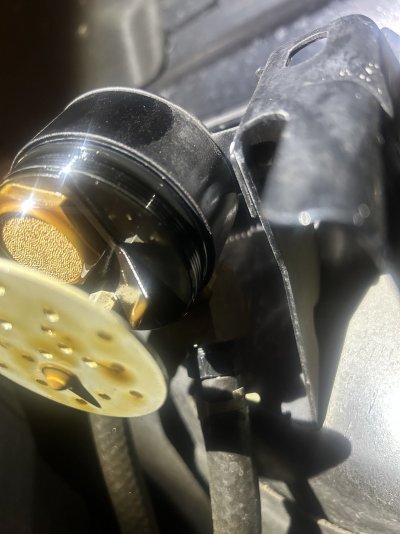
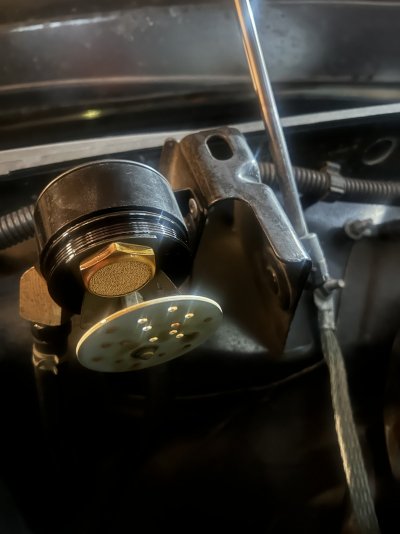
@iamdub it’s hard to get a good picture. Mine doesn’t have the inlet or the outlet labeled but as you and I discussed, I’m coming out of the valve cover into the port that has the little brass filter and then it leaves the can through the unfiltered port to the intake.

I did notice my hose running to the Intake is collapsed and flat so I’ll have to replace that tomorrow

It is fuel rated hose but it must be kind of thin walled.What hose did you use? Is it fuel rated? The wrong hose can dissolve and get soft from the inside out. It'd be best to keep particles of rubber out of your engine.
It is fuel rated hose but it must be kind of thin walled.
My main experience would be with the drying of compressed air via my garage air system.
To get the water to seperate from freshly compressed air.
I have an overly complex drying setup that uses mostly distance from the air compressor to cool the air.
That alone catches a bit of water.
From there it's about using gravity to help that water separate.
So i have a series of vertical pathways, looks like a cage going up and down.
That serves to also further cool and give that water even more surface to stick to and separate from the air.
Place for the water to settle at the bottom of each rise, and of course a manual drain.
Then finally you want to spin that air via the air drier, filter, and regulator.
I get very little water in that final drier, even when running the compressor hard with something like my basting cabinet.
With our cars, we have basically the same idea, hot air mixing with oil splash and going out through the pcv.
It doesn't appear to be nearly as difficult to separate the two, but i went with the same basic idea.
Try to cool the air, make the oil fight a little gravity, and did my best to try and force the air to spin.
I took a cheap amazon catch can that had a design that had caps that are held on by a bunch of screws.
If i had to screw my top or bottom on, it might fk with my overly complex baffle system... lol
I made a chamber at the bottom, the inlet/valve cover side has a little aluminum tube to force the air to the bottom of the can.
Then the first baffle to help screen the air.
Then the second chamber where i made an aluminum fan or sorts.
Idea being that it forces a little spin to the air.
I doubt in practice it does exactly that, probably just more surface area for the oil to stick to..
Then the final chamber full of the scrubber mesh, mostly to force the air through and to give that oil somewhere to stick.
In my setup, i have my catch can mounted in the front of the engine bay, in the space where the second battery would go.
I also added a second catch can in series to see how well the first one works.
The second can never catches any oil, just water...
And that water never shows up unless it's winter/cold outside.
I replaced that section with a piece of SAE 30R6 hose that was made in the USA and increased the radius. If that doesn’t do it I will hard pipe it in SS tube.I've had "meh" luck with fuel/vapor rated hoses, mostly the bulk stuff bought by-the-foot at the chain stores. Probably a source quality thing. It seems to be sure, you have to get fuel submersion rated. Kinda ridiculous for PCV, though. I like to nab factory PCV hoses off cars at the salvage yard. Cheap and guaranteed to last for 100K+ miles.
I replaced that section with a piece of SAE 30R6 hose that was made in the USA and increased the radius.
If that doesn’t do it I will hard pipe it in SS tube.
I'm intrigued by catch cans and what they can do, why they exist, etc. Generally speaking, I like to challenge things with questions, only in an attempt to gain a better understanding of something that's new (to me).
With that said, has anyone ever sent their catch can gatherings to Blackstone or any similar oil analysis company to be evaluated? I've seen some online say they believe the catch can gatherings are mostly fuel, with only a very small part of it being oil. That being why most people report the can gatherings look quite thin.
Thoughts? As stated before, I truly am intrigued by these things, but I'm thinking if some of those who have the catch cans would be willing to send their catch can gatherings for analysis then we could better position ourselves to either have more trust in these, or possibly push them off as unnecessary add-ons.
Awesome explanation! Thanks!!It's just oil that gets blown from inside the engine. If there's fuel in it, then the oil circulating through the engine has fuel in it. If there's fuel in the oil beyond a certain, acceptable amount, then the engine is worn, damaged or not running properly. The only way I'd see the oil in the catch can being any different than what's in the crankcase is from something (fuel or moisture) being introduced into the PCV system from the top end, like just under the valve cover. If the oil in the catch can is thinned from being mixed with fuel, then it's likely thinned with fuel in the crankcase.
They have been proven time and again to be, at the very least, a "better safe than sorry" addition. They don't need to be proven any further to garner trust. They can do no harm if installed and later found to not be needed. If anything, it's a monitoring device if you just so happen to have an engine that moves no oil through the PCV system.
There are instances where they collect a bunch of moisture. Aside from the engine consuming moisture due to an internal coolant leak, this is environmental due to ambient temperatures, humidity and drive cycles. All this means to me is that's moisture (and oil) not being dumped into your engine and you should get a larger catch can or drain yours more often if it fills up. Regardless, its still doing its job of keeping stuff out of the engine's induction side.
Great topic. Other than Joe’s post I didn’t see much about how much “oil” is being seen between oil changes. And, is that a good measure of if it actually working well given the different configurations. I also have the Amazon can but it’s a fancy anodized blue and has a dipstick.