
Oil Consumption

Disclaimer: Links on this page pointing to Amazon, eBay and other sites may include affiliate code. If you click them and make a purchase, we may earn a small commission.

nonickatall

Full Access Member
Joined
Nov 19, 2022
Posts
860
Reaction score
1,599
Location
Germany
Hello,

I currently have a relatively high oil consumption, around 1 liter per 1000 km. That's appx. 1 Quart per 600 Miles.

The engine currently has 220,000 km (136.00 miles) on it, runs perfectly and does not consume excessive fuel. There is no pressure on the crankcase so no blow by problem. It doesn't smoke much, when I drive normally. I think the PCV valve is OK. Yesterday I drove faster on the German highway and accelerated the car to top speed appx. 112 miles and drove for about 20 km.

Then I came home, I live right next to the motorway exit and it's still a bit downhill, so I drove to my place in coast mode.

This morning I turned the car on and a huge gray cloud came out of the exhaust.

To me it looks typical of worn valve stem seals.

I've noticed the phenomenon more often recently, that it smokes gray in the first few revolutions. I know that the cylinder heads were reworked during the installation of the LPG gas system, but I don't know whether they installed new valve stem seals at the time.

In my opinion, the valve stem seals are very suspicious. I know this from BMW vehicles that have already had the valve stem seals worn at 170,000 km.

Is this a typical problem with our cars? Are the valve stem seals designed in such a way that oil can still flow into the combustion chamber, when the engine is switched off, which would explain why it smokes significantly for a short time after it is switched on?

Or am I on the wrong track and that could also be another problem?

Best regards from rainy and cold Germany
 
Last edited:
drdave81

Full Access Member
Joined
Oct 7, 2020
Posts
261
Reaction score
401
Location
Waterford, MI
Since you said someone did work on the heads, I would take it back to them. What all did they do to the heads, how long ago was this done?

Piston rings aren't typically something that goes bad on these engines, so I would tend to lean toward the valve seals, especially since you said someone was in there. And if it only smokes on first start up, that's also another indication of guides. Rings would tend to smoke more than just start up or after idling.
 

Mudsport96

Full Access Member
Joined
Jun 6, 2020
Posts
1,421
Reaction score
2,331
Location
40.923,-89.488. Illinois
Still early morning here so I'm doing my best to think clearly. So, your Escalade has 170,000 km on it right now? If so that is roughly 105,000 miles. I would not think that your valve guides are worn. My Silverado did not start excessively consuming oil and making valve noise until 390,000 miles, or 628,000 km. So I am fairly confident you have a few kilometers till your guides are worn badly.

Now, if I remember correctly, you do have a 2006. So AGE may have taken its toll on the valve guide seals, and they COULD be leaking. They are not terrible to do... however they are not fun to do if you don't have the space or equipment to do them with the heads on the engine.

However, your rate of consumption seems high for just guide seals.

In 2003 General Motors switch the PCV valve from the old rattle valve to a fixed orifice that continuously pulls a vacuum. It is for lack of a better description, a controlled vacuum leak. There were a few revisions to correct heavy oil consumption by these engines. The drain holes in the metal deflector were enlarged to help keep the oil from clogging them. The clogging lead the imitation pcv to act as a straw and suck oil out of the valve covers. You couldn't really see oil smoke at highway speed but you could on startup and heavy acceleration.
I cured this on BOTH of my 2006 5.3 vehicles (Tahoe and Silverado)by installing an older style PCV valve cover from 2001 vehicles and an oil catch can on them.
The Tahoe has gone to virtually zero oil consumption between oil changes. The Silverado has dropped from 2 quarts per 1500 miles (1.9 liters per 2400km) to 2 quarts every 3000 miles ( 1.9 per 4830km). But it also has now 414,000 miles give or take ( 667877.76 km approximately). So oil consumption is expected.

If you have the ability to do some fairly easy work on it, I would start by inspecting the inside of the valve cover where the "PCV" is and see if the drain holes are clogged. I personally think that is possibly your culprit. And it requires just time, a little cleaning solution( degrease liquid), some pipe cleaners to clean the little holes and maybe a valve cover gasket set. Fairly inexpensive here in the States. But, it is winter... so if you do not have an indoor place to work, it can get a bit cold.
 
OP
OP
nonickatall

nonickatall

Full Access Member
Joined
Nov 19, 2022
Posts
860
Reaction score
1,599
Location
Germany
Thank you very much for the comprehensive answer.

My truck has 220,000 km on it, but that's not much more. The previous owner handled it very carefully and I do all repairs and maintenance as soon as they need to be done. He gets regular oil changes every 5000 km and only good Motul oil.

I have my own workshop with two lifts and I also repair automatic transmissions and have already overhaul some engines. However, everything is private, not commercial, and generally German cars, some of which are incredibly complicated to repair. The newer German engines are, the more terrible they are. Everything is just over engineered, throwaway products.

I've actually been secretly looking forward to working on the LS engine, which I've become very fond of because of its ingenious simplicity.

The idea with the valve covers is very good, I wanted to do a compression test in the near future anyway, take a look into the cylinders with the camera, so it's not such a big problem to remove the cylinder head covers and take a look.

However, I recently took off the oil pan to swap the O-ring for the oil pump and had previously poured a liter of diesel into the engine oil to dissolve carbon.

The oil pan actually looked pretty good. I think that the valve train is probably not completely carbonized either.

I don't think either it's the valve guides, but rather the valve stem seals.

I recently did this on a BMW n42 engine. That was such a bad screw-up.

The valve stem seals on the LS engine are probably like a vacation in Hawaii... :favorites37:
 

Mudsport96

Full Access Member
Joined
Jun 6, 2020
Posts
1,421
Reaction score
2,331
Location
40.923,-89.488. Illinois
Well with your experience the stem seals should not be too difficult for you.

You can find videos on YouTube that explain how to do them. And I believe videos explaining how to check the baffle drains for the PCV in the valve covers. If you can't find good videos I can look tomorrow for you. It is currently almost 2100 hours here and I just got back from cutting down a Christmas tree and dragging it back to the Tahoe, loading it on the rack and getting it to the house. I am dead on my feet haha. So it is bedtime, if you have more questions or can't find a good video explaining the pcv issue, just ask and I or someone else can find one I'm sure.
 
Last edited:

Mudsport96

Full Access Member
Joined
Jun 6, 2020
Posts
1,421
Reaction score
2,331
Location
40.923,-89.488. Illinois
Ok so, you may need to translate this as I do not know how fluent you are in American English. ( I don't speak the Kings English since they called an Oreo a cream chocolate biscuit , so I call what I speak American English). Hahaha
Anyway, here is a video of a modification to help oil to drain from the baffle on that valve cover.
Valve cover oil drain modification
 
OP
OP
nonickatall

nonickatall

Full Access Member
Joined
Nov 19, 2022
Posts
860
Reaction score
1,599
Location
Germany
Ok so, you may need to translate this as I do not know how fluent you are in American English. ( I don't speak the Kings English since they called an Oreo a cream chocolate biscuit , so I call what I speak American English). Hahaha
Anyway, here is a video of a modification to help oil to drain from the baffle on that valve cover.
Valve cover oil drain modification
Thank you very much for your information. My American English is not to bad. I think I would be able to to order an Donut and a coffee by pointing at them. :)

No only joking i think my english is quite okay and with the help of Google translate in some cases, it works very good.

At the moment I have no time to look at my engine, because winter is coming and I have quite a lot of work in my normal job to do.

But when I have time i will check the compression ratio and the valve cover.

I watched it now and there was no oil thrown out while engine start.
 

rockola1971

Full Access Member
Joined
Dec 29, 2016
Posts
2,862
Reaction score
4,084
Location
Indiana (formerly IL)
AFter verifying no leaks at oil pan, oil coiler lines if equipped, oil pressure sender, etc then I would do the compression check and if it passes then I would definitely suspect the valve seals. They could have been replaced and not done correctly or yours are original and/or your valve guides are worn for whatever reason but you would think when the heads were "reworked" they recut valves, installed new guides and seals and then redecked heads.
 
OP
OP
nonickatall

nonickatall

Full Access Member
Joined
Nov 19, 2022
Posts
860
Reaction score
1,599
Location
Germany
AFter verifying no leaks at oil pan, oil coiler lines if equipped, oil pressure sender, etc then I would do the compression check and if it passes then I would definitely suspect the valve seals. They could have been replaced and not done correctly or yours are original and/or your valve guides are worn for whatever reason but you would think when the heads were "reworked" they recut valves, installed new guides and seals and then redecked heads.
No, my car has no external oil leaks, the engine, all differentials, steering and the break booster are dry.

The oil is definitely burned by the engine. And in my opinion it can only disappear in four places.

On the oilrings of the pistons, on the valve stem seals, on the PCV valve and at most a defective cylinder head gasket, if I see it correctly.

So I think you're right and it will be the valve stem seals.

I now want to buy a decent camera to look into the cylinders and then I will do a compression test, take a look at the combustion chambers from the inside, look at the baffle plate in the valve cover at the top and then I may decide to change the valve stem seals close.

I don't think it's that much of a problem with the engine.

As I said, I constantly see German engines, built by engineers who, for whatever reason, deeply hate mechanics.

And when you see how long their engines last, the customers obviously as well...

I never thought I'd say this, when I was 16 and in the US for the first time, I defended the German car manufacturers and told every American that we build the best cars in the world.

Today in Germany, we are apparently only moral world champions... :emotions122:

but I digress...;)
 

Mudsport96

Full Access Member
Joined
Jun 6, 2020
Posts
1,421
Reaction score
2,331
Location
40.923,-89.488. Illinois
No, my car has no external oil leaks, the engine, all differentials, steering and the break booster are dry.

The oil is definitely burned by the engine. And in my opinion it can only disappear in four places.

On the oilrings of the pistons, on the valve stem seals, on the PCV valve and at most a defective cylinder head gasket, if I see it correctly.

So I think you're right and it will be the valve stem seals.

I now want to buy a decent camera to look into the cylinders and then I will do a compression test, take a look at the combustion chambers from the inside, look at the baffle plate in the valve cover at the top and then I may decide to change the valve stem seals close.

I don't think it's that much of a problem with the engine.
I am curious on the compression results.
Also how often do you run a tank of fuel through the engine? Are you using primarily LPG? Or do you change back and fourth?
 
OP
OP
nonickatall

nonickatall

Full Access Member
Joined
Nov 19, 2022
Posts
860
Reaction score
1,599
Location
Germany
I am curious on the compression results.
Also how often do you run a tank of fuel through the engine? Are you using primarily LPG? Or do you change back and fourth?
The cold start runs with fuel, after approximate 1 km it switches to lpg and if my lpg tank is not empty, i drive with lpg, because i pay at the moment 1€ for 1liter, while gasoline costs at the moment 1,80€. That means that with my consumption, i spend as much as a Hyundai i30 driver, with a 1 liter 3cylinder engine, which would be not used as a starter for real engines by GM when my car was made. I had that car recently in holiday is a rental car. You always have to step on the asseleration paddle, because the engine has nothing what would be called power.

When i go to Berlin, what i prevent if i can, i drive with 100liter lpg the 600km. A friend of mine works at VW Audi dealer and they recently drove an Audi e-tron electric ******** to Berlin for a customer. He told me, that they have to charge two times for 53€, so that means, that they invest more in electric energy than I in LPG....

And the funny thing is when people see me in Germany with my truck, the people always say: This car must have a huge fuel consumption...
 

cjmcglaughlin

Member
Joined
Jan 2, 2024
Posts
39
Reaction score
64
Location
Gettysburg, Pennsylvania
Still early morning here so I'm doing my best to think clearly. So, your Escalade has 170,000 km on it right now? If so that is roughly 105,000 miles. I would not think that your valve guides are worn. My Silverado did not start excessively consuming oil and making valve noise until 390,000 miles, or 628,000 km. So I am fairly confident you have a few kilometers till your guides are worn badly.

Now, if I remember correctly, you do have a 2006. So AGE may have taken its toll on the valve guide seals, and they COULD be leaking. They are not terrible to do... however they are not fun to do if you don't have the space or equipment to do them with the heads on the engine.

However, your rate of consumption seems high for just guide seals.

In 2003 General Motors switch the PCV valve from the old rattle valve to a fixed orifice that continuously pulls a vacuum. It is for lack of a better description, a controlled vacuum leak. There were a few revisions to correct heavy oil consumption by these engines. The drain holes in the metal deflector were enlarged to help keep the oil from clogging them. The clogging lead the imitation pcv to act as a straw and suck oil out of the valve covers. You couldn't really see oil smoke at highway speed but you could on startup and heavy acceleration.
I cured this on BOTH of my 2006 5.3 vehicles (Tahoe and Silverado)by installing an older style PCV valve cover from 2001 vehicles and an oil catch can on them.
The Tahoe has gone to virtually zero oil consumption between oil changes. The Silverado has dropped from 2 quarts per 1500 miles (1.9 liters per 2400km) to 2 quarts every 3000 miles ( 1.9 per 4830km). But it also has now 414,000 miles give or take ( 667877.76 km approximately). So oil consumption is expected.

If you have the ability to do some fairly easy work on it, I would start by inspecting the inside of the valve cover where the "PCV" is and see if the drain holes are clogged. I personally think that is possibly your culprit. And it requires just time, a little cleaning solution( degrease liquid), some pipe cleaners to clean the little holes and maybe a valve cover gasket set. Fairly inexpensive here in the States. But, it is winter... so if you do not have an indoor place to work, it can get a bit cold.
Would you recommend installing the older style valve covers over newer ones meant to resolve this? I don’t have high consumption but I was thinking about the Dorman ones with the slotted baffles just to be safe.
 

Mudsport96

Full Access Member
Joined
Jun 6, 2020
Posts
1,421
Reaction score
2,331
Location
40.923,-89.488. Illinois
Would you recommend installing the older style valve covers over newer ones meant to resolve this? I don’t have high consumption but I was thinking about the Dorman ones with the slotted baffles just to be safe.
You could use either style. But whichever you choose, open the drain holes more. I have had no issues running the older style but unless you are going to the junkyard to find them, you may have a hard time finding some. As I believe the updated ones are all the stores sell now.
 
OP
OP
nonickatall

nonickatall

Full Access Member
Joined
Nov 19, 2022
Posts
860
Reaction score
1,599
Location
Germany
I now found the time to care for my car and i guess my engine ist finished and need an overhaul. :oops:

The engine runs good, makes no noise, but have oil consumption and coolant water is disappearing in some way.

Today i use an endoscope and made a pressure test.

I have on cylinder 1,2,3,4,6,7,8 around 210 PSI, but on cylinder 5 only 160PSI.

And when i look with the endoscope, i have cracks between the valves in most cylinders and i think my valve steam seals are finished, because i see oil on most of the intake valves. That is not a big problem, but in cylinder 5 there is a crack near the valve seat with missing material, which makes me think, it is better not to drive anymore, because if the valve seat falls out, i guess i can bring the engine to the graveyard.

I think that is the reason for the bad compression on this cylinder. So i guess i need two new heads and when i do that, i makes sense to make a complete overhaul.

I uploadet the videos on YouTube.

I would really appreciate if you guys, who are experienced with the LS/LQ Engine could tell me your thoughts, especially about cylinder 5, what to do and what you think about continue driving the engine, until i have time for an overhaul.

And what do the experts think about the overall condition of the combustion chamber, cylinder surface?

Here are the videos:
Sorry for the wobble, but it is very difficult to hold the endoscope steady and maneuver it correctly

Cylinder 1
Cylinder 2
Cylinder 3
Cylinder 4
Cylinder 5
Cylinder 6 https://youtu.be/o5GvQHSaxFw
Cylinder 7 https://youtu.be/3yXkXcqLphM
Cylinder 8 https://youtu.be/AsnaFQvsRh4?si=O1Enubd2M7C_16lD
 
Last edited:

swathdiver

Full Access Member
Joined
May 18, 2017
Posts
21,320
Reaction score
30,313
Location
Treasure Coast, Florida
I looked at 1, 2 and 5. I think you have a blown head gasket on 5, it's washing the piston clean. I'm not well versed enough with LS engines to tell if those cracks are in the material or carbon build up or casting slag.

There's a leakdown procedure that can tell you where the compression loss is happening.

If it is a head gasket, you could be back on the road in short order without spending a ton of money on an overhaul or new engine, unless that is what you want and are ready for.
 

Mudsport96

Full Access Member
Joined
Jun 6, 2020
Posts
1,421
Reaction score
2,331
Location
40.923,-89.488. Illinois
I did not see the crack you were speaking about. I believe the valve stem seals are shot by looking at the videos. Also you will see more buildup than other engine. The fact you run propane or CNG is the reason. Liquid fuel washes the oil buildup away when it is introduced to the cylinder. Vapor fuel does not.
 
OP
OP
nonickatall

nonickatall

Full Access Member
Joined
Nov 19, 2022
Posts
860
Reaction score
1,599
Location
Germany
I did not see the crack you were speaking about. I believe the valve stem seals are shot by looking at the videos. Also you will see more buildup than other engine. The fact you run propane or CNG is the reason. Liquid fuel washes the oil buildup away when it is introduced to the cylinder. Vapor fuel does not.
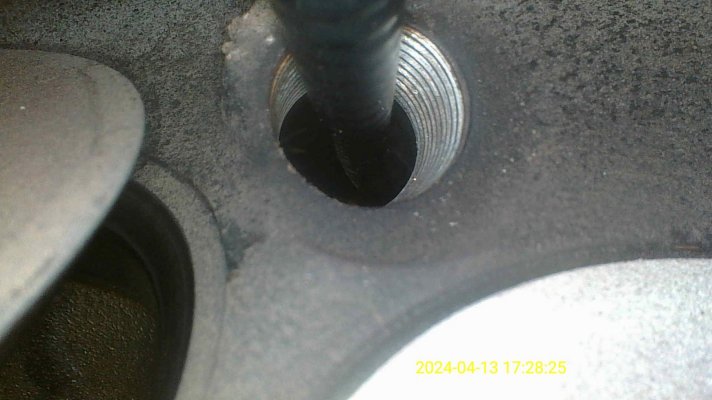
Here you can see the place I'm talking about. The dark spot right on the valve seat and the dark groove above the dark spot, where it looks like the valve seat is loose somehow.

I'm wondering if the reduced compression could also be a head gasket issue. But as far as I know. If the head gasket is blown, there will be pressure in the crankcase or cooling system, depending on where the leak is located. what do you think?
 

Attachments

  • Image_2024-04-13 17_28_25_470.jpg
    Image_2024-04-13 17_28_25_470.jpg
    194.5 KB · Views: 34
OP
OP
nonickatall

nonickatall

Full Access Member
Joined
Nov 19, 2022
Posts
860
Reaction score
1,599
Location
Germany
I looked at 1, 2 and 5. I think you have a blown head gasket on 5, it's washing the piston clean. I'm not well versed enough with LS engines to tell if those cracks are in the material or carbon build up or casting slag.

There's a leakdown procedure that can tell you where the compression loss is happening.

If it is a head gasket, you could be back on the road in short order without spending a ton of money on an overhaul or new engine, unless that is what you want and are ready for.
Yes properly I have a head gasket problem because there is also a consumption of cooling liquid.

What leakdown procedure do you mean?
 

Mudsport96

Full Access Member
Joined
Jun 6, 2020
Posts
1,421
Reaction score
2,331
Location
40.923,-89.488. Illinois
Ok. I looked again. That may possibly be a production flaw that just looks different than the rest of the cylinders. But if you are concerned, it is good enough reason to inspect better.
As for the coolant loss. Do you know that it is consuming coolant? Or is it possible that it is leaking somewhere else? Do you have rear heat? The lines that run to the rear could be leaking. Or a slow leak at the water pump.
 

Forum statistics

Threads
138,046
Posts
1,997,798
Members
102,983
Latest member
AllyNJ
Back
Top