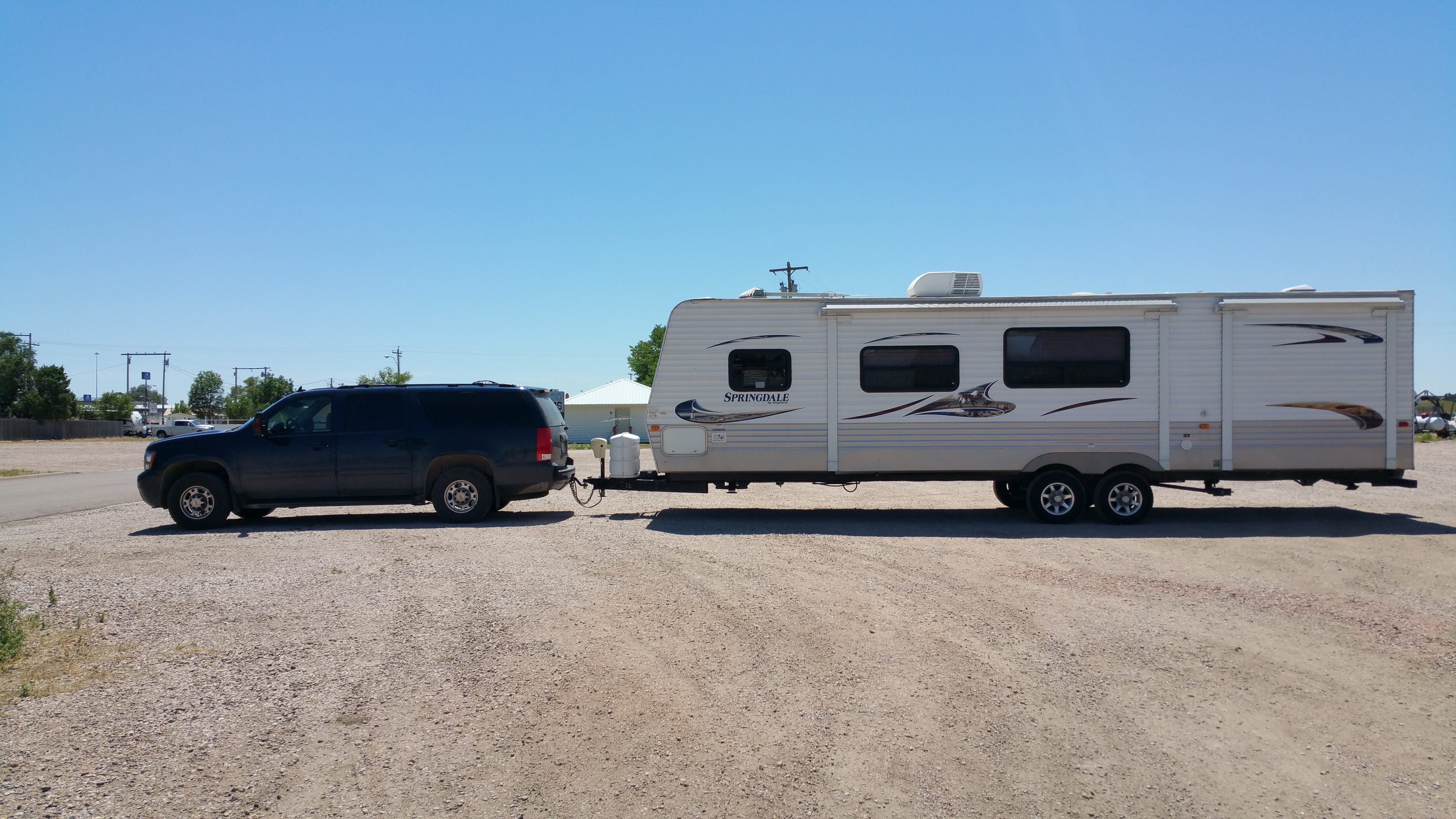
Yukon Denali 6.2 towing Travel Trailer

Disclaimer: Links on this page pointing to Amazon, eBay and other sites may include affiliate code. If you click them and make a purchase, we may earn a small commission.

OP
OP
O

optimusprime

Full Access Member
Joined
Jul 15, 2016
Posts
151
Reaction score
59
So here is what I have for my calculations. Please let me know if this seems right. I haven't made it to a CAT scale yet but this is a starting point for me.

08 Yukon XL Denali
Towing- 7900#/ 7400#GVWR/ 5,984# Curb weight/ Available Payload- 1416# (per yellow sticker)
Payload in vehicle- Me, wife, 3 kids...645#/ Hitch weight ProPride P3...180#
Available Payload...1416 (-) TV Payload...825#= 591# Payload LEFTOVER for TT hitch weight

I added weight to my kiddos because obviously they are going to grow so I allotted extra for them. This includes ZERO extra cargo inside the Yuk or the TT. Obviously the TW is going to increase the more gear I put inside the TT and if we carry anything inside the Yuk, the payload will only decrease. Add to this another kid if we have one and that number continues to diminish. If allowing for up to 10-15% tongue weight, this leaves me with the ability to only haul a roughly 4000#-5910# trailer fully loaded. If I am doing my math correctly, I would be looking for a TT with a dry weight of 2500-4400# that would have to fit up to 6. Basically, it appears I am SOL for towing a TT with my family and my only option is as stated above, the 2500 Burb. Does anyone else agree with this assessment or am I missing something. Again, thank you all for the time you've spent helping me out.

 

97audia4

Full Access Member
Joined
Jun 19, 2018
Posts
208
Reaction score
190
Something I didn't see in this thread is to upgrade to an external transmission cooler if your Yukon doesn't have one. The engine is a workhorse and will handle 4000 RPM all day long but generally when towing the transmission will run at a lower numbered gear which will drive up the transmission temperature, especially on hills. You want to keep the transmission temperature around 200F.

A weight distribution hitch is a must.
40k trucool with factory lines.

Someone also mentioned summer months the coolant temp rises, mine seems to cycle and levels back out at 210 on the cluster after a long hill pull.

IMG_20180928_184940.jpg
 

swathdiver

Full Access Member
Joined
May 18, 2017
Posts
21,296
Reaction score
30,248
Location
Treasure Coast, Florida
08 Yukon XL Denali
Towing- 7900#/ 7400#GVWR/ 5,984# Curb weight/ Available Payload- 1416# (per yellow sticker)
Payload in vehicle- Me, wife, 3 kids...645#/ Hitch weight ProPride P3...180#
Available Payload...1416 (-) TV Payload...825#= 591# Payload LEFTOVER for TT hitch weight

Does anyone else agree with this assessment or am I missing something.

No and yes. You have not considered the mechanical advantage of what a weight distribution hitch does when you tension the bars. You are thinking in terms of using a Weight Carrying Hitch and not a Weight Distribution Hitch.

You should easily be able to handle an all up weight of 6,200 pounds or so, probably more.

Let's say your trailer weighs 6,251 pounds on its two axles and tongue. If you were to simply back up and hitch it up to your truck, your payload would exceed 1,600 pounds and your truck's GVW would be over 7,600 pounds. Following me so far?

Now, put tension on those weight distribution bars. This moves weight off the hitch and rear axle and transfers some to the steer axle of the Denali and to the axles on the trailer. How much I cannot tell but consider this example: If the bars are tensioned to move 8% of the tongue weight off of the hitch/rear axle to the steer axle and 16% to each trailer axle would effectively redistribute 396 pounds off of the back of your truck. Your cargo weight would now be 1,239 pounds and your Denali's GVW would be 7,302 pounds. Does this make sense?


upload_2020-2-4_23-54-33.png


upload_2020-2-4_23-56-3.png
 

intheburbs

Full Access Member
Joined
Aug 10, 2017
Posts
935
Reaction score
1,861
Location
SE MI
My one caveat to James' above post. You can't change the physics of how a trailer behaves. 13% tongue weight offers good stability while not consuming too much payload. If you seriously crank up your weight bars to transfer some of that tongue weight back to the trailer axles, you're making the rig less stable and more prone to sway. The P3 hitch will certainly help.

Bottom line - if it was me, I'd find the trailer I like and take it for a "test tow" to a truck stop with scales. Before I buy. Only way to be sure. I've bought used, so that's never been a problem.

Here's another picture I like to post to make heads explode. And it also illustrates the benefits of a 2500 with that monster rear axle. 8600-lb trailer, 1100-lb tongue weight, and 900-lb family. Look closely at my hitch....

M3b1R3W.jpg


xdyg0Au.jpg


Here's a good video that illustrates...

 
Last edited:

swathdiver

Full Access Member
Joined
May 18, 2017
Posts
21,296
Reaction score
30,248
Location
Treasure Coast, Florida
My one caveat to James' above post. You can't change the physics of how a trailer behaves. 13% tongue weight offers good stability while not consuming too much payload. If you seriously crank up your weight bars to transfer some of that tongue weight back to the trailer axles, you're making the rig less stable and more prone to sway.

Thanks Bill. So even with the bars tensioned, you are saying that you still want to maintain the optimum tongue weight? If so, I'll revise that calculator to reflect such.

One trailer I looked at, the tongue weight was but 510 pounds while another was over 800 pounds even though both trailers weighed about the same. The latter had an up front galley. These were dry weights, before the hitch, batteries and gas bottles were added too.
 
OP
OP
O

optimusprime

Full Access Member
Joined
Jul 15, 2016
Posts
151
Reaction score
59
No and yes. You have not considered the mechanical advantage of what a weight distribution hitch does when you tension the bars. You are thinking in terms of using a Weight Carrying Hitch and not a Weight Distribution Hitch.

You should easily be able to handle an all up weight of 6,200 pounds or so, probably more.

Let's say your trailer weighs 6,251 pounds on its two axles and tongue. If you were to simply back up and hitch it up to your truck, your payload would exceed 1,600 pounds and your truck's GVW would be over 7,600 pounds. Following me so far?

Now, put tension on those weight distribution bars. This moves weight off the hitch and rear axle and transfers some to the steer axle of the Denali and to the axles on the trailer. How much I cannot tell but consider this example: If the bars are tensioned to move 8% of the tongue weight off of the hitch/rear axle to the steer axle and 16% to each trailer axle would effectively redistribute 396 pounds off of the back of your truck. Your cargo weight would now be 1,239 pounds and your Denali's GVW would be 7,302 pounds. Does this make sense?


View attachment 240000

View attachment 240001

Sort of. I’m a little lost regarding some of the numbers. Like the 7302 vehicle weight. Best I could come up with by filling the chart was 7223. But the thought makes sense. But at what point does transferring weight to the other axels become dangerous?


Sent from my iPhone using Tapatalk
 
OP
OP
O

optimusprime

Full Access Member
Joined
Jul 15, 2016
Posts
151
Reaction score
59
My one caveat to James' above post. You can't change the physics of how a trailer behaves. 13% tongue weight offers good stability while not consuming too much payload. If you seriously crank up your weight bars to transfer some of that tongue weight back to the trailer axles, you're making the rig less stable and more prone to sway. The P3 hitch will certainly help.

Bottom line - if it was me, I'd find the trailer I like and take it for a "test tow" to a truck stop with scales. Before I buy. Only way to be sure. I've bought used, so that's never been a problem.

Here's another picture I like to post to make heads explode. And it also illustrates the benefits of a 2500 with that monster rear axle. 8600-lb trailer, 1100-lb tongue weight, and 900-lb family. Look closely at my hitch....

M3b1R3W.jpg


xdyg0Au.jpg


Here's a good video that illustrates...

When it says 60% of the weight on the front of the trailer, are they referring to 60% of the tongue weight staying at the tongue?


Sent from my iPhone using Tapatalk
 

swathdiver

Full Access Member
Joined
May 18, 2017
Posts
21,296
Reaction score
30,248
Location
Treasure Coast, Florida
Look closely at my hitch....

xdyg0Au.jpg

Looks like a Weight Carrying setup, not WDH.

How about this?:

upload_2020-2-5_0-33-44.png


Weight transfer to the axles becomes dangerous when you exceed the capacity of those axles.

The 60/40 rule has to do with weight distribution within the trailer itself. 60% of the weight on the tongue and front axle and 40% of the weight on the rear axle.

upload_2020-2-5_0-37-43.png
upload_2020-2-5_0-37-56.jpeg
upload_2020-2-5_0-38-5.png
 
OP
OP
O

optimusprime

Full Access Member
Joined
Jul 15, 2016
Posts
151
Reaction score
59
Looks like a Weight Carrying setup, not WDH.

How about this?:

View attachment 240002

Weight transfer to the axles becomes dangerous when you exceed the capacity of those axles.

The 60/40 rule has to do with weight distribution within the trailer itself. 60% of the weight on the tongue and front axle and 40% of the weight on the rear axle.

View attachment 240003View attachment 240004View attachment 240005
How do you go about figuring out how much weight is distributed? Is this referring to how much extra you’re putting in?


Sent from my iPhone using Tapatalk
 

swathdiver

Full Access Member
Joined
May 18, 2017
Posts
21,296
Reaction score
30,248
Location
Treasure Coast, Florida
How do you go about figuring out how much weight is distributed? Is this referring to how much extra you’re putting in?


Sent from my iPhone using Tapatalk

Therein lies my problem Andrew. I do not know, just guessing based on research. I do not have a trailer with a WDH so I cannot play with the tension and keep weighing the whole setup at the CAT scales. But if and when I buy one, that's what I'll do. I'm hoping that someone here knows of a correlation between how many links of chain equals such and such to this axle and that axle. Then I could modify the calculator for the benefit of all. It's still a work in progress and demands peer review.
 
OP
OP
O

optimusprime

Full Access Member
Joined
Jul 15, 2016
Posts
151
Reaction score
59
Therein lies my problem Andrew. I do not know, just guessing based on research. I do not have a trailer with a WDH so I cannot play with the tension and keep weighing the whole setup at the CAT scales. But if and when I buy one, that's what I'll do. I'm hoping that someone here knows of a correlation between how many links of chain equals such and such to this axle and that axle. Then I could modify the calculator for the benefit of all. It's still a work in progress and demands peer review.
Thanks for all your help. I’m so new to this whole thing I’m still trying to wrap my head around it. I think part of what confuses me is seeing so many people towing heavy rigs with the same vehicle as me but seeing numbers that don’t seem to make that possible for me. And then add to it trying to figuring out how the weight distribution system works and how that effects the weight of the hitch itself...oh man.


Sent from my iPhone using Tapatalk
 

swathdiver

Full Access Member
Joined
May 18, 2017
Posts
21,296
Reaction score
30,248
Location
Treasure Coast, Florida
Thanks for all your help. I’m so new to this whole thing I’m still trying to wrap my head around it. I think part of what confuses me is seeing so many people towing heavy rigs with the same vehicle as me but seeing numbers that don’t seem to make that possible for me. And then add to it trying to figuring out how the weight distribution system works and how that effects the weight of the hitch itself...oh man.

I think it's safe to say that a great many are way overloaded! The chassis and engine can handle it, the weakest link on trucks with the 5.3s or AWD 6.2s is the carrier in those 8.6 rear axles.

Our vehicles are similar, I was looking for a trailer with a dry weight of well under 5,000 pounds. There's one I really like that has a dry weight of 3,925 pounds with a tongue weight of 580 pounds. There's another (the example in the calculator) that weighs 4,860 pounds but has a tongue weight of just 510 pounds. According to the manufacturer of these two trailers, the heavier one will tow properly with its lighter tongue weight compared with the lighter one with it higher tongue weight. Have a headache? Me too!
 

Derick

Full Access Member
Joined
Aug 13, 2018
Posts
632
Reaction score
696
Location
Indy Suburbs
Thanks for all your help. I’m so new to this whole thing I’m still trying to wrap my head around it. I think part of what confuses me is seeing so many people towing heavy rigs with the same vehicle as me but seeing numbers that don’t seem to make that possible for me. And then add to it trying to figuring out how the weight distribution system works and how that effects the weight of the hitch itself...oh man.


Sent from my iPhone using Tapatalk
Keep in mind a few things......what are the years of what you're looking at vs what they have. Around 2007/2008 they went to the 'ultralight' designs. That will drastically cut the weight. So if you're thinking of a little older 23', you can see another guy towing a newer 30' with no trouble because of the weight difference and construction changes. So, just something to think about. But yea, I kinda made the same assumptions with my toyota sequoia......V8, full size SUV, should tow anything, right? Not so much. It can do it, but it will burn out components that much quicker in the process.
 

intheburbs

Full Access Member
Joined
Aug 10, 2017
Posts
935
Reaction score
1,861
Location
SE MI
Therein lies my problem Andrew. I do not know, just guessing based on research. I do not have a trailer with a WDH so I cannot play with the tension and keep weighing the whole setup at the CAT scales. But if and when I buy one, that's what I'll do. I'm hoping that someone here knows of a correlation between how many links of chain equals such and such to this axle and that axle. Then I could modify the calculator for the benefit of all. It's still a work in progress and demands peer review.

Too many variables. There are weight bars with different ratings, different ways of attaching them, and different hitch interfaces. Best way to do it is to spend a few hours at the CAT scales playing with the different tension/link settings. That's what I did when I first started towing.

But I did notice that whenever I tried to relieve weight off the rear axle, either by cranking up the weight bars or shifting cargo, it did indeed make the trailer more prone to sway. I had the basic friction brake sway control.

This was our first rig. I believe the trailer was 4550 lbs. Half-ton Suburban, and of course the kids were much smaller (and lighter). My twin boys are both 6 feet and 200 lbs now. The lighter trailers are called "half-ton towables."

a0XXg09.jpg
 

swathdiver

Full Access Member
Joined
May 18, 2017
Posts
21,296
Reaction score
30,248
Location
Treasure Coast, Florida
Too many variables. There are weight bars with different ratings, different ways of attaching them, and different hitch interfaces. Best way to do it is to spend a few hours at the CAT scales playing with the different tension/link settings. That's what I did when I first started towing.

Yeah, that's been the dilemma with this. I wanted to produce something that would get us close and knowing that there are different ways of tensioning and shifting loads, left it more manual. But I have to thank you again Bill, for in playing with the calculator for a few hours these past few nights, it seems the weights must come down if one is to maintain the proper percentage of hitch weight and keeping the truck's balance proper and level or near so. The best way to carry more weight is stick everybody and the dog in the trailer and keep the truck light!

While I have you here, what are your thoughts on this? When I was writing this stuff up, I went through every owner's manual and discovered that the WDH rating for 2010-2012 was 1,100 pounds but before and after is 1,000 pounds.

Then for your 2500s, They are all 1,000 pounds WCH and 1,500 pounds WDH except in 2010 the WCH is 1,100 pounds and in 2013 they are the same as the 1500s, 600/1,000.
 

intheburbs

Full Access Member
Joined
Aug 10, 2017
Posts
935
Reaction score
1,861
Location
SE MI
On my '08, the sticker on the receiver says 600/1000. So technically, I'm overloading it with the ~1,120 tongue weight of my trailer. Doubly so because I'm not using WD. So that makes me a bad person.

I think GM has had some issues with the numbers in the owners manuals. I've seen different weight ratings in the manuals of different years of the same platform. My '08 should have the exact same ratings as every other 2500 Suburban from 2007 to 2013. No changes were made during that time, but yet the manuals for the various years have different numbers. I'd be willing to wager that the sticker on the receiver of every 2500 Burb from those years is the same. Hell, most of the suspension bits on my truck go all the way back to 1999. I have torsion bars up front, and leafs in the rear, and no rear sway bar. The production numbers were too low for GM to bother with tweaks in between model years.
 

swathdiver

Full Access Member
Joined
May 18, 2017
Posts
21,296
Reaction score
30,248
Location
Treasure Coast, Florida
On my '08, the sticker on the receiver says 600/1000. So technically, I'm overloading it with the ~1,120 tongue weight of my trailer. Doubly so because I'm not using WD. So that makes me a bad person.

I think GM has had some issues with the numbers in the owners manuals. I've seen different weight ratings in the manuals of different years of the same platform. My '08 should have the exact same ratings as every other 2500 Suburban from 2007 to 2013. No changes were made during that time, but yet the manuals for the various years have different numbers. I'd be willing to wager that the sticker on the receiver of every 2500 Burb from those years is the same. Hell, most of the suspension bits on my truck go all the way back to 1999. I have torsion bars up front, and leafs in the rear, and no rear sway bar. The production numbers were too low for GM to bother with tweaks in between model years.

I think it's a lack of attention to detail since you have the same sticker on the back as I do. Yours should be 1,100/1,500 so you are good. If GM bumped them up for marketing purposes, then the 1500s should be good for 600/1,100.

Like you, I've seen none or read of any changes to the platform during its run.
 

wjburken

Elite Member
Supporting Member
Joined
Dec 26, 2017
Posts
10,313
Reaction score
29,536
Location
Eastern Iowa
I think it's a lack of attention to detail since you have the same sticker on the back as I do. Yours should be 1,100/1,500 so you are good. If GM bumped them up for marketing purposes, then the 1500s should be good for 600/1,100.

Like you, I've seen none or read of any changes to the platform during its run.
I rented a 2WD 2019 Tahoe this week for work (VIN - 1GNSCBKC2KR331221) and this is what is on the receiver. Didn’t think to grab photo of door sticker.
6D2F06C2-5AB5-4358-BDC0-4860C315DEA7.jpeg
 

Forum statistics

Threads
137,745
Posts
1,991,106
Members
102,735
Latest member
Jumpshot12
Back
Top