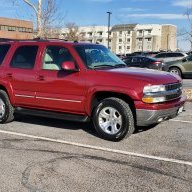
2001 Tahoe
5.3L V-8
202,000 miles
I have been battling misfire issues for the over a month now. I first changed plugs and wires (routine maintenance) about 2-3 months ago. When I did that I noticed a slight misfire and trouble shot it down to 2 bad coils. I replaced all 8 to be safe and everything was fine and the check engine light came on. I diagnosed it and replaced B1S1 upstream O2 sensor.
The truck drove fine for a little while then after for about 1.5 months when my vehicle started misfiring and the check engine light flashing. I got it to the shop the next morning.
Since then and 6 or seven trips to the shop. Typically about 50-60 miles after the previous trip.
During those visits they replaced intake manifold gaskets, cleaned fuel rails/injectors, replaced 2 injectors, replaced B1S1 O2 sensor 2-3 times, catalytic converter twice, 2 additional spark plugs and coils at cylinders #1 and #3.
Below are the comments from the Corporate Technician following pretty much all the maintenance mentioned above and still having the same issues:
“Customer request vehicle intermittently misfires and illuminates the check engine light. Customer advised the vehicle had been parked for approximately one year and, after returning it to service, developed an intermittent misfire concern. Customer previously replaced spark plugs, ignition wires, and ignition coils with aftermarket components in an attempt to correct the concern. We inspected the vehicle and verified stored DTC P0300 (Random/Multiple Cylinder Misfire Detected) and P1133 (HO2S Insufficient Switching Bank 1 Sensor 1). Freeze frame data associated with the fault indicated the event occurred with the engine fully warmed, operating in closed loop during light cruise conditions at approximately 49-50 MPH. Road testing was performed under the same operating conditions present in the freeze frame data. During testing, we were able to successfully duplicate the customer’s concern. The vehicle developed a noticeable intermittent misfire condition and misfire counters began accumulating. Live data monitoring revealed the majority of misfire activity was concentrated on Cylinder #3, with additional misfire activity observed on Cylinder #1. Remaining cylinders showed little to no significant misfire accumulation. Relative compression testing was performed and all cylinders displayed even cranking contribution, with no indication of a mechanical engine condition sufficient to cause the observed misfire. Inspection of the aftermarket ignition components revealed concerns with the spark plugs installed by the customer. Spark plugs removed from Cylinders #1 and #3 exhibited abnormal appearance and questionable condition. Plug gap was verified at approximately .060”. Due to the concentration of misfire activity on these cylinders and the condition of the installed plugs, Cylinders #1 and #3 spark plugs were replaced with new components. Ignition wires were then cross-swapped between Cylinders #1 and #2 and between Cylinders #3 and #4 to assist in identifying any wire-related fault should the concern return. Additional inspection identified a broken exhaust manifold bolt at the front of the exhaust manifold. A brief exhaust leak was noted during cold start operation. However, freeze frame data associated with the stored oxygen sensor code occurred during fully warmed cruise conditions rather than during cold start operation. Following spark plug replacement, the vehicle was road tested extensively under the same operating conditions that originally duplicated the concern. Vehicle was driven approximately 40 miles in city driving as well as extended highway operation. Throughout the verification drive, current and history misfire counters remained at or near zero on all cylinders, engine operation remained smooth, and the previously duplicated misfire concern could not be reproduced. Fuel trim values remained within normal operating range and oxygen sensor activity appeared normal during closed-loop operation. Based on diagnostic findings, the primary concern appears related to an ignition misfire condition affecting Bank 1 cylinders, particularly Cylinders #1 and #3. The previously stored P1133 oxygen sensor switching code is believed to be secondary to the misfire condition, as repeated combustion misfires can introduce excess oxygen into the exhaust stream and adversely affect oxygen sensor switching calculations. At this time, vehicle operation has significantly improved following replacement of the affected spark plugs and extended verification testing. Recommendation: Continue monitoring vehicle operation. If concern returns, further diagnosis should focus on aftermarket ignition component integrity, exhaust manifold leakage due to the broken manifold bolt, ignition wire fault isolation, and Bank 1 oxygen sensor performance verification under fault conditions.“
5.3L V-8
202,000 miles
I have been battling misfire issues for the over a month now. I first changed plugs and wires (routine maintenance) about 2-3 months ago. When I did that I noticed a slight misfire and trouble shot it down to 2 bad coils. I replaced all 8 to be safe and everything was fine and the check engine light came on. I diagnosed it and replaced B1S1 upstream O2 sensor.
The truck drove fine for a little while then after for about 1.5 months when my vehicle started misfiring and the check engine light flashing. I got it to the shop the next morning.
Since then and 6 or seven trips to the shop. Typically about 50-60 miles after the previous trip.
During those visits they replaced intake manifold gaskets, cleaned fuel rails/injectors, replaced 2 injectors, replaced B1S1 O2 sensor 2-3 times, catalytic converter twice, 2 additional spark plugs and coils at cylinders #1 and #3.
Below are the comments from the Corporate Technician following pretty much all the maintenance mentioned above and still having the same issues:
“Customer request vehicle intermittently misfires and illuminates the check engine light. Customer advised the vehicle had been parked for approximately one year and, after returning it to service, developed an intermittent misfire concern. Customer previously replaced spark plugs, ignition wires, and ignition coils with aftermarket components in an attempt to correct the concern. We inspected the vehicle and verified stored DTC P0300 (Random/Multiple Cylinder Misfire Detected) and P1133 (HO2S Insufficient Switching Bank 1 Sensor 1). Freeze frame data associated with the fault indicated the event occurred with the engine fully warmed, operating in closed loop during light cruise conditions at approximately 49-50 MPH. Road testing was performed under the same operating conditions present in the freeze frame data. During testing, we were able to successfully duplicate the customer’s concern. The vehicle developed a noticeable intermittent misfire condition and misfire counters began accumulating. Live data monitoring revealed the majority of misfire activity was concentrated on Cylinder #3, with additional misfire activity observed on Cylinder #1. Remaining cylinders showed little to no significant misfire accumulation. Relative compression testing was performed and all cylinders displayed even cranking contribution, with no indication of a mechanical engine condition sufficient to cause the observed misfire. Inspection of the aftermarket ignition components revealed concerns with the spark plugs installed by the customer. Spark plugs removed from Cylinders #1 and #3 exhibited abnormal appearance and questionable condition. Plug gap was verified at approximately .060”. Due to the concentration of misfire activity on these cylinders and the condition of the installed plugs, Cylinders #1 and #3 spark plugs were replaced with new components. Ignition wires were then cross-swapped between Cylinders #1 and #2 and between Cylinders #3 and #4 to assist in identifying any wire-related fault should the concern return. Additional inspection identified a broken exhaust manifold bolt at the front of the exhaust manifold. A brief exhaust leak was noted during cold start operation. However, freeze frame data associated with the stored oxygen sensor code occurred during fully warmed cruise conditions rather than during cold start operation. Following spark plug replacement, the vehicle was road tested extensively under the same operating conditions that originally duplicated the concern. Vehicle was driven approximately 40 miles in city driving as well as extended highway operation. Throughout the verification drive, current and history misfire counters remained at or near zero on all cylinders, engine operation remained smooth, and the previously duplicated misfire concern could not be reproduced. Fuel trim values remained within normal operating range and oxygen sensor activity appeared normal during closed-loop operation. Based on diagnostic findings, the primary concern appears related to an ignition misfire condition affecting Bank 1 cylinders, particularly Cylinders #1 and #3. The previously stored P1133 oxygen sensor switching code is believed to be secondary to the misfire condition, as repeated combustion misfires can introduce excess oxygen into the exhaust stream and adversely affect oxygen sensor switching calculations. At this time, vehicle operation has significantly improved following replacement of the affected spark plugs and extended verification testing. Recommendation: Continue monitoring vehicle operation. If concern returns, further diagnosis should focus on aftermarket ignition component integrity, exhaust manifold leakage due to the broken manifold bolt, ignition wire fault isolation, and Bank 1 oxygen sensor performance verification under fault conditions.“