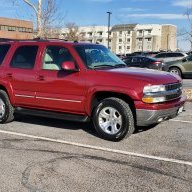

Don't worry, I have new shocks on deck for when I drop it. Also working on a possible repurposing of the Auto-Level system.
A classic tease....

Disclaimer: Links on this page pointing to Amazon, eBay and other sites may include affiliate code. If you click them and make a purchase, we may earn a small commission.
Don't worry, I have new shocks on deck for when I drop it. Also working on a possible repurposing of the Auto-Level system.

Do tell...
Nice!
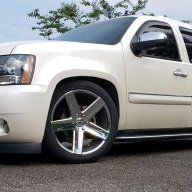
Nothing extraordinary. Just getting a new compressor assembly and connecting it to Airlift bags instead of the air shocks. I have the short (Nissan Pathfinder?) Airlift bags to fit lowering coils. I'll have to play with the ride height sensor links to fine-tune the balance of lift at start-up with increased spring rate.
Rear bump stops as in free travel mod?Thank ya! It's SOMETHING, right?!
You know how it goes, though. Now I'm plotting on installing those Belltech alignment cams- just doing the little not-so-fun things so I can focus on the big stuff and have it all completed sooner. I'm glad I've already knocked out the bump stop removal!
Oh boy here we go....I am curious how this will work out... I have considered it before myself but was afraid I would blow the bags because they aren't rated beyond 35-50 psi.
The factory auto leveling compressor is capable of up to 150 psi according to the techs I talked to at Arnott.
I have been thinking about adding a second set of shocks to the rear end of the Burb.
The reason being is I don't want to lose the auto leveling feature for the times when I hook up to a trailer or load the truck up with luggage and kids for family vacations...
BUT...
I really want to add the Rancho 9 way adjustable shocks to the rear to take the bucking bronco effect when I go over repetitive bumps like on certain bridges.
I hate how the rear end bounces like an old hoopty with worn out shocks.
Ideally I would like to buy the Rancho shocks with the air bladders already on them like the Arnotts and factory shocks... but that is not an option so my second thought was to just add the Ranchos and keep the air shocks I currently have.
I have already found a set of Ranchos that will fit the rear for my lowered application. They are actually for the front end of an older Suburban so the dampening should be good for a heavy truck but they are essentially the same length as the Belltech drop shocks for the rear of my truck with the 6" drop.
I have also considered removing the rear springs altogether and installing the Trailblazer SS air bags and hooking them to the auto leveling compressor to keep the adjustability and then running the Rancho 9 way adjustable shocks to keep the bouncing to a minimum... so many choices... lol

Oh boy here we go....
Rear bump stops as in free travel mod?
I am curious how this will work out... I have considered it before myself but was afraid I would blow the bags because they aren't rated beyond 35-50 psi.
The factory auto leveling compressor is capable of up to 150 psi according to the techs I talked to at Arnott.
I have been thinking about adding a second set of shocks to the rear end of the Burb.
The reason being is I don't want to lose the auto leveling feature for the times when I hook up to a trailer or load the truck up with luggage and kids for family vacations...
BUT...
I really want to add the Rancho 9 way adjustable shocks to the rear to take the bucking bronco effect when I go over repetitive bumps like on certain bridges.
I hate how the rear end bounces like an old hoopty with worn out shocks.
Ideally I would like to buy the Rancho shocks with the air bladders already on them like the Arnotts and factory shocks... but that is not an option so my second thought was to just add the Ranchos and keep the air shocks I currently have.
I have already found a set of Ranchos that will fit the rear for my lowered application. They are actually for the front end of an older Suburban so the dampening should be good for a heavy truck but they are essentially the same length as the Belltech drop shocks for the rear of my truck with the 6" drop.
I have also considered removing the rear springs altogether and installing the Trailblazer SS air bags and hooking them to the auto leveling compressor to keep the adjustability and then running the Rancho 9 way adjustable shocks to keep the bouncing to a minimum... so many choices... lol
I don't see air bags helping much with your issue of oscillation. They're springs, just like coils, so they can squish and unsquish just the same. You need damping, so shock absorption should be your focus.
I've been pondering the PSI thing lately. The way I'm currently thinking, Airlift makes a bag that is inflated to lift and level a loaded vehicle, and does so with a max of 35PSI. I don't know what PSI the factory air sleeves get to lift the Tahoe. I've read that the compressor is capable of 135+PSI, but that doesn't necessarily mean that it's gonna push that amount of pressure into the air sleeves. The system is triggered by position sensors and not PSI, so that's the savior here. I think it's simply that the Airlift bags are multiple times bigger than the air sleeves, so they can lift with a lower pressure, but just require more volume.
So, the compressor may actually work about the same or less amount. It'll run a little longer trying to fill a larger volume, but it's only gonna need to pump them up to ~35PSI (probably as a near-max, too) to get the same amount of lift that the smaller sleeve bags do but at a much higher PSI.
Unless I hear something that stops me in my tracks, I'm just gonna go for it and see what happens. I'm currently shopping replacement compressors and hope to have one ordered for this weekend.
I don't see air bags helping much with your issue of oscillation. They're springs, just like coils, so they can squish and unsquish just the same. You need damping, so shock absorption should be your focus.
I've been pondering the PSI thing lately. The way I'm currently thinking, Airlift makes a bag that is inflated to lift and level a loaded vehicle, and does so with a max of 35PSI. I don't know what PSI the factory air sleeves get to lift the Tahoe. I've read that the compressor is capable of 135+PSI, but that doesn't necessarily mean that it's gonna push that amount of pressure into the air sleeves. The system is triggered by position sensors and not PSI, so that's the savior here. I think it's simply that the Airlift bags are multiple times bigger than the air sleeves, so they can lift with a lower pressure, but just require more volume.
So, the compressor may actually work about the same or less amount. It'll run a little longer trying to fill a larger volume, but it's only gonna need to pump them up to ~35PSI (probably as a near-max, too) to get the same amount of lift that the smaller sleeve bags do but at a much higher PSI.
Unless I hear something that stops me in my tracks, I'm just gonna go for it and see what happens. I'm currently shopping replacement compressors and hope to have one ordered for this weekend.
The air bags wouldn't help with the oscillating BUT they would allow me to keep the auto leveling feature while running the Rancho 9 way adjustable shocks, in place of the current air shocks, to control the oscillating. The setup described would keep me from trying to figure out how to run a dual shock setup on each side.
The compressor is built for low volume, high pressure. Notice the ID of the air lines- tiny tiny. It runs 1/8” lines which won’t inflate something as big as airlift bags unless it runs forever. I’m not sure what CFM the compressor is capable of but I’m pretty sure you’re going to be frustrated waiting for the bags to fill.
The OEM only runs a few seconds at start up but that’s just to top off the airbags in the shocks which are tiny in comparison to the airlift bags. They’re completely different animals. Airlift hold way more air and operate at low pressure. You would be better off wiring the Viair into the place of the stock compressor but I’m not sure how that would work. You need more volume somehow. If you use the stock compressor to fill the airlift bags I would expect 15 -20 minutes or maybe more of run time if the comp doesn’t burn up first.I definitely noticed cuz I was planning on gluing the factory air line inside the Air Lift air line! lol
Any idea on how long, on average, the OEM setup runs at start-up? I'd like to say that I can be patient since I rarely drive it and I always let it idle for a few minutes before I take off. I also rarely ever tow. My main point for keeping the system is that I'm planning on the drop springs to be much softer than the stock ones as well as yield a little more drop than I'm wanting. I want to use the air to both pick it up to the height I want and put the spring rate where I want it. Sitting level when parked/"aired out" and slightly raked when driving would be ideal for me. Having it automatically lift when loaded and/or towing is a cool side benefit, although one that will rarely ever be utilized.
I have an old Viair 380c and 3 gallon aluminum tank that I'd love to tuck in the factory compressor's place. Incorporating the dryer, exhaust valve and other electronic controls would be the hurdle. But I can look at my roached original one to see if I can come up with anything.
The OEM only runs a few seconds at start up but that’s just to top off the airbags in the shocks which are tiny in comparison to the airlift bags. They’re completely different animals. Airlift hold way more air and operate at low pressure. You would be better off wiring the Viair into the place of the stock compressor but I’m not sure how that would work. You need more volume somehow. If you use the stock compressor to fill the airlift bags I would expect 15 -20 minutes or maybe more of run time if the comp doesn’t burn up first.
The stock shocks have a tiny bag that surrounds the shock itself, you have to keep in mind that inside those stock bags are a complete shock assembly that takes up most of that room. They’re not “real” air bags like on a bagged vehicle. That’s why you can still drive on them after the bag blows. They just don’t adjust up and down anymore but the shocks are still there.Geeeeez. I was thinking it ran for 20-30 seconds to top off the stock bags and was guessing the Air Lifts to be about 5 times the size, leading to 2.5 minutes run time at most.
I'm gonna need a functioning compressor, dryer, exhaust valve, etc. regardless of what I do so I guess I should bite the bullet and order one. It can hang out with the fuse pulled for all I care while I cannibalize my original one. Connecting the factory stuff may not be so bad. It'd probably be more a matter of adapting the Viar and tank's output size to the factory compressor lead hose and exhaust port sizes.
The stock shocks have a tiny bag that surrounds the shock itself, you have to keep in mind that inside those stock bags are a complete shock assembly that takes up most of that room. They’re not “real” air bags like on a bagged vehicle. That’s why you can still drive on them after the bag blows. They just don’t adjust up and down anymore but the shocks are still there.
 ) and there's maybe 1/4" air space between the inside and outside walls. There's obviously very little cylindrical volume on top as well. Now that I've put eyes on it better, I'd say the comparison, using fluid volume, is more like 1 cup in the OEM sleeves and 2 quarts in the Air Lift bags, which is 8 times the volume. Again, these are very rough figures, but probably conservative so the difference is probably larger.
I’m interested to see what that comp will do with the airlift bags.Right, it's a rollover sleeve. I was just looking at mine (since I have an inside view due to the complete separation
I couldn't decide if the Cardone was any different than the Dorman, so I aimed for the middle and the most popular with 600+ 5-star reviews and ordered the Dorman. I also ordered a new air line kit for the Air Lift bags so at least I'll be able to use them manually. Maybe I should order a bicycle pump to keep in the factory jack compartment in case I'm away from home and need to pump up.


