

Catch can flow discussion

Disclaimer: Links on this page pointing to Amazon, eBay and other sites may include affiliate code. If you click them and make a purchase, we may earn a small commission.

iamdub

Full Access Member
Joined
Apr 23, 2016
Posts
20,821
Reaction score
45,011
Location
Li'l Weezyana
First off, this is more of a universal discussion and not exclusive to the '07-'14. I couldn't decide where else would be appropriate so I just picked the GMT900 forum. Mods, feel free to move it if there's a better place for it.


I have an average Amazon catch can slated for installation on a friend's Tahoe. I'll be modding it, making a mounting bracket and getting the hoses made up so it'll be a quick install on his. I'll use my '08 as a template since his Tahoe is an '09. In the process, I'll take pics to use in a how-to for these these- mounting, connecting, modding, etc.


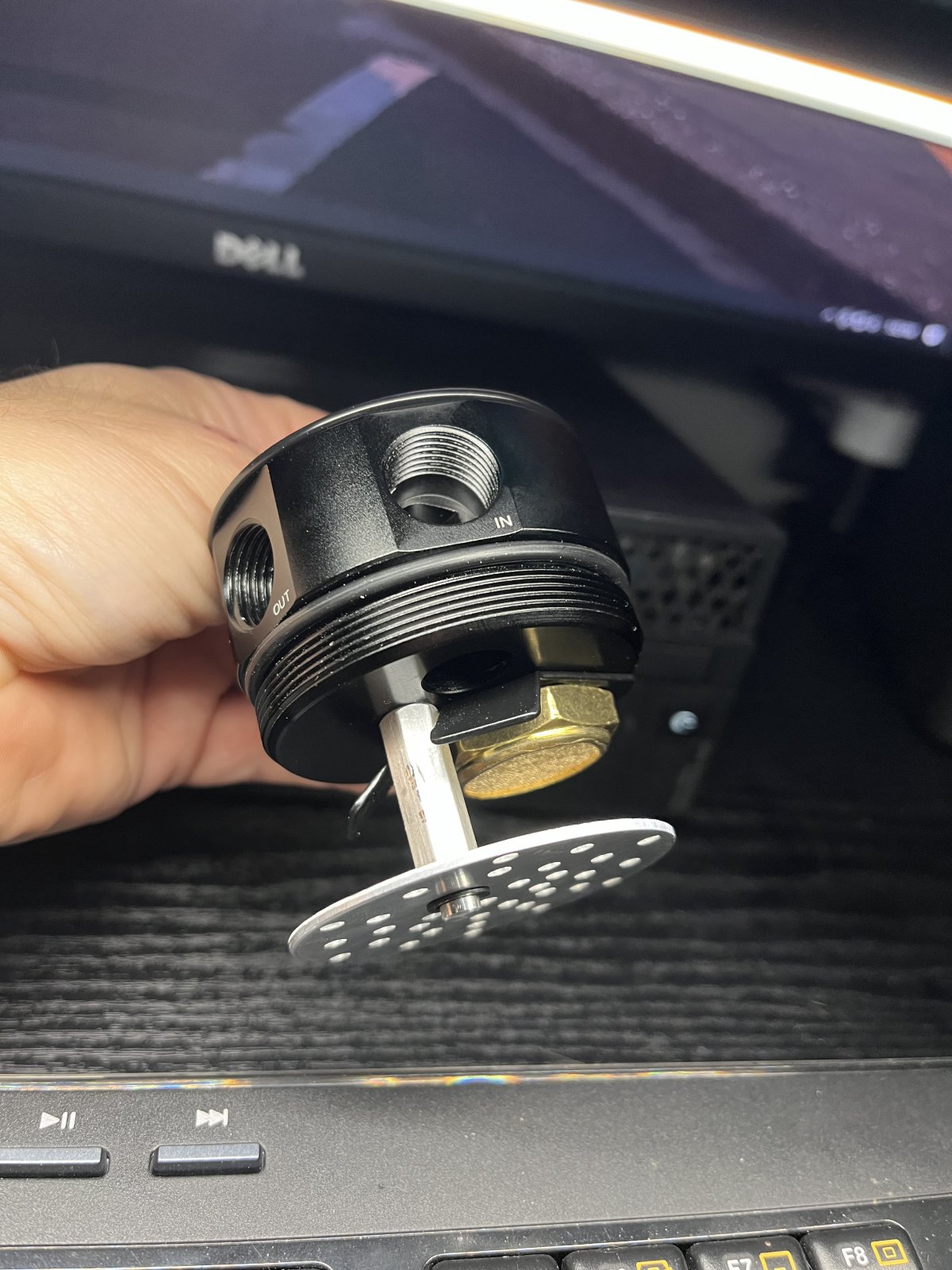
In checking over this catch can, I noticed the "IN" and "OUT" ports seem to be opposite of the way my $100 catchcans.com can is oriented. With that one, the dirty air comes in and goes straight into the filters, baffles, etc. The filters drip the oil into the can's reservoir and the scrubbed air then exits the can through an unrestricted port. In the Amazon one, the inlet is the unrestricted port that feeds the reservoir then the air travels through the baffle, filtration media, etc. before exiting.

This is the can off Amazon, representative of most any other one:
IMG_8412.JPG


If connected per the labels, the oily air comes in through that port with the small metal flap and fills the reservoir. The flow continues up through the baffle then the bronze filter then out of the can and on towards the intake manifold. Picturing the direction of air flow, the oil droplets collecting on the filter would have to drip against the direction of flow.

Referencing the catch can in my sig pic, from catchcans.com, the dirty air from the valve cover enters into the top center where it immediately hits one of a few stages of filtration then continues into the reservoir then up through the port in the side to go to the intake manifold.

Really, it seems they'd work fine either way. But one of the two ways has to be better than the other for some reason. This is what I wanna discuss. I'll be adding a stainless steel scouring pad to it for extra filtration media. But that's irrelevant in this convo.


My thoughts: These things work by coalescing. Hitting the filter first to stall the air so the oil droplets can collide and coalesce makes sense to me. The engine's suction will pull the oil through the filter. The oil slowly making its way through will (eventually) drip down into the reservoir as the air that gets through the filtration media more easily continues on through the unrestricted port. I read where some people said that this would keep the oil in hose coming from the engine. My response to that is "And?" The oil was in the engine in the first place, why wouldn't you want it to stay? It's not gonna fill the hose and plug off the flow of PCV. If it went into the can then was filtered on the way out, I guess the filtering effectiveness would be about the same. But, the reservoir might get more oil in it, which is that much more oil removed from the engine rather than remaining in it, under the valve cover where it can drain back into the crankcase.

After spelling out my thoughts here, I'm now thinking that either way would be fine for scrubbing the air. But if you need to actually remove stuff, like moisture, you'd hook it up as the ports are labeled. If you just wanna scrub the air to get the oil out of it, you'd hook it up in reverse. I've never drained anything but a few ounces of oil from mine. No milkshake (no moisture). So, I'd wanna keep as much inside the engine as possible. If my thoughts are correct, then I can leave mine hooked up as it is and I'll set up my friend's can in the same "backwards" direction of flow.


Your turn.

 
Joined
Apr 11, 2018
Posts
7,124
Reaction score
14,375
Location
St. Louis
My thoughts is that gravity helps the oil drop out of suspension once the air has entered a larger space and changes direction. Baffles help by making the air change direction, like in a muffler, and causing the oil to stick to the baffle. Also in the same line of thinking with gas lines in your home and how they have a down leg on verticle runs for any debris that may get into the line to drop out.

I always thought our Catchcans.com one should have the input on the side port and exit through the top port. One of the reasons is that if oil in the can gets full enough up close to that side port that is sucking to the intake, any bumps or jostle of the can could easily let oil splash up to that port and suck oil in. Also, usually the suction port on any of these cans I've looked at are usually at the top and/or have a filter or screen before it. Thinking to keep oil from getting to it and sucked into the intake.

The cheap ebay can I had on previously for 4 years had both ports on the side, one about an inch below the other. The bottom port was the in and top port was out.

I have a breather type can on the blown mustang, but also run a mechanical vacuum pump. The discharge from the pump goes into the side of the can. Inside the can between the side port and the top opening are 2 or 3 staggered metal tabs that are the baffles and a small air filter is at the top. It does not return to the intake. The air hits a baffle plate and turns 90* to get around it. Oil catches on the plate and drops down into the can.

When I first installed the catchcans.com one like yours last year I hooked it up with side port in/top port out. Worked fine. After talking to you and also sending an email to catchcans.com asking correct orientation, both telling me top in, side out, I switched it. Works fine also, lol.
 

donjetman

Full Access Member
Joined
Oct 22, 2018
Posts
1,976
Reaction score
3,618
I have a $130 Mike Norris Motorsports catch can on my C5 Corvette. Inlet on top, outlet on side. It doesn't catch liquid any better than the $30 side inlet and outlet chicom cc that's been on the Yukon for 5 yrs.
DSCN7855.JPG
 
Last edited:

George B

¯\_(ツ)_/¯
Joined
Feb 5, 2020
Posts
7,880
Reaction score
18,983
Location
Oconomowoc, Wisconsin 53066
Some old reading from a while ago.


Mounted the catch can today but need some 90° or 45° Hose fittings. I also need someone to confirm my thinking on the flow. The catch can has a port that goes straight into the body of the can and one with a filter on it. I assume the filtered port should be out to the manifold and the unfiltered one is in from the valve cover.

As required. :deal:

View attachment 275297

The inlet is the filtered side. Unless they flipped the design, the inlet should be the port on the left, if facing the top with both ports aimed away from you.

So out the valve cover and into the catch can port with the filter. Then out the port without the filter to the intake. If so mine is opposite the orientation you described.

Installed. I hope the flow is right. It comes out of the valve cover and into the port with the brass filter. Then out the unfiltered port and into the intake. I have some 45° elbows on the way because I don’t like the way the hoses come up to the can.

View attachment 275995 View attachment 275996

They must've flipped the inlet and outlets. I remember it being the other way around because it makes the hoses cross as they're routed from the cover and to the intake manifold. I considered getting the 3-port (dual inlet) version and plugging the other side just so the hoses didn't cross and looked neater. But, it's my bro's truck and he couldn't care less. All resolved with a simple hood slam.
 
Joined
Apr 11, 2018
Posts
7,124
Reaction score
14,375
Location
St. Louis
Some old reading from a while ago.
My thinking on those models with the round brass filter covering the port, that port should be the exit back to the intake. If it was the input from the valve cover the oil will catch on that brass filter on the input side of it. Will it get sucked/seep through to the can side of the filter, yes eventually but may cause a restriction to the air going into the can
 

Joseph Garcia

Elite Member
Supporting Member
Joined
Aug 2, 2018
Posts
10,284
Reaction score
14,888
I have the JLT 3.0 oil catch can installed on my 07 Yukon XL Denali, and here is an excerpt from their web site:

"A filter on the inlet side of the oil catch can traps fine oil vapors and releases them once heavy enough to fall. By the time the oil gets through the filter it's too heavy to be passed on into the intake.

The tank holds 3 oz of fluid, while that may not sound like a lot, you shouldn’t see that much oil in your PCV system. Drain it every 2000-2500 miles on most applications and you will never come close to filling it. Average collection for most applications is roughly an ounce every 1000 miles."

You can see the inside of this catch can with an explanation of its function in the following YouTube video as the 2:45 minute mark:


Oil Catch Can Installed2.jpg
 

George B

¯\_(ツ)_/¯
Joined
Feb 5, 2020
Posts
7,880
Reaction score
18,983
Location
Oconomowoc, Wisconsin 53066
I have the JLT 3.0 oil catch can installed on my 07 Yukon XL Denali, and here is an excerpt from their web site:

"A filter on the inlet side of the oil catch can traps fine oil vapors and releases them once heavy enough to fall. By the time the oil gets through the filter it's too heavy to be passed on into the intake.

The tank holds 3 oz of fluid, while that may not sound like a lot, you shouldn’t see that much oil in your PCV system. Drain it every 2000-2500 miles on most applications and you will never come close to filling it. Average collection for most applications is roughly an ounce every 1000 miles."

You can see the inside of this catch can with an explanation of its function in the following YouTube video as the 2:45 minute mark:


View attachment 412545
I swear the video says opposite what the text you quoted says. I think they mean the inlet port of the can not the intake of the engine. According to this the guy in the vid has it backwards.
 

Charlie207

Full Access Member
Joined
Apr 13, 2021
Posts
3,009
Reaction score
5,903
Location
LFOD, New Hampshire
I installed this cheap amazon chicom catch can 5 yrs ago. I added pot scrubber matl and drain valve. Its still working good today.
View attachment 412499
View attachment 412500

I have the same one as you, and I haven't had any oil/water collected in the last 2 oil changes I've done. I pulled it apart, and it wasn't the ball-valve seized. It was just empty.

When I first installed it, I'd get water/sludge in there. I wonder if it's something that's a non-issue in the warm months, but will return during the cold winter weather.

Edit: the bracket is straight garbage, but I've been too lazy to improve it.
 
Joined
Apr 11, 2018
Posts
7,124
Reaction score
14,375
Location
St. Louis
I swear the video says opposite what the text you quoted says. I think they mean the inlet port of the can not the intake of the engine. According to this the guy in the vid has it backwards.
And that silver mesh filter that is in that can looks exactly like the mesh filters that would go under the PCV valve on the lower intake on a Ford 302 engine and would help keep oil from getting sucked up through the PCV valve/hose


The Mustang PCV (positive crankcase ventilation) Filter Screen is a metal casing that is stuffed with a steel mesh type material. Its job is to trap oil vapor while the engine is running and keep it from collecting on the PCV valve or intake manifold. Once the Engine is shut off and cool again. The Vapor turns back into a liquid state and drains back into the lifter valley. Over time, however, these filters get clogged up and no longer allow proper ventilation. These are normally replaced when replacing the Pressure Control Valve (PCV).
 
OP
OP
iamdub

iamdub

Full Access Member
Joined
Apr 23, 2016
Posts
20,821
Reaction score
45,011
Location
Li'l Weezyana
I installed this cheap amazon chicom catch can 5 yrs ago. I added pot scrubber matl and drain valve. Its still working good today.
View attachment 412499
View attachment 412500


That's the one I installed on my brother's truck and two or three others. It's basically the same as what I just bought for my friend's Tahoe, the difference being this one has a 750ml reservoir. I've added the stainless scouring pad to mine and all of 'em I've installed.
 
OP
OP
iamdub

iamdub

Full Access Member
Joined
Apr 23, 2016
Posts
20,821
Reaction score
45,011
Location
Li'l Weezyana
My thoughts is that gravity helps the oil drop out of suspension once the air has entered a larger space and changes direction. Baffles help by making the air change direction, like in a muffler, and causing the oil to stick to the baffle. Also in the same line of thinking with gas lines in your home and how they have a down leg on verticle runs for any debris that may get into the line to drop out.

Gravity might play a small role in it. But, it's atomized oil droplets riding an air current. They ride it out of the crank case, through the valve cover (as well as additional droplets from there), through a hose, etc. What's to stop them from riding that air current straight from the port dumping into the reservoir across to the outlet port? So, the coalescing media is required. I think if the air hits it first, the droplets collect and are then too heavy to make it from where the port dumps into the reservoir, across and out. If it goes through the void of the reservoir then hits the media, yes, it's stalled and the droplets will eventually be too large for the air currents (vacuum, actually) to hold them to/in the media and then gravity is able to overcome so the now larger drops fall. But, there's still a suction on the filter media and surely some oil is bound to be pulled through and up the hose leading into the intake manifold.


I always thought our Catchcans.com one should have the input on the side port and exit through the top port. One of the reasons is that if oil in the can gets full enough up close to that side port that is sucking to the intake, any bumps or jostle of the can could easily let oil splash up to that port and suck oil in. Also, usually the suction port on any of these cans I've looked at are usually at the top and/or have a filter or screen before it. Thinking to keep oil from getting to it and sucked into the intake.

Valid. But, this is why you get a large reservoir if your engine passes that much oil or check/drain your can more often. But, hey, if it's catching that much oil, then it's gotta be working that good, right? Or your engine has problems. lol


The cheap ebay can I had on previously for 4 years had both ports on the side, one about an inch below the other. The bottom port was the in and top port was out.

The arrangement makes sense. But I'm a firm believer in scrubbing media.


I have a breather type can on the blown mustang, but also run a mechanical vacuum pump. The discharge from the pump goes into the side of the can. Inside the can between the side port and the top opening are 2 or 3 staggered metal tabs that are the baffles and a small air filter is at the top. It does not return to the intake. The air hits a baffle plate and turns 90* to get around it. Oil catches on the plate and drops down into the can.

A breather filter sure would make things easy, but also smelly.


When I first installed the catchcans.com one like yours last year I hooked it up with side port in/top port out. Worked fine. After talking to you and also sending an email to catchcans.com asking correct orientation, both telling me top in, side out, I switched it. Works fine also, lol.

This is my conundrum! I see how it'd work fine with the flow in either direction. I just think it's optimal going the way they suggest. The confusion was when I noticed the Amazon/ebay cans all have theirs reversed. I've never paid attention to it until now. Clearly, they work fine like this. I change the oil on my brother's truck and, after 4+ years, his intake manifold is dry. It's a healthy Gen3, so it moves very little oil to begin with. The expensive can companies don't advertise such details that I could find.
 
OP
OP
iamdub

iamdub

Full Access Member
Joined
Apr 23, 2016
Posts
20,821
Reaction score
45,011
Location
Li'l Weezyana
I have a $130 Mike Norris Motorsports catch can on my C5 Corvette. Inlet on top, outlet on side. It doesn't catch liquid any better than the $30 side inlet and outlet chicom cc that's been on the Yukon for 5 yrs.
View attachment 412525


That's a catchcans.com one. They're one of the pioneers for these things. I bought mine in a group purchase (on ls1tech, I think) back in 2011ish- back when there weren't many companies offering them and especially no dirt cheap ones on ebay or Amazon. Years later, I exclusively buy the Amazon ones since, just as you said- they function just the same but at a fraction of the price. What you're paying for with the expensive ones is appearance and usually vehicle-specific bracketry and hoses. I have tools and metal stock to make my own brackets and regular hose clamps (spring, worm, EFI, etc.) suit me just fine.
 
OP
OP
iamdub

iamdub

Full Access Member
Joined
Apr 23, 2016
Posts
20,821
Reaction score
45,011
Location
Li'l Weezyana
My thinking on those models with the round brass filter covering the port, that port should be the exit back to the intake. If it was the input from the valve cover the oil will catch on that brass filter on the input side of it. Will it get sucked/seep through to the can side of the filter, yes eventually but may cause a restriction to the air going into the can

Wouldn't it work better then? If the oil has been stalled and scrubbed from the air, and has coalesced on/in the filter media (the bronze plus the added scouring pad), the droplets would already be too big to remain "in flight" to get to the "unprotected" outlet port. Going the other way, the oil is already stuck to the filter media and is being pulled through via engine vacuum at all times. Eventually, it'll get through and make its way up the hose to the intake manifold.

The oil would have to pretty much be solidified in the hose to be a restriction. Obviously, it's very far from being a solid. Also, a restriction stalls air flow and this weakens the vacuum on a fluid substance. If there's enough oil going through the PCV system (through that tiny hole in the PCV "valve", for one), to fill the 5/16" hose, then your engine was already moving that much oil and it needs more help than a catch can would ever provide. Does an oil-soaked brass filter reduce air flow? Of course. But it's not enough to cause excess pressure inside the engine or affect engine vacuum in any amount the PCM sees and reacts to.
 
OP
OP
iamdub

iamdub

Full Access Member
Joined
Apr 23, 2016
Posts
20,821
Reaction score
45,011
Location
Li'l Weezyana
I have the JLT 3.0 oil catch can installed on my 07 Yukon XL Denali, and here is an excerpt from their web site:

"A filter on the inlet side of the oil catch can traps fine oil vapors and releases them once heavy enough to fall. By the time the oil gets through the filter it's too heavy to be passed on into the intake.

The tank holds 3 oz of fluid, while that may not sound like a lot, you shouldn’t see that much oil in your PCV system. Drain it every 2000-2500 miles on most applications and you will never come close to filling it. Average collection for most applications is roughly an ounce every 1000 miles."

You can see the inside of this catch can with an explanation of its function in the following YouTube video as the 2:45 minute mark:


View attachment 412545


Yes! This is my exact train of thought. Although, unless I missed something, the guy in the video has his connected opposite of what JLT says.
 
OP
OP
iamdub

iamdub

Full Access Member
Joined
Apr 23, 2016
Posts
20,821
Reaction score
45,011
Location
Li'l Weezyana
I swear the video says opposite what the text you quoted says. I think they mean the inlet port of the can not the intake of the engine. According to this the guy in the vid has it backwards.

Okay, so I'm not just tired and misunderstanding.
 
Joined
Apr 11, 2018
Posts
7,124
Reaction score
14,375
Location
St. Louis
The arrangement makes sense. But I'm a firm believer in scrubbing media.


A breather filter sure would make things easy, but also smelly.
The old cheap can did have a screen seperating the upper and lower part of the can and the corresponding ports.

As far as the open breather, yeah a bit smelly but it's not a daily driver, has a large cam, longtubes and no cats so it smells anyway
 
OP
OP
iamdub

iamdub

Full Access Member
Joined
Apr 23, 2016
Posts
20,821
Reaction score
45,011
Location
Li'l Weezyana
The old cheap can did have a screen seperating the upper and lower part of the can and the corresponding ports.

Ah. That's better than it just relying on gravity and [rather ineffective] fluid dynamics.


As far as the open breather, yeah a bit smelly but it's not a daily driver, has a large cam, longtubes and no cats so it smells anyway

Right. Perfectly fine for a race car. But could be an annoyance on a family hauler kept in the garage. I don't have cats on mine. That, coupled with jacked-up idle spark tables leading to more raw fuel in the exhaust makes mine a nuisance if idled in the garage. Other than that, I appreciate just smelling hot metal and plastic when I pop the hood after a drive. If I ever smell anything, then I'll know right away I have a leak.
 

Forum statistics

Threads
137,691
Posts
1,989,698
Members
102,690
Latest member
RobK

Latest posts

Back
Top