5.3 timing marks

Disclaimer: Links on this page pointing to Amazon, eBay and other sites may include affiliate code. If you click them and make a purchase, we may earn a small commission.

rockola1971

Full Access Member
Joined
Dec 29, 2016
Posts
2,862
Reaction score
4,083
Location
Indiana (formerly IL)
I do not know where you read this is supposed to be done on the compression stroke. Alldatadiy.com which is the online version of the factory service manual, doesn’t mention anything about that. It just states to rotate the crank pulley until the mark is at 12:00 and then install the chain with the cam pulley at 6:00 and the dots lined up. Here’s a screenshot of that page. View attachment 381986
You dont have to do anything on the compression stroke. Its just easier to do it that way for the reasons I have listed. Plus if one of the rockers are tight while attempting to find #1 TDC then you are either not on #1 cylinder OR you are 360deg out. This method has been used for alot longer than ive been alive, especially for when the ignition distributor had to be rotated to adjust timing and adjusting ignition point gap before solid state ignition existed.
 

MassHoe04

Full Access Member
Joined
Nov 4, 2021
Posts
1,588
Reaction score
2,841
Location
Western MA
With the gears for the cam and the crank being keyed or indexed to only go on the shafts one way, you could pull the gears and chain wherever the landed when the engine was shut down. As long as the cam and crank 100% absolutely do not budge... You can slap on new gears and chain in that same spot and be off and running. You may need/want to do a crank sensor re-learn, just to be sure. But, if nothing moved, you would be good to go.

It is the relative positions of the cam and crank that determines timing. If nothing moves, there is no change in timing, no matter what stroke it stoped on.

I was super-nervous the first timing set I replaced (my 05 Jeep 4.0L). but it was a lot easier than I thought it was going to be. I didn't have to do a thing once it was back together and it fired right up and ran like nothing happened.
 

Rocket Man

Mark
Supporting Member
Joined
Dec 25, 2014
Posts
26,678
Reaction score
52,942
Location
Oregon
With the gears for the cam and the crank being keyed or indexed to only go on the shafts one way, you could pull the gears and chain wherever the landed when the engine was shut down. As long as the cam and crank 100% absolutely do not budge... You can slap on new gears and chain in that same spot and be off and running. You may need/want to do a crank sensor re-learn, just to be sure. But, if nothing moved, you would be good to go.

It is the relative positions of the cam and crank that determines timing. If nothing moves, there is no change in timing, no matter what stroke it stoped on.

I was super-nervous the first timing set I replaced (my 05 Jeep 4.0L). but it was a lot easier than I thought it was going to be. I didn't have to do a thing once it was back together and it fired right up and ran like nothing happened.
Why take the chance when the outcome could be serious damage? The cam is super easy to let move a tiny bit and then you’re screwed, even at one tooth off. So then you put it all back together including the harmonic damper which you don’t want to do twice and it won’t run or worse it does damage to the engine. The timing marks are there for this reason and its super easy to make sure they’re lined up. I don’t really believe in gambling with something like this, that makes no sense to me when it’s so easy to use the marks.
 
Last edited:

MassHoe04

Full Access Member
Joined
Nov 4, 2021
Posts
1,588
Reaction score
2,841
Location
Western MA
You are right on that @Rocket Man .

Be careful in the process, do it right once.

I did line up the marks on the Jeep gears. I just did not stress on what stroke it was on at the time. I knew all would be good if the dots lined up before the gears came off and still lined up when they went back on.
 

Rocket Man

Mark
Supporting Member
Joined
Dec 25, 2014
Posts
26,678
Reaction score
52,942
Location
Oregon
You are right on that @Rocket Man .

Be careful in the process, do it right once.

I did line up the marks on the Jeep gears. I just did not stress on what stroke it was on at the time. I knew all would be good if the dots lined up before the gears came off and still lined up when they went back on.
Yep, the service manual doesn’t say anything about compression or exhaust stroke, I’m not sure where the OP got that from.
 

iamdub

Full Access Member
Joined
Apr 23, 2016
Posts
20,821
Reaction score
45,011
Location
Li'l Weezyana
Yep, the service manual doesn’t say anything about compression or exhaust stroke, I’m not sure where the OP got that from.

This. With the heads off, how is one to know if compression or exhaust stroke? Yeah, you could look at the cam lobes and all that jazz, but it isn't necessary. I've never given it a second thought- just put the #1 piston at the top (not necessarily perfect TDC) and made sure the dot on the crank sprocket was at or near 12:00. With the chain hooked on the crank sprocket, I rotate the cam sprocket so that it's at 6:00 and I rotate it or the cam slightly as needed to get the cam sprocket bolted up. I have a pretty good eye for aligning the dots and can easily spot it if it's within a half a link off. No worries, just rotate the cam and/or cam sprocket accordingly and bolt it up. Then turn the crank a hair until the dots are aligned. The #1 piston will then automatically be at TDC and the system will be timed properly. Give it a couple spins and realign the dots to confirm, if that's what will give you the warm fuzzy feeling to proceed. The dots will only align properly with the #1 piston at TDC and it'll only be on the compression stroked due to the positioning of the cam lobes. This is why the cam sprocket has a locator dowel.
 

djhoch83

TYF Newbie
Joined
Mar 5, 2023
Posts
3
Reaction score
2
My 2006 Tahoe Z71 5.3 was running fine, but lost oil pressure. It’s been lower than my 02 Tahoe, but it suddenly dropped while idling. I opened it up to replace that stupid O ring at the top of the pickup tube and the oil pump, and decided the timing chain needed to be replaced as well.

I haven’t removed the chain yet, because when I set the #1 piston to TDC on the compression stroke, the timing marks were both at 12:00, not 6:00 on the cam and 12:00 on the crank (pointing at each other) as the manual says they should be. Since the engine was running fine, I’m assuming I should put it back that way, but I don’t know if there’s a reason I should move it 180° to point the marks at each other. Has anyone else found this to be the case?

I’ve only had this truck for about 20k miles and 6 months. My ‘02 is at 554k and needs a rebuild soon, so this is the replacement for now and I don’t have a lot of history on it. The guy I bought it from does specialty engine rebuilding and LS swaps for hot rods but said he had never done anything to this truck other than drain all the fluids as soon as he got it. I don’t have any history prior to that, but it’s in good shape with under 200k so I doubt the timing chain has been done before.
Hey Ken I’m having the same issue with my ‘16 Yukon. 1# piston is up and valve are up but indicators are 180 off. With cylinder one still up tdc I took the pressure off the rockers, took the chain off. Rotated the cam to line up the marks (cam 6 crank 12 o’clock). Put everything back together rotated with the pressure gauge in #1 plug hole. Its still coming up 180 off. Just wondering what your outcome was. Thanks in advance
 

Rocket Man

Mark
Supporting Member
Joined
Dec 25, 2014
Posts
26,678
Reaction score
52,942
Location
Oregon
Hey Ken I’m having the same issue with my ‘16 Yukon. 1# piston is up and valve are up but indicators are 180 off. With cylinder one still up tdc I took the pressure off the rockers, took the chain off. Rotated the cam to line up the marks (cam 6 crank 12 o’clock). Put everything back together rotated with the pressure gauge in #1 plug hole. Its still coming up 180 off. Just wondering what your outcome was. Thanks in advance
Read The whole thread. Put your pressure gauge away and simply line up the dots on your crank and cam. Nothing in the service manual says anything about compression or exhaust stroke. You can read the section in this link relating to cam install. And verify afterwards by turning the engine over by hand to see there’s no interference and the dots still line up. I’ve done 3 cam installs in LS engines this way.


nonickatall

Full Access Member
Joined
Nov 19, 2022
Posts
806
Reaction score
1,493
Location
Germany
There is nothing in the description about compression stroke, because you are automatically in the compression stroke, when the two marks are in line with each other, i.e. the crankshaft is at 12 o'clock and the camshaft is at 6 o'clock.

And that's all you need to know.

It's also right, that it's best to do this in this position and that only for one reason:

Because you see if your timing is correct.

It's of course also right that you can change the timing chain at any position, if you put it back on without moving crank and camshaft but may be, the camshaft twists a bit, due to the tension of the valve springs and you then no longer know which tooth is exactly the right point.

So it is best to turn the engine to the appropriate marks to take the timing chain down and reassemble the timing chain back on and then crank the engine once, which means you have to turn the crankshaft twice.

Then the marks are back in the right place and must match. Manual cranking also prevents mechanical damage generated if the timing chain is not placed correctly, because you notice when the piston hits the valves without making damage.

When you do that with the starter, you notice it as well. But then you have to check the manual for the section engine swap. ;)

That's why you should crank the engine twice by hand. Two crankshaft rotation, check. Two rotations again, check again.

If the markings are still correct, then everything is fine and you can reassemble the engine.

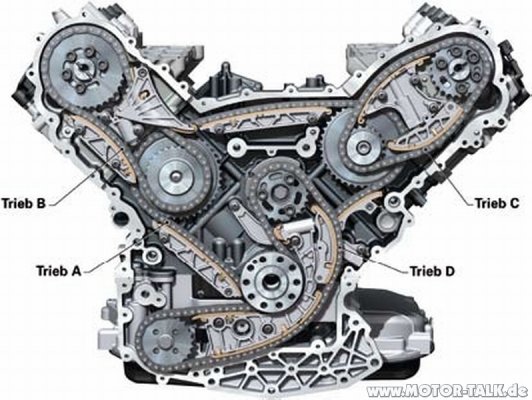
At the LS engines that is as simple as it can be. If you see some German engines from BMW or Porsche.

In a V8 with 4 camshafts, they sometimes have several balancing shafts and a high-pressure injection pump that has to be also lined, plus a chain tensioner. Then it becomes really difficult and usually only to do with setting tools.

I never in my mechanic life, saw a timing chain which is so simple like on the LS...

 

nonickatall

Full Access Member
Joined
Nov 19, 2022
Posts
806
Reaction score
1,493
Location
Germany
Here an example.. An Audi 3Liter TFSI.

A Pain in the A....
 

Attachments

  • kettentrieb-2008358457876299095.jpg
    kettentrieb-2008358457876299095.jpg
    266.5 KB · Views: 40
Last edited:

djhoch83

TYF Newbie
Joined
Mar 5, 2023
Posts
3
Reaction score
2
Read The whole thread. Put your pressure gauge away and simply line up the dots on your crank and cam. Nothing in the service manual says anything about compression or exhaust stroke. You can read the section in this link relating to cam install. And verify afterwards by turning the engine over by hand to see there’s no interference and the dots still line up. I’ve done 3 cam installs in LS engines this way.

Ok thank you
 

djhoch83

TYF Newbie
Joined
Mar 5, 2023
Posts
3
Reaction score
2
There is nothing in the description about compression stroke, because you are automatically in the compression stroke, when the two marks are in line with each other, i.e. the crankshaft is at 12 o'clock and the camshaft is at 6 o'clock.

And that's all you need to know.

It's also right, that it's best to do this in this position and that only for one reason:

Because you see if your timing is correct.

It's of course also right that you can change the timing chain at any position, if you put it back on without moving crank and camshaft but may be, the camshaft twists a bit, due to the tension of the valve springs and you then no longer know which tooth is exactly the right point.

So it is best to turn the engine to the appropriate marks to take the timing chain down and reassemble the timing chain back on and then crank the engine once, which means you have to turn the crankshaft twice.

Then the marks are back in the right place and must match. Manual cranking also prevents mechanical damage generated if the timing chain is not placed correctly, because you notice when the piston hits the valves without making damage.

When you do that with the starter, you notice it as well. But then you have to check the manual for the section engine swap. ;)

That's why you should crank the engine twice by hand. Two crankshaft rotation, check. Two rotations again, check again.

If the markings are still correct, then everything is fine and you can reassemble the engine.

At the LS engines that is as simple as it can be. If you see some German engines from BMW or Porsche.

In a V8 with 4 camshafts, they sometimes have several balancing shafts and a high-pressure injection pump that has to be also lined, plus a chain tensioner. Then it becomes really difficult and usually only to do with setting tools.

I never in my mechanic life, saw a timing chain which is so simple like on the LS...

Ok thanks bud
 

Rocket Man

Mark
Supporting Member
Joined
Dec 25, 2014
Posts
26,678
Reaction score
52,942
Location
Oregon
Here an example.. An Audi 3Liter TFSI.

A Pain in the A....
I swear, German engineers think “ how can I make this as complicated as possible?”. I’ll never never never work on a German car again. The entire time I’m thinking “why the hell did they make this so difficult” as I’m cussing them out.
 

nonickatall

Full Access Member
Joined
Nov 19, 2022
Posts
806
Reaction score
1,493
Location
Germany
Translated: Here, for example, this is a pain in the a.
Sometimes I use google translate to better understand. My english is not bad, but sometimes the special words for technical issues a missing.

When I forget to switch that of, when I write it automatically translate what I write... :Big Laugh:

A German mechanic would not say: pain in the ass. He calls it Volkswagen.....:cool:
 

nonickatall

Full Access Member
Joined
Nov 19, 2022
Posts
806
Reaction score
1,493
Location
Germany
I swear, German engineers think “ how can I make this as complicated as possible?”. I’ll never never never work on a German car again. The entire time I’m thinking “why the hell did they make this so difficult” as I’m cussing them out.
That is absolutely true and the reason why I not want to drive a German car anymore. You can drive a Mercedes up to 1995, a BMW 2005 and Volkswagen and the other shi... you can forget as well...

They turnt due to the market, the people who what more and more complex technic and the emmision rules in Germany into computers on wheels, overengineered and less and less to repair.

A friend of mine is a foreman at a VW/Audi Dealer. I asked him if he agrees or if I'm just too stupid to repair these cars. He says the ones in the workshops could throw up every day because everything is built in such a way, that you cant reach somewhere, everything is built in, special screws are everywhere and everything is built in such a way that you throw it away after 200,000 km.

When I see for myself that you used to change a bulb when you had a broken rear light, today you have to buy the complete LED rear light for a Golf for €280 from VW. And that is good for envoirememt? And Mercedes shoots the bird and encodes the headlights, so that you cannot go to a junkyard and get a used headlight for your Mercedes. No, it has to be coded by the Mercedes for your Car and you can only buy it used from Mercedes.

Of course, the headlight costs €2000 new and you can get it used for €1200.

I've never been particularly into American cars, because I used to like driving fast and when you're driving on the German Autobahn at 200km/h, there are hardly any American cars that are suitable for that.

I only bought the truck, because I saw from a friend how great it is to repair. And now I love it and don't want German scrap anymore.

My neighbors and friends always ask me
Doesn't it consume an infinite amount of fuel? And i always tell them it clearly needs more fuel but i have less depreciation and repair costs than all of you together and in summit i drive it cheaper than you do.

And I tell them: The Americans don't calculate in Liter per 100 Kilometer, they calculate in smiles per gallon... :cool:

Meanwhile two more of my friends plan to get a GMT 820...
 

rockola1971

Full Access Member
Joined
Dec 29, 2016
Posts
2,862
Reaction score
4,083
Location
Indiana (formerly IL)
That is absolutely true and the reason why I not want to drive a German car anymore. You can drive a Mercedes up to 1995, a BMW 2005 and Volkswagen and the other shi... you can forget as well...

They turnt due to the market, the people who what more and more complex technic and the emmision rules in Germany into computers on wheels, overengineered and less and less to repair.

A friend of mine is a foreman at a VW/Audi Dealer. I asked him if he agrees or if I'm just too stupid to repair these cars. He says the ones in the workshops could throw up every day because everything is built in such a way, that you cant reach somewhere, everything is built in, special screws are everywhere and everything is built in such a way that you throw it away after 200,000 km.

When I see for myself that you used to change a bulb when you had a broken rear light, today you have to buy the complete LED rear light for a Golf for €280 from VW. And that is good for envoirememt? And Mercedes shoots the bird and encodes the headlights, so that you cannot go to a junkyard and get a used headlight for your Mercedes. No, it has to be coded by the Mercedes for your Car and you can only buy it used from Mercedes.

Of course, the headlight costs €2000 new and you can get it used for €1200.

I've never been particularly into American cars, because I used to like driving fast and when you're driving on the German Autobahn at 200km/h, there are hardly any American cars that are suitable for that.

I only bought the truck, because I saw from a friend how great it is to repair. And now I love it and don't want German scrap anymore.

My neighbors and friends always ask me
Doesn't it consume an infinite amount of fuel? And i always tell them it clearly needs more fuel but i have less depreciation and repair costs than all of you together and in summit i drive it cheaper than you do.

And I tell them: The Americans don't calculate in Liter per 100 Kilometer, they calculate in smiles per gallon... :cool:

Meanwhile two more of my friends plan to get a GMT 820...
200km/h which is roughly 124mph. My man hasn't had the chance to open up an LS engine in a Corvette on a highway, has he? You'll go alot faster than 200km/h. Even the Chevy Camaro can do that with ease.
 

nonickatall

Full Access Member
Joined
Nov 19, 2022
Posts
806
Reaction score
1,493
Location
Germany
200km/h which is roughly 124mph. My man hasn't had the chance to open up an LS engine in a Corvette on a highway, has he? You'll go alot faster than 200km/h. Even the Chevy Camaro can do that with ease.
The engine yes, but not the chassis... :cool:
 

Forum statistics

Threads
137,691
Posts
1,989,677
Members
102,691
Latest member
RobK
Back
Top