

I'm doing my typical engineer "paralysis by analysis" for installing an auxiliary transmission cooler and I've run across some interesting stuff.
Before I say what that is, yes Tru-Cool 40K cultists, I've heard your proselytizing plenty and know The Good Word of your sacred installations!
The first thing is something that I've always known and assumed others did too, but I'm apparently mistaken in my assumption. A surprising number of folks don't understand that the in-radiator transmission cooler is on the "cooled" outlet side of the radiator, not the "hot" inlet side of the radiator. They think and a few tech articles imply the in-radiator transmission cooler being in coolant means it is in coolant that's at the engine's operating temperature -- IT IS NOT! It's not in contact with coolant coming out of the engine, it's in contact with coolant going back into the engine.
The second thing is that the traditional "knowledge" that the transmission fluid is warmed up more quickly by being in the coolant. However, this doesn't apply for ambient temperatures of ~80°F and above (and undoubtedly lower, but how low I don't know because I haven't tested at those temperatures). I know this because I have installed thermocouples on the radiator outlet, transmission "hot" line as it goes into the radiator, and the transmission "cooled" line as it exits the radiator. The transmission "hot" and "cooled" temperatures always climb faster than the radiator "out" temperature, so the transmission fluid is never being warmed in these conditions.
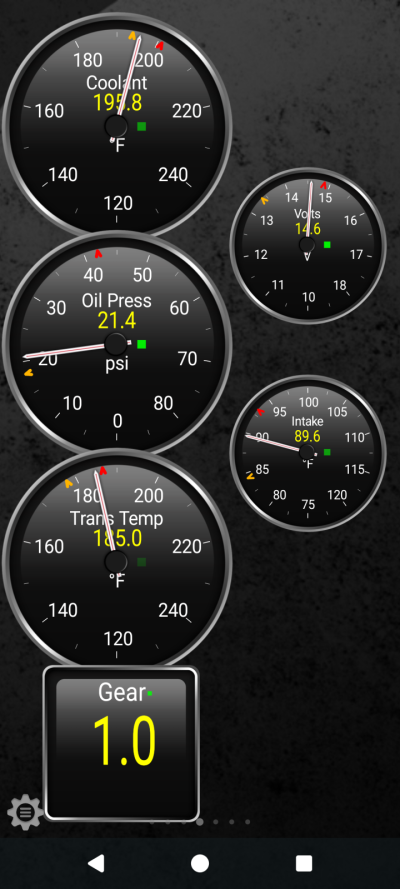
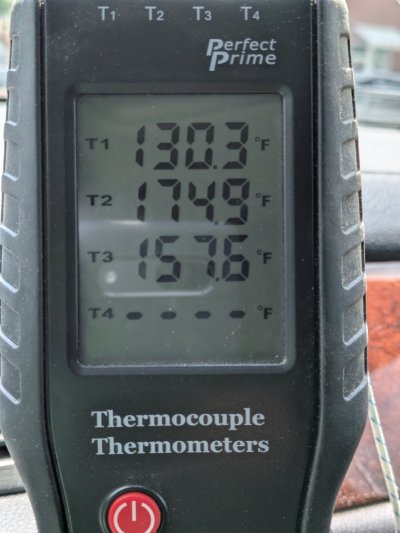
The pics attached below show a Torque Pro screenshot and a picture of the thermocouple unit, taken within a few seconds of each other. This is in moderate stop-and-go traffic, and ambient is a couple of degrees lower than the intake temperature; from top to bottom, the thermocouple readouts are: radiator outlet, trans hot in, trans cool out. Before anyone asks why the trans temp on Torque Pro and the thermocouple trans hot temperatures don't match, I've found that when in traffic the trans temp is always higher, but when in steady-state on the highway, they are very close.
Before I say what that is, yes Tru-Cool 40K cultists, I've heard your proselytizing plenty and know The Good Word of your sacred installations!
The first thing is something that I've always known and assumed others did too, but I'm apparently mistaken in my assumption. A surprising number of folks don't understand that the in-radiator transmission cooler is on the "cooled" outlet side of the radiator, not the "hot" inlet side of the radiator. They think and a few tech articles imply the in-radiator transmission cooler being in coolant means it is in coolant that's at the engine's operating temperature -- IT IS NOT! It's not in contact with coolant coming out of the engine, it's in contact with coolant going back into the engine.
The second thing is that the traditional "knowledge" that the transmission fluid is warmed up more quickly by being in the coolant. However, this doesn't apply for ambient temperatures of ~80°F and above (and undoubtedly lower, but how low I don't know because I haven't tested at those temperatures). I know this because I have installed thermocouples on the radiator outlet, transmission "hot" line as it goes into the radiator, and the transmission "cooled" line as it exits the radiator. The transmission "hot" and "cooled" temperatures always climb faster than the radiator "out" temperature, so the transmission fluid is never being warmed in these conditions.
The pics attached below show a Torque Pro screenshot and a picture of the thermocouple unit, taken within a few seconds of each other. This is in moderate stop-and-go traffic, and ambient is a couple of degrees lower than the intake temperature; from top to bottom, the thermocouple readouts are: radiator outlet, trans hot in, trans cool out. Before anyone asks why the trans temp on Torque Pro and the thermocouple trans hot temperatures don't match, I've found that when in traffic the trans temp is always higher, but when in steady-state on the highway, they are very close.