Is this a crazy idea to cool my 4L60E transmission?

Disclaimer: Links on this page pointing to Amazon, eBay and other sites may include affiliate code. If you click them and make a purchase, we may earn a small commission.

davidavidd

Member
Joined
Oct 29, 2020
Posts
81
Reaction score
105
Location
CO
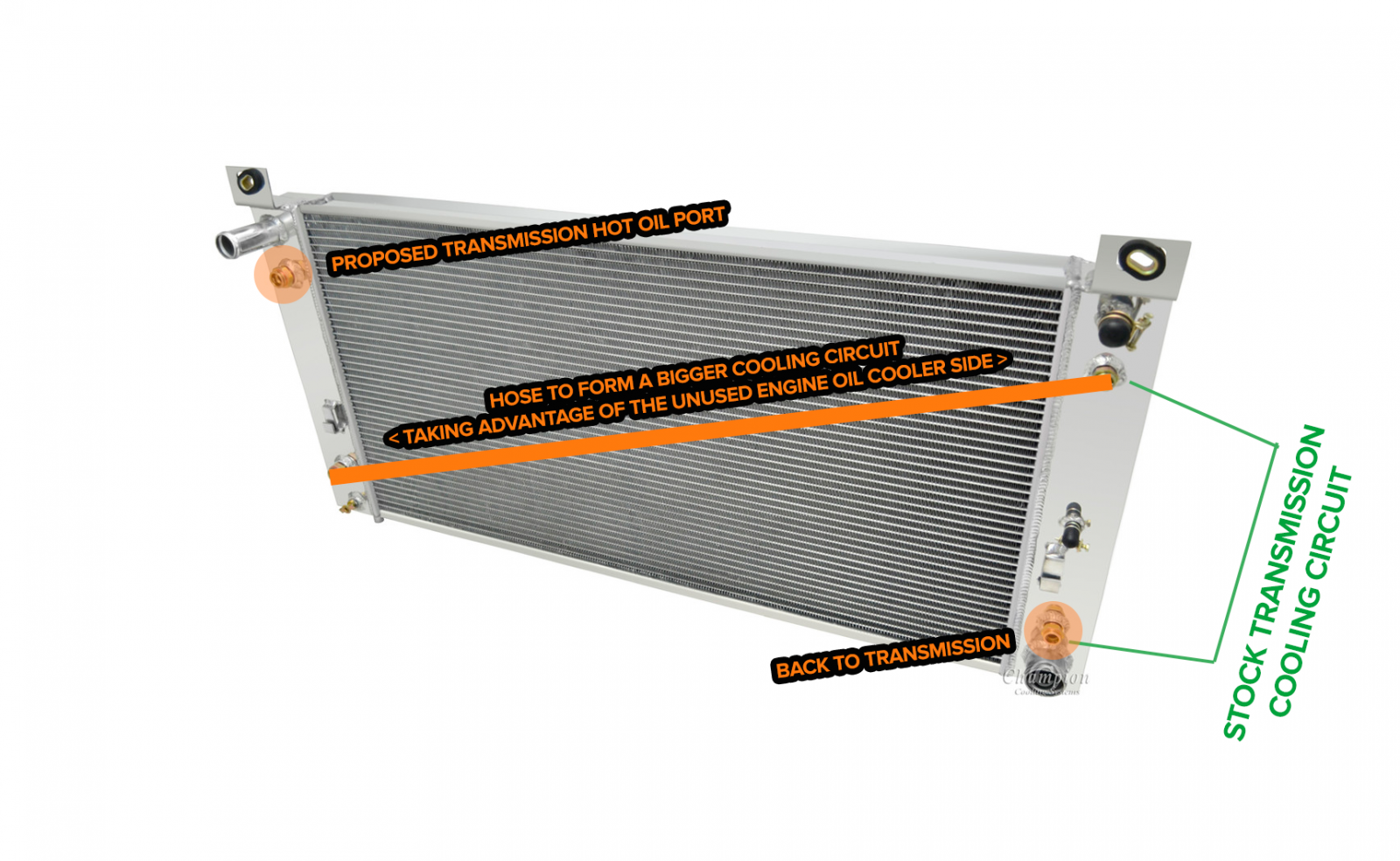
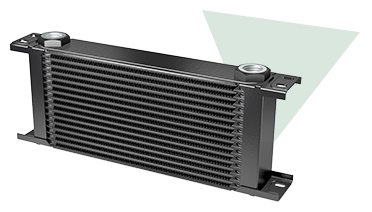
Hi TYForum friends, I am changing my Tahoe (07 stock Tahoe, 5.3, 4L60E) stock radiator because it's leaking like crazy, when I saw the new radiator I had this idea:

2370_a_w_w__38878.png


Since I don't use the engine oil cooler, can I bridge the lines on both sides to form a larger cooling circuit for my 4L60E?
I am towing frequently this year, where I live the temperature can reach 97 and we don't have winter so overcooling the transmission wouldn't be a problem.

What do you guys think?
 

Marky Dissod

Full Access Member
Joined
Mar 3, 2023
Posts
4,081
Reaction score
5,891
Location
(718)-
... changing my '07 stock Tahoe, 5.3L, 4L60E, stock radiator because it's leaking like crazy, when I saw the new radiator I had this idea ...
Since I don't use the engine oil cooler, can I bridge the lines on both sides to form a larger cooling circuit for my 4L60E?
I am towing frequently this year, where I live the temperature can reach 97F and we don't have winter so overcooling the transmission wouldn't be a problem.

What do you guys think?
It's nowhere near as good as an external air-to-ATF cooler, but it can't hurt.
Some people might see its greatest limitations as features (I'm not one of those):
the ATF will never be colder than the engine coolant (helps engine warm up in winter)
if the transmission is working hard enough, it will make the engine (coolant) hotter

Since you are towing frequently, very seriously consider:
an external air-to-ATF cooler upgrade
a colder-than-OE engine thermostat
an ecm & tcm tune to enhance fan operation & improve shifting & towing performance
if your axle gear(s) is / are under 4.10, even using Tow / Haul mode, keep the shifter away from 'D' unless your tcm is properly tuned
 

Foggy

Full Access Member
Joined
Jul 25, 2019
Posts
1,403
Reaction score
1,920
Location
KS
Interesting theory.. But I don't think it will work very well as you can only
cool down to the "coolants" temp once... but maybe
IF you are towing frequently just add an aux trans cooler - air to air- AFTER
the fluid exits the new radiator. You could use a factory one or any aftermarket one
 

Marky Dissod

Full Access Member
Joined
Mar 3, 2023
Posts
4,081
Reaction score
5,891
Location
(718)-
FYI, this is one of GM's OE ATF cooling configurations.
No engine oil warmer, 2 ATF warmers.
As said above, an external air-to-ATF cooler after the radiator is typically recommended.
Especially if you're going to warm the ATF twice.
 

Doubeleive

Wes
Supporting Member
Joined
Nov 7, 2017
Posts
30,501
Reaction score
47,903
Location
Stockton, Ca.
Hi TYForum friends, I am changing my Tahoe (07 stock Tahoe, 5.3, 4L60E) stock radiator because it's leaking like crazy, when I saw the new radiator I had this idea:

View attachment 425491

Since I don't use the engine oil cooler, can I bridge the lines on both sides to form a larger cooling circuit for my 4L60E?
I am towing frequently this year, where I live the temperature can reach 97 and we don't have winter so overcooling the transmission wouldn't be a problem.

What do you guys think?
you could do it that way, probably won't help much but you will need to note that those connectors are different sizes so
you will need adapters to make it work.
you would be better off with a tru-cool 40k and these
(2) edlebrock 640610 or compatible brand (matching part number)
(2) gm 19130039
(2) 6an male flare to 5/8"-18 inverted flare adapter fitting
(2) 6an 24" hose/line such as this one


j91z28d1

Full Access Member
Joined
Feb 28, 2022
Posts
4,603
Reaction score
5,863
if you do it, go thru the drivers side first, and then the passenger side cooler.

the drivers side is the the oil cooler side, it's the hot side, what the coolent comes out of the engine at. then once cooled down across the fens the pass side will cool it lower than coolent temp sensor reading that's in the block. what the that temp actually is, you'd need a extra sensor to say. you could also wire in a toggle switch to run the fans at high speed if you needed them, the coolent thermostat would keep the engine from over cooling and you might get a bit more tranny cooling if needed. honestly don't know if what you're towing is enough the engine needs both fans on anyways.


I don't pretend to have any experience with tranny cooling with towing, the little I've done has been fine with my stock setups. my in radiator cooling experience is from the oil side, my car is notorious for hot oil Temps, 2 flying laps of the track and I was hitting 300 deg. 260deg is comfortable, 320-340 depending on the oil is basically baking it, I try to shut down at 300. my car had the optional front mount oil to air cooler, it couldn't even handle mountain road runs, I put a small good quality spal fan on the cooler itself, and that kept me under 300 on the roads. went to the track and 2 laps I was having to do cool down laps. I then had 2 options, the larger aftermarket cooler that's well over 1000$ setup, most guys have good luck with it. or I caught a few old threads with some info about the in radiator coolers working well for them, not many replies and mainly the same thing, oh it's inefficient, you'll add heat to coolent blah blah blah theory's, (never hard coolent temp issues even with stock rad and fan) but no where did anyone post about trying it and it failing. so I took the gamble, found top brand radiator on ebay from a wrecked zo6, (wasn't paying 1500$ for a radiator to test the theory lol) swapped it in and ran lines to radiator cooler first, and than since I already had it, I left the oem front mount with the fan on it.

well next track day, I completely forgot to turn the fan cooler on, but never was about to hit over 270deg and that was running 2 seconds faster lap time, mainly from being able to run longer sessions lead to driving harder, times came down and not worried about Temps anymore. except tires and brakes.

day did get cut short cause of a oil hose on a fitting didn't hold, so make sure what you make the lines with is proper rated. it was my fault, I researched the part numbers from the Parker catalog at work but then ordered it from a random Amazon listing by the foot (I should have ordered from our vendor, but they really only deal in 50ft or more orders) I never checked that they sent me what ordered till after I got it home from the track, checked the numbers on the left over hose and it wasn't what I wanted. the temp rating wasn't high enough to have headroom for the hot side oil. must have been really hot before being cooled. the temp sensor is in the sump. it's much hotter as it exits the pump from being compressed. I'd guess tranny fluid would be the same, if you took a temp reading off the converter outlet, it would be pushing the limits of the fluid.

anyways, it can't hurt to try, if it doesn't work you'll already have the hoses and fitting made up for a big from mount cooler. there's a long 20plus page thread around there about it. worth a read if you can find it.

 
OP
OP
davidavidd

davidavidd

Member
Joined
Oct 29, 2020
Posts
81
Reaction score
105
Location
CO
Thank you all for your good advice, forgot to mention that I have an external radiator too, I will do the experiment next week; if it doesn't work or I'm not convinced I'll just plug it in as it was.
 

latvius

Full Access Member
Joined
Nov 17, 2014
Posts
581
Reaction score
986
Location
Ariton Alabama
So you want to run trans oil lines into the radiator cooler, then to the other radiator cooler, then to the external cooler? Are you trying to make it a BMW?
Just by pass the radiator and run the lines to the external cooler.
Look at it this way you eliminate the chance of your radiator leaking into your transmission and tanking it. Your plan increases this chance by x2.
 

Geotrash

Dave
Supporting Member
Joined
Feb 16, 2018
Posts
7,843
Reaction score
20,396
Location
Richmond, VA
So you want to run trans oil lines into the radiator cooler, then to the other radiator cooler, then to the external cooler? Are you trying to make it a BMW?
Just by pass the radiator and run the lines to the external cooler.
Look at it this way you eliminate the chance of your radiator leaking into your transmission and tanking it. Your plan increases this chance by x2.
I did this on my '12 XL Denali with a Derale 13960 and it didn't work out. The fluid-to-air cooling method is far less efficient than water-to-fluid so I was getting spikes to 265ºF towing our 7K lb camper over the Blue Ridge mountains. I plumbed the radiator end tank cooler back into the loop before the external cooler and problem solved. The radiator taks a big cut of the heat out of the fluid so that the external cooler can finish the job.

In my opinion, what the OP is trying to do is a mistake also and won't deliver the results he's looking for. The best cooler setup on these is the way the factory did it. After numerous experiments on my own and studiously logging data with various coolers and configurations, I gained nothing over the factory setup.

Lots of guys love the Trucool 40K but unless you're towing, or it's 100ºF in the summer, you'll never get the fluid to the minimum 150ºF that GM recommends. And if you have a 6.2L, the Trucool in front of the radiator will block enough airflow to cause engine cooling problems when towing.

I finally landed on the Derale 13960 mounted below the front bumper behind the lower grille on the Denali and plumed in series with the radiator's cooler. It's absolutely perfect. Warms nicely to 160ºF in daily driving with no trailer, and never gets above 230ºF towing over the steepest passes in the Blue Ridge or the Rockies. And the engine stays nice and cool, too.
 

latvius

Full Access Member
Joined
Nov 17, 2014
Posts
581
Reaction score
986
Location
Ariton Alabama
I did this on my '12 XL Denali with a Derale 13960 and it didn't work out. The fluid-to-air cooling method is far less efficient than water-to-fluid so I was getting spikes to 265ºF towing our 7K lb camper over the Blue Ridge mountains. I plumbed the radiator end tank cooler back into the loop before the external cooler and problem solved. The radiator taks a big cut of the heat out of the fluid so that the external cooler can finish the job.

In my opinion, what the OP is trying to do is a mistake also and won't deliver the results he's looking for. The best cooler setup on these is the way the factory did it. After numerous experiments on my own and studiously logging data with various coolers and configurations, I gained nothing over the factory setup.

Lots of guys love the Trucool 40K but unless you're towing, or it's 100ºF in the summer, you'll never get the fluid to the minimum 150ºF that GM recommends. And if you have a 6.2L, the Trucool in front of the radiator will block enough airflow to cause engine cooling problems when towing.

I finally landed on the Derale 13960 mounted below the front bumper behind the lower grille on the Denali and plumed in series with the radiator's cooler. It's absolutely perfect. Warms nicely to 160ºF in daily driving with no trailer, and never gets above 230ºF towing over the
steepest passes in the Blue Ridge or the Rockies. And the engine stays nice and cool, too.

If you live in cold weather get one of these - problem solved.
If fluid to water is more efficient why did my 2005 Denali have a fluid to air trans cooler? I upgraded the stock one to a tru cool model, it's bigger and my trans temps are cooler.


1712843128680.png
 

Geotrash

Dave
Supporting Member
Joined
Feb 16, 2018
Posts
7,843
Reaction score
20,396
Location
Richmond, VA
If you live in cold weather get one of these - problem solved.
If fluid to water is more efficient why did my 2005 Denali have a fluid to air trans cooler? I upgraded the stock one to a tru cool model, it's bigger and my trans temps are cooler.


View attachment 425816
It's a good idea but I would want it to open at 150ºF, not 180. A similar valve is stock on the 2015+ rigs and they've had heat-related transmission problems as a result. The problem is that in really hot weather, either with a rig full of people and stuff, or when towing, you have less thermal headroom to work with and the fluid spends more time at higher temperatures than it would if you started cooling it at 30ºF lower temperature. 150ºF is the minimum that GM sets for both optimal fluid viscosity and to rid it of any residual moisture. But the warmer the fluid gets above that, the faster the additives break down and the harder it is on the soft parts (e.g. seals) in the transmission.
 

latvius

Full Access Member
Joined
Nov 17, 2014
Posts
581
Reaction score
986
Location
Ariton Alabama
OP writes
1712847536932.png

So why are you posting about what is needed for cold environments?

I won't even get into your thermal headroom theory or the that you never replied to my rebuttal of your radiator cooler cools better than external air cooler.
If you're going to quote what "GM says" you should include a reference, anyone can say "GM said" anything. Doesn't make it true.
 

Geotrash

Dave
Supporting Member
Joined
Feb 16, 2018
Posts
7,843
Reaction score
20,396
Location
Richmond, VA
OP writes
View attachment 425824
So why are you posting about what is needed for cold environments?

I won't even get into your thermal headroom theory or the that you never replied to my rebuttal of your radiator cooler cools better than external air cooler.
If you're going to quote what "GM says" you should include a reference, anyone can say "GM said" anything. Doesn't make it true.
Who are you talking to?
 

Forum statistics

Threads
137,691
Posts
1,989,691
Members
102,691
Latest member
RobK
Back
Top