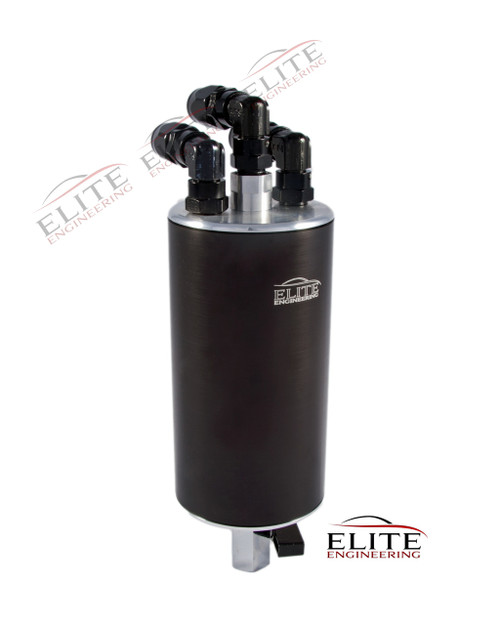

Catch can flow discussion

Disclaimer: Links on this page pointing to Amazon, eBay and other sites may include affiliate code. If you click them and make a purchase, we may earn a small commission.

OP
OP
iamdub

iamdub

Full Access Member
Joined
Apr 23, 2016
Posts
20,821
Reaction score
45,011
Location
Li'l Weezyana
Top one is the oil after 5k miles from the cheap cc on our 191k mile 07 Yukon.
Bottom is the oil after 5k miles from the pricie cc on our 68k mile 02 Corvette.
View attachment 412746


The problem with this comparison is the Gen 3 engine tends to not blow as much oil as the Gen 4. Unless you drive your 'Vette very differently than your Yukon! It'd be awesome to swap the cans between the vehicles and drive them just as you normally do and make another comparison at the next 5K mile interval.
 

George B

¯\_(ツ)_/¯
Joined
Feb 5, 2020
Posts
7,880
Reaction score
18,983
Location
Oconomowoc, Wisconsin 53066
So far, it seems the consensus is to have the inlet hit the filter. That's what the "big brands", which I'd be inclined to believe have put more R&D into their products than the Chi-clones, seem to agree on. But that's not to say that having it reversed won't work, either.

I'm gonna stick to my assessment that make a whole lot of difference, assuming you have proper coalescing media. But, where it would matter is if you're trying to keep something in the engine (like oil) and just catch what makes it through versus trying to vacate and capture something (like moisture). If just oil, inlet goes directly to filter. If moisture, inlet goes to reservoir.
I capture oil in the summer and lots of moisture in the winter with mine.
 

k_arnold72

Full Access Member
Joined
Jun 2, 2023
Posts
199
Reaction score
240
I have a JLT as well and get about an ounce every oil change. I've used Blackstone in the past, if I'm not mistaken, I believe the instructions ask you to take the oil sample from the crank case. The results will tell you what trace amounts of metals are found in your sample, where that metal comes from and how it compares to similar engines.

image.jpg
 
OP
OP
iamdub

iamdub

Full Access Member
Joined
Apr 23, 2016
Posts
20,821
Reaction score
45,011
Location
Li'l Weezyana
I capture oil in the summer and lots of moisture in the winter with mine.

*Sucks teeth*
See, now you just tryna be difficult!

shenanah-martin-lawrence.gif


You should get two: Valve cover in to unfiltered port of first can, out of filtered port of first can in to filtered port of second can, out of unfiltered port of second can in to intake manifold. Cover all bases and transcend us single can peasants.
 

George B

¯\_(ツ)_/¯
Joined
Feb 5, 2020
Posts
7,880
Reaction score
18,983
Location
Oconomowoc, Wisconsin 53066
*Sucks teeth*
See, now you just tryna be difficult!

View attachment 412933


You should get two: Valve cover in to unfiltered port of first can, out of filtered port of first can in to filtered port of second can, out of unfiltered port of second can in to intake manifold. Cover all bases and transcend us single can peasants.
No Sir! I ain’t foolin wit it no mo.
 

89Suburban

Bull in the china shop
Space X Supporting Member
Joined
Jan 10, 2013
Posts
17,814
Reaction score
50,749
Location
SE PA
Wouldn't it work better then? If the oil has been stalled and scrubbed from the air, and has coalesced on/in the filter media (the bronze plus the added scouring pad), the droplets would already be too big to remain "in flight" to get to the "unprotected" outlet port. Going the other way, the oil is already stuck to the filter media and is being pulled through via engine vacuum at all times. Eventually, it'll get through and make its way up the hose to the intake manifold.

The oil would have to pretty much be solidified in the hose to be a restriction. Obviously, it's very far from being a solid. Also, a restriction stalls air flow and this weakens the vacuum on a fluid substance. If there's enough oil going through the PCV system (through that tiny hole in the PCV "valve", for one), to fill the 5/16" hose, then your engine was already moving that much oil and it needs more help than a catch can would ever provide. Does an oil-soaked brass filter reduce air flow? Of course. But it's not enough to cause excess pressure inside the engine or affect engine vacuum in any amount the PCM sees and reacts to.
 

j91z28d1

Full Access Member
Joined
Feb 28, 2022
Posts
4,603
Reaction score
5,863

select the 400$ dual one for ls engines and hit buy now lol
 

j91z28d1

Full Access Member
Joined
Feb 28, 2022
Posts
4,603
Reaction score
5,863


this video is blah, I don't think these engines care much about 2 sec run time till it fills the filter but also since it's a bottom mount filter that's easy to fill there's no good reason not to do it.

I did find some of his other videos very interesting, especially the 0w8 Toyota oil made by Exxon. interesting stuff.
 

j91z28d1

Full Access Member
Joined
Feb 28, 2022
Posts
4,603
Reaction score
5,863

select the 400$ dual one for ls engines and hit buy now lol


so I trolled myself. I was bored, watched some YouTube videos, messed around and ordered a 3 port lol.
 

BlaineBug

Full Access Member
Joined
Dec 29, 2019
Posts
1,179
Reaction score
678
Location
Clown World
Correct me if I am wrong but this is what I understand-

Passenger side PCV routing is clean air. Do not modify - leave untouched, no need to install a catch can on the passenger side PCV system (it's all connected regardless.)

IN fitting of catch can comes from driver's side valve cover PCV fitting. OUT fitting on catch can routes to the intake manifold fitting near/below the electronic throttle body.

I have a catch can coming next week, so this is what I know about it thus far.
 
OP
OP
iamdub

iamdub

Full Access Member
Joined
Apr 23, 2016
Posts
20,821
Reaction score
45,011
Location
Li'l Weezyana
Correct me if I am wrong but this is what I understand-

Passenger side PCV routing is clean air. Do not modify - leave untouched, no need to install a catch can on the passenger side PCV system (it's all connected regardless.)

IN fitting of catch can comes from driver's side valve cover PCV fitting. OUT fitting on catch can routes to the intake manifold fitting near/below the electronic throttle body.

I have a catch can coming next week, so this is what I know about it thus far.


Correct-ish.

The fitting on the intake manifold that you'll connect the hose from the catch can is at the top center, not near the TB. It's where the factory hose is going. The catch can is just spliced inline in that circuit from the back of the valve cover to the top center of the manifold.

Instead of:

Out of valve cover > In to manifold

it's

Out of valve cover > In to catch can > Out of catch can > In to manifold
 

BlaineBug

Full Access Member
Joined
Dec 29, 2019
Posts
1,179
Reaction score
678
Location
Clown World
Correct-ish.

The fitting on the intake manifold that you'll connect the hose from the catch can is at the top center, not near the TB. It's where the factory hose is going. The catch can is just spliced inline in that circuit from the back of the valve cover to the top center of the manifold.

Instead of:

Out of valve cover > In to manifold

it's

Out of valve cover > In to catch can > Out of catch can > In to manifold
I'll take a look. I was watching a video from an installation, possibly from a previous generation 5.3, if there was a different PCV routing for that era.
 
OP
OP
iamdub

iamdub

Full Access Member
Joined
Apr 23, 2016
Posts
20,821
Reaction score
45,011
Location
Li'l Weezyana
I'll take a look. I was watching a video from an installation, possibly from a previous generation 5.3, if there was a different PCV routing for that era.

It's the same on a Gen 3 as it is on a Gen 4. The Gen 3 car engines (LS1, etc.) had a slightly different setup since they were more hi-po with more vacuum, higher RPM, etc. and the TB sucked from both valve covers.
 

BlaineBug

Full Access Member
Joined
Dec 29, 2019
Posts
1,179
Reaction score
678
Location
Clown World
It's the same on a Gen 3 as it is on a Gen 4. The Gen 3 car engines (LS1, etc.) had a slightly different setup since they were more hi-po with more vacuum, higher RPM, etc. and the TB sucked from both valve covers.
Isn't that how it works on the 2014/2015+ motors? There is a quick disconnect hose on both the left and right side valve covers that both lead to the monstrosity of an air intake silencer tube pre-throttle body.

One of the videos I watched showed a quick-disconnect fitting on the intake manifold beneath the electronic throttle body.
 
OP
OP
iamdub

iamdub

Full Access Member
Joined
Apr 23, 2016
Posts
20,821
Reaction score
45,011
Location
Li'l Weezyana
Isn't that how it works on the 2014/2015+ motors? There is a quick disconnect hose on both the left and right side valve covers that both lead to the monstrosity of an air intake silencer tube pre-throttle body.

One of the videos I watched showed a quick-disconnect fitting on the intake manifold beneath the electronic throttle body.

Probably. I've seen it on the 2014+ Ecotecs but never studied the routing and flow. I'm referring to the Gen3 and Gen4 engines. That's a GenV engine. I guess I'm too old school.
 

BlaineBug

Full Access Member
Joined
Dec 29, 2019
Posts
1,179
Reaction score
678
Location
Clown World
Probably. I've seen it on the 2014+ Ecotecs but never studied the routing and flow. I'm referring to the Gen3 and Gen4 engines. That's a GenV engine. I guess I'm too old school.

s-l1600[1].jpg


It looks to me as if it's sucking from both valve covers, as you can see here. With other cars and trucks I've been accustomed to in the past, normally the driver's side valve cover will connect to the air intake tube pre-throttle body and then the passenger side cover will connect to the intake manifold post-throttle body.

I suppose it doesn't matter though - I've never seen anyone on any forum talking about running a dual-catch can setup for both valve covers.
 

Forum statistics

Threads
137,691
Posts
1,989,691
Members
102,691
Latest member
RobK
Back
Top