So those are spacers for a front and rear lift?
I assume that's UAE dollars? If so, that's a great deal including labor!
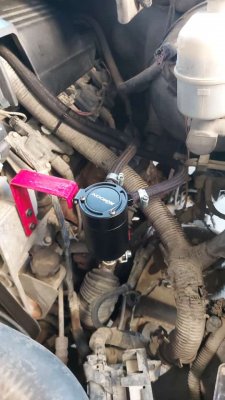
Also i need some guidance for the oil catch can install. Looks like i have to use the old hose and cut it to use the ends.
TY

Disclaimer: Links on this page pointing to Amazon, eBay and other sites may include affiliate code. If you click them and make a purchase, we may earn a small commission.
So those are spacers for a front and rear lift?
I assume that's UAE dollars? If so, that's a great deal including labor!

I converted the price to American dollars. haha
Just lift in front
Also i need some guidance for the oil catch can install. Looks like i have to use the old hose and cut it to use the ends.
TY
Ah, okay. I thought you decided to lift the front and rear. The rear is lifted with coil spacers and/or lift coils.
Definitely go with the teflon spacer lift. $137 parts and labor from a shop isn't bad considering it's about an hour job. No need to take the struts apart to install a coil spacer when you can accomplish the same with a lower bolt-in spacer. Besides, the ones that go on top or bottom don't affect the shock travel or anything.
Did you ever determine how much lift you want in the front?
Super easy. You connect nipple on the driver side valve cover (at the back near the firewall) to the inlet of the catch can. You connect the outlet of the catch can to the nipple at the top center of the intake manifold where the valve cover was originally routed to. How you connect these is up to you. Either use fuel-rated hose (most catch cans come with hose) or you can modify the stock hoses and use those. I think I used a combination of both.
BE CAREFUL with the fitting on top of the manifold. It will snap very easily. I support it from moving while I use a razor knife to slice the hose lengthwise (using multiple cuts) then peel it off the nipple. When slipping the new hose onto it, use a little oil to help it slide onto the fitting and support the fitting while you gently push the hose onto it. Treat it like its made of tissue paper.
Post a pic or link for the catch can you have.

That's what I did. I cut a couple inches out of the factory line at the elbow, basically removing the elbow, and just slipped the rubber hose over and used hose clamps.The catch can is the one you recommended. That looks like a fake mishimoto.
The top part is where I think Ill have problems. Because I saw some videos and the only way to connect the hose is to cut it and push the new hose onto it.
TY
That's what I did. I cut a couple inches out of the factory line at the elbow, basically removing the elbow, and just slipped the rubber hose over and used hose clamps.
Been like that for 2 years, no problems.
Sent from my SM-G930V using Tapatalk
Super easy. You connect nipple on the driver side valve cover (at the back near the firewall) to the inlet of the catch can. You connect the outlet of the catch can to the nipple at the top center of the intake manifold where the valve cover was originally routed to. How you connect these is up to you. Either use fuel-rated hose (most catch cans come with hose) or you can modify the stock hoses and use those. I think I used a combination of both.
BE CAREFUL with the fitting on top of the manifold. It will snap very easily. I support it from moving while I use a razor knife to slice the hose lengthwise (using multiple cuts) then peel it off the nipple. When slipping the new hose onto it, use a little oil to help it slide onto the fitting and support the fitting while you gently push the hose onto it. Treat it like its made of tissue paper.
Post a pic or link for the catch can you have.
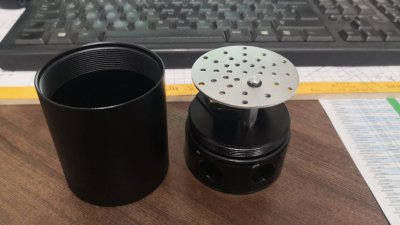
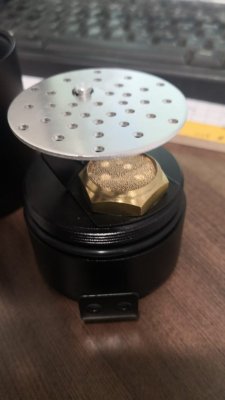
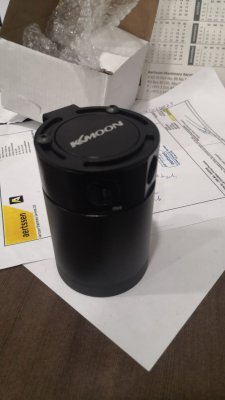
This is the one i got. looks like fake mishimoto. But still connecting thing. I have to cut the tube to connect the hoses. think 10mm size hose ID.
TY
View attachment 266140 View attachment 266141 View attachment 266142
That one will work fine. Get that stainless steel scrubber pad and it'll work even better.
Find the center of the scrub pad, it'll be like a hole where you can poke your finger through. Spread it open and slip it around that disc with the holes in it. Tuck the pad completely under that disc. It'll fill in all of the space between that brass filter and disc. When you screw the top back onto the reservoir, you'll have to push all of the little strands of the scrub pad inside to keep them out of the threads. I used a tiny flat head screwdriver. It's a little tedious, and is why getting a catch can with a drain valve is recommended. It's so you don't have to keep removing the reservoir and dealing with the strands every time you drain the catch can.
You can see my catch can in my sig pic. I simply place a cup under the can, in front of the power steering pump, open the valve until it quits draining, close the valve and wipe it clean.
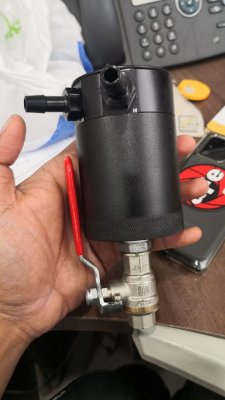
I fixed a ball valve under the catch can. I will do the fixing on Saturday after new year. Hopefully a muffler change by end of January.
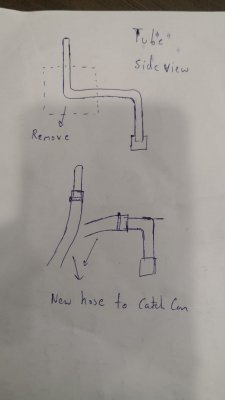
Sorry Im asking again. I attached a pic of the cut I will make to fix the new hose.
Is this correct ?
TY
View attachment 266323 View attachment 266324
Oooo... Stainless steel ball valve- fancy!
If I'm understanding your drawing, it looks correct. It's really straightforward-
You have a hose/pipe that goes from the rear of the left (driver side in US) valve cover to a port on the top center of the intake manifold. All you're doing with the catch can is splicing it inline with this. So, following the direction of flow, it would go from the port on the valve cover to the inlet of the can, then from the outlet of the can to the port on the intake manifold. It's that simple.
Cutting the factory plastic pipe and slipping rubber hose over it is probably the safest way to do it since that port on the top of the manifold is plastic and will break very easily if bent.
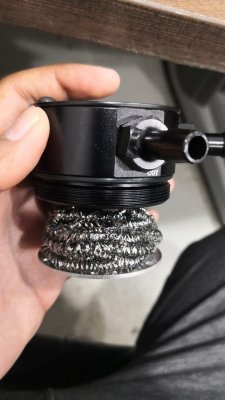
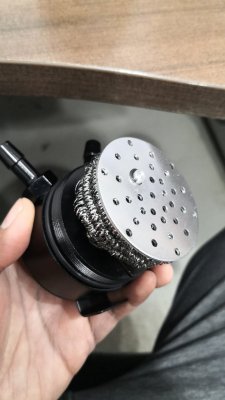



I must have missed the explanation for the steel scrubber. What’s the reason for adding it?
That’s just beyond my pea sized brain to understand, but will certainly be doing it as well once I get going on the catch can.
It's how catch cans work. The oily air passes through a filtration media that the tiny oil droplets stick to, separating them from the air. More droplets stick to those droplets ("coalesce") and, eventually, they become a larger drop that is too heavy to stay in the filtration media so they fall (drip) into the bottom of the can. The more coalescing media you have, the more oil will be separated from the air.
A stainless scrubber is a cheap, but effective filter media. It provides lots of surface area for the oil to stick to, but covers a large area so the flow isn't inhibited. Which, by the way, is why the stock engine air filter isn't a restriction as many believe. The air filter is multiple times larger in area than that of the throttle body. An air filter absolutely restricts flow- that's just physics. But, a large area of this restricted flow will pass way more volume than if that restricted flow area were constrained to the size of the TB.