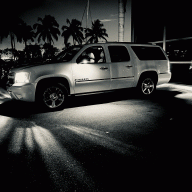
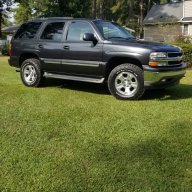
What did you do to your NBS GMT800 Tahoe/Yukon Today?

Disclaimer: Links on this page pointing to Amazon, eBay and other sites may include affiliate code. If you click them and make a purchase, we may earn a small commission.

rgosart

Full Access Member
Joined
Sep 9, 2019
Posts
205
Reaction score
375
Ok so for the front keys.. I bought some aftermarket keys, thinking that they would offer a higher starting point before having to crank up the torsion bars. Is that incorrect? I’m not looking for anything but maybe 2”, to level with the rear. I also will be installing Bilstein 5100’s as I think my front shocks could use a refresh. Are you saying it’s pointless to install the aftermarket keys, and it will ride like shit either way..? Is the only point of the aftermarket keys, to allow more lift from cranking the torsion bars ?

And obviously I’m ignorant, please indulge me.

I'm sure that those who posted in the last 8 or so posts will disagree with me, but I'll tell you what I did to level mine as close to "correct" as I could. There aren't any kits that I have seen to level one of these trucks a different way. Using spindles is not an option for 4x4 trucks... Ultimately, changing ride height changes the ride.

Before I bought anything, I took fender measurements and figured out how far I would have to raise the front end to get what I was looking for. At that point, I jacked up the front end to that height and looked at my CV angles. Then I raised the truck until the front end ran out of downward travel and took another measurement. This told me how much downward travel I still have left. I have those measurements somewhere... If I remember correctly, I still have 2"+.

That being said, my truck IS stiffer. There is no doubt in my mind that cranking keys or aftermarket keys changes the ride. How much of that comes from my switch to load range E tires and how much comes from the keys I'm not sure. I am still happy with the ride and I went into it with the expectation that it would change. Just because the bolt is in the same place as it was from the factory does not mean that the ride will be the same. Raising the front end increases the tension on the torsion bars. No way around that.
This is not correct. My fault for not fully understanding. I do not want to misinform anyone. The height of the front of the truck changes proportionally with the twist in the rear of the torsion bar so the resting position remains the same.

I used aftermarket keys because I did not think that I would be able to get the ~2" that I needed out of my stock keys after looking at where the bolts were. Maybe I wasted $30. Not really a big issue to me... It was more important to me that I had everything I needed to do it all in one day so that I could align it while I had access to an alignment rack. It may be worth trying cranking your stock keys and seeing what you think. Just count turns and put them back. No reason you can't do that and see how the ride changes. The alignment didn't change that drastically for me. Now I wouldn't leave it without aligning it, but trying it for a couple days before you make the commitment won't hurt your tires or anything (IMO). I also did not put shocks on my Tahoe as it has almost brand new Delco shocks. The 5100s may be an improvement, but I see that as money that I do not need to spend right now.

As I recommended to other people on here, going any further than I did starts to limit your downward travel and that will make the truck ride like crap. I would not use any spacers over springs in the rear. That is too much to get out of just cranking the front end. The only time I have really noticed an issue with down travel is when I go over one really abrupt speed bump in my neighborhood. If I hit it going too fast, the front end does feel like it is pulled down. In normal driving, I haven't noticed any issues.
 
Last edited:
Scottydoggs

Full Access Member
Joined
Dec 16, 2017
Posts
2,883
Reaction score
4,525
Location
NJ
i did keys on my 03 2500 hd pick up. wish i never did. made the ride stiffer then a old ford 350 with a solid axle.

the lower arms were pushed all the way down and had no real movement/travel to them at all. only time it rode nice was when i had the plow on the front, with the extra weight the front end would actually move and feel like normal.

if you hit a large pot hole the truck would just fall in the hole. oh, and it broke front shocks like crazy.
 

rgosart

Full Access Member
Joined
Sep 9, 2019
Posts
205
Reaction score
375
i did keys on my 03 2500 hd pick up. wish i never did. made the ride stiffer then a old ford 350 with a solid axle.

the lower arms were pushed all the way down and had no real movement/travel to them at all. only time it rode nice was when i had the plow on the front, with the extra weight the front end would actually move and feel like normal.

if you hit a large pot hole the truck would just fall in the hole. oh, and it broke front shocks like crazy.

That's the effect of going too far! No down travel will make it ride like garbage.

Not speaking from my own experience, so I am not 100% sure if this is true. I thought I had read that the Cognito UCAs will help with caster and allow for a little more downward travel.
 

TheAutumnWind

Full Access Member
Joined
Jan 8, 2015
Posts
3,255
Reaction score
1,997
I'm sure that those who posted in the last 8 or so posts will disagree with me, but I'll tell you what I did to level mine as close to "correct" as I could. There aren't any kits that I have seen to level one of these trucks a different way. Using spindles is not an option for 4x4 trucks... Ultimately, changing ride height changes the ride.

Before I bought anything, I took fender measurements and figured out how far I would have to raise the front end to get what I was looking for. At that point, I jacked up the front end to that height and looked at my CV angles. Then I raised the truck until the front end ran out of downward travel and took another measurement. This told me how much downward travel I still have left. I have those measurements somewhere... If I remember correctly, I still have 2"+.

That being said, my truck IS stiffer. There is no doubt in my mind that cranking keys or aftermarket keys changes the ride. How much of that comes from my switch to load range E tires and how much comes from the keys I'm not sure. I am still happy with the ride and I went into it with the expectation that it would change. Just because the bolt is in the same place as it was from the factory does not mean that the ride will be the same. Raising the front end increases the tension on the torsion bars. No way around that.

I used aftermarket keys because I did not think that I would be able to get the ~2" that I needed out of my stock keys after looking at where the bolts were. Maybe I wasted $30. Not really a big issue to me... It was more important to me that I had everything I needed to do it all in one day so that I could align it while I had access to an alignment rack. It may be worth trying cranking your stock keys and seeing what you think. Just count turns and put them back. No reason you can't do that and see how the ride changes. The alignment didn't change that drastically for me. Now I wouldn't leave it without aligning it, but trying it for a couple days before you make the commitment won't hurt your tires or anything (IMO). I also did not put shocks on my Tahoe as it has almost brand new Delco shocks. The 5100s may be an improvement, but I see that as money that I do not need to spend right now.

As I recommended to other people on here, going any further than I did starts to limit your downward travel and that will make the truck ride like crap. I would not use any spacers over springs in the rear. That is too much to get out of just cranking the front end. The only time I have really noticed an issue with down travel is when I go over one really abrupt speed bump in my neighborhood. If I hit it going too fast, the front end does feel like it is pulled down. In normal driving, I haven't noticed any issues.
How the keys are indexed does not increase tension on the bars. That is a common misconception. Tbars are linear. The jounce bumper is what gives you a progressive ride. When you change the ride height with keys it alters the way the jounces interact with the control arms. If you have raised the truck you want to add a spacer so that the jounce stop is just touching. If you have lowered you should trim it back or find a shorter one. They are integral to suspension feel on tbar trucks.

In addition you have lost downward travel when you index the keys higher. This makes it ride rougher.
 

TheAutumnWind

Full Access Member
Joined
Jan 8, 2015
Posts
3,255
Reaction score
1,997
That's the effect of going too far! No down travel will make it ride like garbage.

Not speaking from my own experience, so I am not 100% sure if this is true. I thought I had read that the Cognito UCAs will help with caster and allow for a little more downward travel.
Lifted control arms can allow for more travel and adjustment.
 

rgosart

Full Access Member
Joined
Sep 9, 2019
Posts
205
Reaction score
375
How the keys are indexed does not increase tension on the bars. That is a common misconception. Tbars are linear. The jounce bumper is what gives you a progressive ride. When you change the ride height with keys it alters the way the jounces interact with the control arms. If you have raised the truck you want to add a spacer so that the jounce stop is just touching. If you have lowered you should trim it back or find a shorter one. They are integral to suspension feel on tbar trucks.

In addition you have lost downward travel when you index the keys higher. This makes it ride rougher.

Please explain how, without increasing tension, the resting position of the front end rises...
 

alaska_guy

Full Access Member
Joined
Dec 29, 2015
Posts
121
Reaction score
102
Location
Alaska
My brother in law cranked his keys all the way to max to fit some 35's I believe. Hates the way it rides now.

I've owned a bunch of off road rigs and it's always true... You get what you pay for. A true lift kit is where it's at that way you don't compromise the handling.
 

wjburken

Elite Member
Supporting Member
Joined
Dec 26, 2017
Posts
10,314
Reaction score
29,541
Location
Eastern Iowa
Please explain how, without increasing tension, the resting position of the front end rises...
Its the definition of tension. Tension is what a rope sees when it is pulled on.

You are not pulling on the Torsion bar. You are twisting it (Torsional) ( determined by how keys are adjusted) and flexing it (bending due to hitting the jounce stops). The combination of twisting and flexing of the torsion bar is what provides the spring in your suspension. The more you twist the bar by adjusting the keys, the more it wants to rotate the control arm down, thus raising the truck. When you do that, you need to extend the jounce stop so you can maintain the proper amount of flex load on the torsion bar. Conversely, if you take twist out of the torsion bar, your control arm will be able to rotate up further, thus lowering the truck but you will need to shorten your jounce stop to maintain the desired flexing of the torsion bar.
 

rgosart

Full Access Member
Joined
Sep 9, 2019
Posts
205
Reaction score
375
Its the definition of tension. Tension is what a rope sees when it is pulled on.

You are not pulling on the Torsion bar. You are twisting it (Torsional) ( determined by how keys are adjusted) and flexing it (bending due to hitting the jounce stops). The combination of twisting and flexing of the torsion bar is what provides the spring in your suspension. The more you twist the bar by adjusting the keys, the more it wants to rotate the control arm down, thus raising the truck. When you do that, you need to extend the jounce stop so you can maintain the proper amount of flex load on the torsion bar. Conversely, if you take twist out of the torsion bar, your control arm will be able to rotate up further, thus lowering the truck but you will need to shorten your jounce stop to maintain the desired flexing of the torsion bar.

Okay. Wrong word. How does increasing the twist on the torsion bar not change the spring rate of the torsion bar to make the suspension stiffer. By twisting the bar further you are increasing the preload.

My argument is that the "jounce stop" is not the only thing that changes the ride feel.
 

wjburken

Elite Member
Supporting Member
Joined
Dec 26, 2017
Posts
10,314
Reaction score
29,541
Location
Eastern Iowa
Okay. Wrong word. How does increasing the twist on the torsion bar not change the spring rate of the torsion bar to make the suspension stiffer. By twisting the bar further you are increasing the preload.
Again, it is a matter of definition. You are correct, twisting the torsion bar increases, or decreases the preload or twist in the torsion bar. The spring rate itself is not affected. Spring rate is a function of material and diameter of the bar only.
 

rgosart

Full Access Member
Joined
Sep 9, 2019
Posts
205
Reaction score
375
Again, it is a matter of definition. You are correct, twisting the torsion bar increases, or decreases the preload or twist in the torsion bar. The spring rate itself is not affected. Spring rate is a function of material and diameter of the bar only.

Alright. I did my research and I understand now. The height change in the front end changes proportionally with the "twist" in the rear so the resting position is the same. Makes sense...
 

TheAutumnWind

Full Access Member
Joined
Jan 8, 2015
Posts
3,255
Reaction score
1,997
Okay. Wrong word. How does increasing the twist on the torsion bar not change the spring rate of the torsion bar to make the suspension stiffer. By twisting the bar further you are increasing the preload.

My argument is that the "jounce stop" is not the only thing that changes the ride feel.
No preload happening here. Think of it more like you are changing the resting position of the lower control arm. Not like compressing a spring.
 

rgosart

Full Access Member
Joined
Sep 9, 2019
Posts
205
Reaction score
375
No preload happening here. Think of it more like you are changing the resting position of the lower control arm. Not like compressing a spring.

Yep! Got it now and edited my initial post. My fault for not fully understanding...

I guess the change in stiffness comes from the load range E tires with stiffer sidewall. I bought small bumpers to add to compensate for the extra distance between the control arm and the jounce stop. I guess it is time to put them on.
 

iamdub

Full Access Member
Joined
Apr 23, 2016
Posts
20,821
Reaction score
45,012
Location
Li'l Weezyana
Alright. I did my research and I understand now. The height change in the front end changes proportionally with the "twist" in the rear so the resting position is the same. Makes sense...

Yaaas. An easier way to imagine it is to picture the T-bar as a solid piece that does NOT bend or twist and it has a lever on each end facing opposite directions. The key is one lever pointing one way, the control arm is the other lever pointing the other way. If you turned one end by lifting the lever, the lever on the opposite end will rotate the opposite direction. You haven't "twisted/wound/flexed" the bar in the middle at all- just rotated it a little.

You turn the key upward a few degrees and the control arm turns downward a few degrees. Since the wheels can't go into the ground, the truck is pushed away from the ground.
 

TheAutumnWind

Full Access Member
Joined
Jan 8, 2015
Posts
3,255
Reaction score
1,997
My argument is that the "jounce stop" is not the only thing that changes the ride feel.
I totally agree. The angle of the arms and the amount of uptravel and down travel when you cycle the suspension plays a part as well.

When you take the suspension out of the sweet spot you actually lose overall travel. Less suspension travel is bad for ride quality. This happens because there is a hard limit on how high or low of an angle the arms/balljoints/ axles can achieve.
 

Forum statistics

Threads
137,788
Posts
1,992,306
Members
102,783
Latest member
Phlipnstik
Back
Top