ivin74
05 NBS Nali
I would like to know as well.What sensor is taking direct readings indexed from the harmonic balancer?

Disclaimer: Links on this page pointing to Amazon, eBay and other sites may include affiliate code. If you click them and make a purchase, we may earn a small commission.
I would like to know as well.What sensor is taking direct readings indexed from the harmonic balancer?

Is the freezing rain sticking to the roads?Took it for a drive halfway across town in freezing rain to pick up 4 nearly brand new Blizzaks for a friend.
Is the freezing rain sticking to the roads?

Looking good!Just returned from my mechanic... New starter / old was original/ failed/ ( why it was at shop)...replaced belts....new A/C belt tensioner....Mobil 1 oil.
( Tesioner wasn't bad, but it was original and it takes a beating down there.)
Yesterday I waxed wheels inside my garage, since it wasn't moving due to starter bad.

The pulley and crankshaft are not machined with keyway/key? I am new to GM and we know there are some GM-specific quirks and features, but I would expect the removal and install of the harmonic balance pulley to be a fail-proof operation. With the pulleys and cam shafts being indexed with a key/keyway, there is only one position for the pulley which would not even matter if the timing chain/cam/crank were not messed with.
Just wondering... What sensor is taking direct readings indexed from the harmonic balancer?
Like I said, I am new to GM and eager to learn more. But right now, I am trying to wrap my head around why the computer would give a hoot where the harmonic balancer pulley is relative to the crankshaft, if the CPS reads off of the flywheel and timing is unchanged.
Thanks for taking the time to get me up to speed on things related to my "new-to-me" 04 Tahoe!
even that, I don't understand?
The pulley bottoms out against the crankshaft. Once that happens, it's essentially "floating" as the only pressure applied would be a result of the belt.
Thrust bearings constrain the crank shaft in the forward/backward direction.
So... Hell if I know
Didn't even know a relearn was needed. I replaced mine while I had some bits apart and can't say I noticed any changes in how the engine behaved
I would like to know as well.
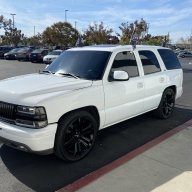
Are those RGB? I installed some in my bagged Silverado grill that are hooked to a controller along with my demon eyes that uses an app on my phone so I can CM them all to the paint color -it’s in the red spectrum which of course is illegal to drive with. I run them in a different color when I’m on the road.Lights in grille
View attachment 361128
Oh nice yeah I was trying to post a video of them flashing all the colors look pretty cool but it’s just something my kids talked me into doing and I think I like itAre those RGB? I installed some in my bagged Silverado grill that are hooked to a controller along with my demon eyes that uses an app on my phone so I can CM them all to the paint color -it’s in the red spectrum which of course is illegal to drive with. I run them in a different color when I’m on the road.
You have to host the video on YouTube or something similar and then post a link if you want to share video here.Oh nice yeah I was trying to post a video of them flashing all the colors look pretty cool but it’s just something my kids talked me into doing and I think I like it

I attached GM Service manual extract, check out #12.I was under the impression that it had to be done when the crankshaft sensor was replaced. First time I hear it needs to done when the harmonic balancer is replaced. I do have the Tech 2 to get it done
I saw where the SM states to perform the relearn but it doesn’t explain why, and even though you say it can potentially throw off misfire detection, I have yet to read anything that actually explains how it can just by R&R’ing the balancer. Why would that cause a slight fluctuation in RPM between cylinders?I attached GM Service manual extract, check out #12.
Basically, the crankshaft does not have a keyway, so balancer can be installed in any position, and since these parts are balanced separately, it can potentially throw off misfire detection due to slight fluctuation in RPM between cylinders.

My guess would be that the imbalance might cause slow down/speed up at some crankshaft positions. It's been a while since physics classes, I have a feeling it might happen, but I can't explain the physics behind it.I saw where the SM states to perform the relearn but it doesn’t explain why, and even though you say it can potentially throw off misfire detection, I have yet to read anything that actually explains how it can just by R&R’ing the balancer. Why would that cause a slight fluctuation in RPM between cylinders?
Lol. I read that too. It still doesn’t explain why, since they state the balancer is an individually balanced item, and it’s being installed right back in the same position fore and aft. I guess if it was a different balancer or say an under drive one that’s a different size but they say to do it even if you’re putting the same one back on. I know I should just probably say “fine, they said to do it so I will” but my mind wants to understand why. Is it just me?My guess would be that the imbalance might cause slow down/speed up at some crankshaft positions. It's been a while since physics classes, I have a feeling it might happen, but I can't explain the physics behind it.
This is what GM has to say on this topic:
DTC P0315
Circuit Description
The crankshaft position (CKP) system variation learn feature is used to calculate reference period errors caused by slight tolerance variations in the crankshaft, and the CKP sensor. The calculated error allows the powertrain control module (PCM) to accurately compensate for reference period variations. This enhances the ability of the PCM to detect misfire events over a wide range of engine speed and load. The PCM stores the Crankshaft Position System Variation values after a learn procedure has been performed. If the actual crankshaft position variation is not within the Crankshaft Position System Variation compensating values stored in the PCM, DTC P0300 may set. If the CKP system variation values are not stored in the PCM memory, DTC P0315 sets.
The CKP system variation learn procedure is also required when the following service procedures have been performed, regardless of whether or not DTC P0315 is set:
• An engine replacement
• A PCM replacement
• A harmonic balancer replacement
• A crankshaft replacement
• A CKP sensor replacement
• Any engine repairs which disturb the crankshaft to CKP sensor relationship.
I always though American manufacturers switched to metric ages ago. That should be M6 nut. Any local HD definitely has them in stock.Note to self..... when cleaning the throttle body DON'T drop the nut that bolts it on...... you know that one thats hidden under the throttle body and blocked by the alternator. But if you do, it's a #12-24 coarse thread. GM dosen't carry it anymore, none of the chain auto stores have it and the box hardware stores only go to a #10. Amzon can have it to you in about 3 days though.
Back to your regularly productive reads.....
What area of San Francisco do you hang? I grew up in Marin.I always though American manufacturers switched to metric ages ago. That should be M6 nut. Any local HD definitely has them in stock