Oil analysis 0-20 Wolf after 10,000 km or 6,250 miles

Disclaimer: Links on this page pointing to Amazon, eBay and other sites may include affiliate code. If you click them and make a purchase, we may earn a small commission.

jfoj

Full Access Member
Joined
Aug 9, 2012
Posts
1,212
Reaction score
1,067
Vladimir,..

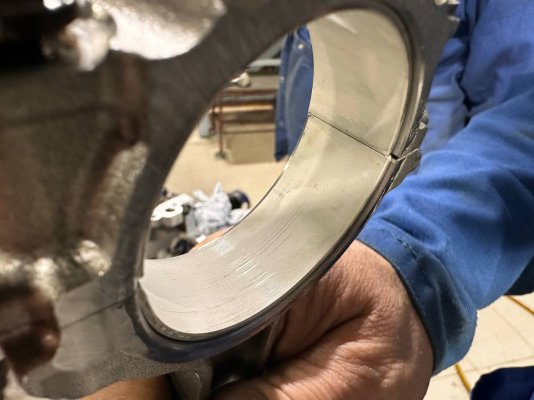
They are not low quality liners or what we refer to as rod bearings or engine bearings. The current bearings are bi-metal which is effectively an aluminum bearing which is not very tolerable to any lack of lubrication. It will start to peel like an onion once there's metal and metal contact.

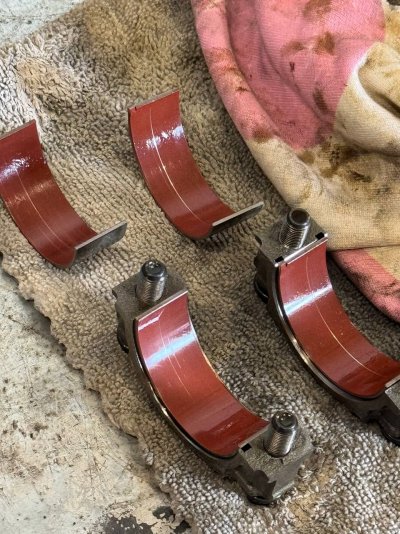
The bearings you have been putting in your engine that GM used to supply are coated bearings, either a Teflon coating or some sort of thin film coating that can tolerate short duration lack of proper lubrication or loss of oil wedge and it will protect the aluminum from shedding like an onion.

I believe in the L87 GM is still using coated main bearings, or at least the last few that I have seen torn down. The coated bearings are a reddish color rather than an aluminum color.

If these engines have fully coated main and rod bearings they're far less likely to have a failure with a 0W-20 oil. But why not just jump to the solution of a higher viscosity oil like 0W-40. For those that don't have the time or money to disassemble a fully operational engine to install coated rod bearings, switching to 0W-40 is the best and quickest thing they can do to add the extra margin of protection.

Funny you're blaming the bearings went at the end of the day it's really the oil that's the problem. The replacement bearings you're putting in your engine are buying you a safety margin for the crappy 0W-20 oil that shouldn't be put in any engine in a vehicle that weighs more than 4,000 lb iMHO.

 
OP
OP
Vladimir2306

Vladimir2306

Full Access Member
Joined
May 18, 2023
Posts
1,048
Reaction score
1,235
Vladimir,..

They are not low quality liners or what we refer to as rod bearings or engine bearings. The current bearings are bi-metal which is effectively an aluminum bearing which is not very tolerable to any lack of lubrication. It will start to peel like an onion once there's metal and metal contact.

The bearings you have been putting in your engine that GM used to supply are coated bearings, either a Teflon coating or some sort of thin film coating that can tolerate short duration lack of proper lubrication or loss of oil wedge and it will protect the aluminum from shedding like an onion.

I believe in the L87 GM is still using coated main bearings, or at least the last few that I have seen torn down. The coated bearings are a reddish color rather than an aluminum color.

If these engines have fully coated main and rod bearings they're far less likely to have a failure with a 0W-20 oil. But why not just jump to the solution of a higher viscosity oil like 0W-40. For those that don't have the time or money to disassemble a fully operational engine to install coated rod bearings, switching to 0W-40 is the best and quickest thing they can do to add the extra margin of protection.

Funny you're blaming the bearings went at the end of the day it's really the oil that's the problem. The replacement bearings you're putting in your engine are buying you a safety margin for the crappy 0W-20 oil that shouldn't be put in any engine in a vehicle that weighs more than 4,000 lb iMHO.
You either read selectively, or you see only what you want. I don't blame the bearings exclusively. The fault lies with the low, very low quality of the engine assembly.

I have already provided a photo of the engine with a production date of 207th day of 2024. And according to the mechanics, it is assembled even worse than the one they gave me, with a production date of May 2024.
And no matter what oil you pour, even 75w90 transmission oil, it will not help the engine. Because it looks like it was assembled in an old garage by a clumsy craftsman.
 

Attachments

  • 2025-08-13 14-46-15_1755085701028.JPG
    2025-08-13 14-46-15_1755085701028.JPG
    154.3 KB · Views: 35
  • 2025-08-13 14-46-15_1755085718660.JPG
    2025-08-13 14-46-15_1755085718660.JPG
    113.6 KB · Views: 31
  • 2025-08-13 14-46-15.JPG
    2025-08-13 14-46-15.JPG
    101.3 KB · Views: 30
OP
OP
Vladimir2306

Vladimir2306

Full Access Member
Joined
May 18, 2023
Posts
1,048
Reaction score
1,235
Vladimir,..

They are not low quality liners or what we refer to as rod bearings or engine bearings. The current bearings are bi-metal which is effectively an aluminum bearing which is not very tolerable to any lack of lubrication. It will start to peel like an onion once there's metal and metal contact.

The bearings you have been putting in your engine that GM used to supply are coated bearings, either a Teflon coating or some sort of thin film coating that can tolerate short duration lack of proper lubrication or loss of oil wedge and it will protect the aluminum from shedding like an onion.

I believe in the L87 GM is still using coated main bearings, or at least the last few that I have seen torn down. The coated bearings are a reddish color rather than an aluminum color.

If these engines have fully coated main and rod bearings they're far less likely to have a failure with a 0W-20 oil. But why not just jump to the solution of a higher viscosity oil like 0W-40. For those that don't have the time or money to disassemble a fully operational engine to install coated rod bearings, switching to 0W-40 is the best and quickest thing they can do to add the extra margin of protection.

Funny you're blaming the bearings went at the end of the day it's really the oil that's the problem. The replacement bearings you're putting in your engine are buying you a safety margin for the crappy 0W-20 oil that shouldn't be put in any engine in a vehicle that weighs more than 4,000 lb iMHO.
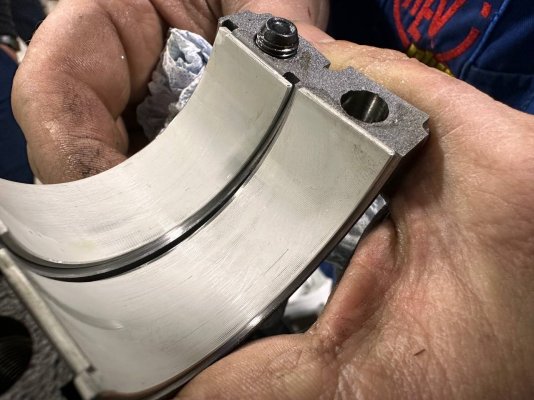
The liners here are like the first wear indicator, which takes the first blow. Moreover, simply replacing the liners, as practice now shows, also does not lead to anything, because if the shavings have already appeared in the oil channels, then even with a replacement for red liners, this shavings will behave as an abrasive, sharpening the red liners too.
If metal dust has already appeared in the oil, then it is already necessary to conduct a deep revision of the engine. Change the oil pump, because it will already begin to wear out, change the oil line tubes, and the oil radiator, because it is impossible to wash out from there. Here is an example of a person on red liners after 8,750 miles, and an oil change every 4,400 miles. and oil 0-40.
Do you see the wear? And this is after a short run. Do you know what will happen next? I'll show you in the next comment.
 

Attachments

  • photo_5251457844715320925_y.jpg
    photo_5251457844715320925_y.jpg
    255.9 KB · Views: 22
OP
OP
Vladimir2306

Vladimir2306

Full Access Member
Joined
May 18, 2023
Posts
1,048
Reaction score
1,235
Vladimir,..

They are not low quality liners or what we refer to as rod bearings or engine bearings. The current bearings are bi-metal which is effectively an aluminum bearing which is not very tolerable to any lack of lubrication. It will start to peel like an onion once there's metal and metal contact.

The bearings you have been putting in your engine that GM used to supply are coated bearings, either a Teflon coating or some sort of thin film coating that can tolerate short duration lack of proper lubrication or loss of oil wedge and it will protect the aluminum from shedding like an onion.

I believe in the L87 GM is still using coated main bearings, or at least the last few that I have seen torn down. The coated bearings are a reddish color rather than an aluminum color.

If these engines have fully coated main and rod bearings they're far less likely to have a failure with a 0W-20 oil. But why not just jump to the solution of a higher viscosity oil like 0W-40. For those that don't have the time or money to disassemble a fully operational engine to install coated rod bearings, switching to 0W-40 is the best and quickest thing they can do to add the extra margin of protection.

Funny you're blaming the bearings went at the end of the day it's really the oil that's the problem. The replacement bearings you're putting in your engine are buying you a safety margin for the crappy 0W-20 oil that shouldn't be put in any engine in a vehicle that weighs more than 4,000 lb iMHO.
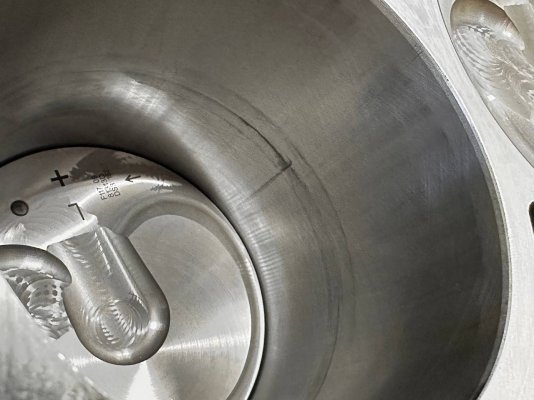
Here's another example, red liners, and more mileage than in the previous example. What we have here is also a simple replacement of liners, and faith in only their replacement... as a result, the red liners were eaten to zero, the crankshaft is blue. I repeat once again, stop writing nonsense about 0-20 oil.
You have been running around this forum for a long time with different ideas, conjectures, sometimes 10th gear is to blame, sometimes the oil is contaminated with fuel, sometimes the oil is too thin... no... absolutely not... and 10th gears are already running on many cars, 0-20 oil has been poured into various cars that drive around the world for 10 years now.
And they don't experience any problems with it. I already wrote on this forum that there is no research that says that 0-20 oil reduces engine life. Yes, there is fuel efficiency, but nothing about life.
There is only one reason for L87 failure. One is the only one, and there is no other.

This is disgustingly low quality of engine assembly. During assembly, GM itself violates its own parameters for gaps and tolerances. That's it, there are no more reasons. Chips, wear, metal in oil, these are all consequences of this very reason. Oil, bearings, crankshaft, these are all consequences... the reason is disgusting engine assembly. And I repeat, changing oil more often, pouring 5-30, 0-40 is generally pointless.
No oil, even the thickest one, will hold up when your bearings are worn out and the crankshaft is already scratched.
 
OP
OP
Vladimir2306

Vladimir2306

Full Access Member
Joined
May 18, 2023
Posts
1,048
Reaction score
1,235
Let me get this straight, you’re saying early oil changes will harm the engine? Don’t tell the dealership I bought from, that has free oil changes for life, they recommend significantly more frequently than 7500 miles and by the way it’s their nickel.
Back to my earlier statement, your posts are puzzling. I think there is more to the story.
I said I had found only one study from Ford that said so. I said there was no study that showed that quick oil changes increased engine life.
 

jfoj

Full Access Member
Joined
Aug 9, 2012
Posts
1,212
Reaction score
1,067
Vladimir,

You do not understand the loading situation the rod bearings are under in the 6.2l. The oil film needs to be able to handle the surface loading and if it can't, then metal to metal contact can occur. Severe loading overwhelms the lower viscosity oil film and breaks down the oil wedge then you have boundary and/or mixed layer lubrication, this is when things fail.

Sure debris can cause scaring but bearings or liners as you call them should have some embeddability, the older tri metal bearings were better than the newer stupid bi metal aluminum hearings. But the scaring you are showing is really a no issue, sure it is better to have a cleaner engine to start with, but as long as the oil film is supporting the load properly you should have have catastrophic failure.

Your guys are right to put the coated rod bearings in these engines if you plan on running 0W20, it will help them last longer but 0W40 is really what these engines need.
 
OP
OP
Vladimir2306

Vladimir2306

Full Access Member
Joined
May 18, 2023
Posts
1,048
Reaction score
1,235
Vladimir,

You do not understand the loading situation the rod bearings are under in the 6.2l. The oil film needs to be able to handle the surface loading and if it can't, then metal to metal contact can occur. Severe loading overwhelms the lower viscosity oil film and breaks down the oil wedge then you have boundary and/or mixed layer lubrication, this is when things fail.

Sure debris can cause scaring but bearings or liners as you call them should have some embeddability, the older tri metal bearings were better than the newer stupid bi metal aluminum hearings. But the scaring you are showing is really a no issue, sure it is better to have a cleaner engine to start with, but as long as the oil film is supporting the load properly you should have have catastrophic failure.

Your guys are right to put the coated rod bearings in these engines if you plan on running 0W20, it will help them last longer but 0W40 is really what these engines need.
You're writing nonsense again. Normally, 0-20 oil copes with the oil film, as it did perfectly on the 6.2 engine on K2XX cars, for many years. And nothing was required to pour 0-40 there.
 

iamlegion

Full Access Member
Joined
Jan 5, 2024
Posts
130
Reaction score
90
Try this link below if you are interested. It may take some feedback to sort out the logistics - I tried to include some instructions, initial data etc. I locked down a few fields and tabs to prevent it from devolving into disjointed data.

If we get some data added I'll try and add a data rollup sheet where people can just pick an oil or a given make/model and see average data. I don't use Google Sheets much so it might take me a minute to figure that out.

Crowd Sourced Oil Analysis
 

BacDoc

Full Access Member
Joined
Apr 11, 2024
Posts
729
Reaction score
911
Location
Vero Beach Florida
Vladimir, you make great logical points for the 0-20W but the points are based on the proper machining and assembly of the engine itself. This is where the dilemma comes, apparently your experience and others have shown that the machining tolerances are not up to standard and assembly standards are poor or quality control is lacking.

If the algorithm was A(proper parts and assembly) + B(0-20W oil) = C(no failure) Yes we would all agree and your logic is correct.

However outcome C is highly dependent on variable A being constant and Im pretty sure nobody on this forum would describe GM as being guilty of that lol .

If the engine passes inspection
GM is not only telling us that 0-40W is better but they are actually putting it in, changing the cap and inserting a owner manual change to this effect. Im not sure what they would even say if you said “Na, I want to stick with 0-20W”. I would imagine that they would void any existing warranty and not give the extended warranty. When I finally get my letter and get my 2024 inspected I will ask just to see what they say and let you know.

As others mentioned GM has to appear surprised that they didn’t specify the right viscosity from the beginning but that’s a horse that has been beaten to death ad nauseum.
 
OP
OP
Vladimir2306

Vladimir2306

Full Access Member
Joined
May 18, 2023
Posts
1,048
Reaction score
1,235
Vladimir, you make great logical points for the 0-20W but the points are based on the proper machining and assembly of the engine itself. This is where the dilemma comes, apparently your experience and others have shown that the machining tolerances are not up to standard and assembly standards are poor or quality control is lacking.

If the algorithm was A(proper parts and assembly) + B(0-20W oil) = C(no failure) Yes we would all agree and your logic is correct.

However outcome C is highly dependent on variable A being constant and Im pretty sure nobody on this forum would describe GM as being guilty of that lol .

If the engine passes inspection
GM is not only telling us that 0-40W is better but they are actually putting it in, changing the cap and inserting a owner manual change to this effect. Im not sure what they would even say if you said “Na, I want to stick with 0-20W”. I would imagine that they would void any existing warranty and not give the extended warranty. When I finally get my letter and get my 2024 inspected I will ask just to see what they say and let you know.

As others mentioned GM has to appear surprised that they didn’t specify the right viscosity from the beginning but that’s a horse that has been beaten to death ad nauseum.
Yes and no, it is clear that you cannot violate GM's instructions. I am saying that if you have had your filler cap changed and GM said to pour 0-40, then pour it, but if GM indicated 0-20 in your manual, then you don't need to invent anything and prove that 5-30 or 0-40 oil will be better. It won't. If the engine is poorly assembled, even 0-60 oil won't help, so let GM have fewer reasons to refuse repairs, when the owner fills in oil other than the recommended one. That's my whole position.
Telling on the forums that 0-20 oil is the cause of engine problems is nonsense. Oil is not the cause of engine failure. Therefore, pour in what GM recommends and do not bother your head.
 

mkcotton

TYF Newbie
Joined
May 1, 2024
Posts
19
Reaction score
29
Location
Virginia
Yes and no, it is clear that you cannot violate GM's instructions. I am saying that if you have had your filler cap changed and GM said to pour 0-40, then pour it, but if GM indicated 0-20 in your manual, then you don't need to invent anything and prove that 5-30 or 0-40 oil will be better. It won't. If the engine is poorly assembled, even 0-60 oil won't help, so let GM have fewer reasons to refuse repairs, when the owner fills in oil other than the recommended one. That's my whole position.
Telling on the forums that 0-20 oil is the cause of engine problems is nonsense. Oil is not the cause of engine failure. Therefore, pour in what GM recommends and do not bother your head.
I guess we should also follow GM's OLM and oil change intervals!? 0W-20 may not be the cause of "this" engine failure, but that is bold statement seeing how "oil" is the life blood all the engines I've ever worked on. If you can change the oil more frequently than GM's stated interval, I don't see a problem with someone opting for better oil (weight change), especially as engines increase in mileage. Additionally, the premise of your argument is that the manufacturers never make mistakes!? Most of us don't have your level of faith and strident belief. Do Firestone tires on Ford Explorers make you think twice?! And many more, they are called "recalls".
 
OP
OP
Vladimir2306

Vladimir2306

Full Access Member
Joined
May 18, 2023
Posts
1,048
Reaction score
1,235
I guess we should also follow GM's OLM and oil change intervals!? 0W-20 may not be the cause of "this" engine failure, but that is bold statement seeing how "oil" is the life blood all the engines I've ever worked on. If you can change the oil more frequently than GM's stated interval, I don't see a problem with someone opting for better oil (weight change), especially as engines increase in mileage. Additionally, the premise of your argument is that the manufacturers never make mistakes!? Most of us don't have your level of faith and strident belief. Do Firestone tires on Ford Explorers make you think twice?! And many more, they are called "recalls".

My oil analysis shows that there is nothing wrong with oil that is changed according to OLM. Oil reaches the end of its life perfectly. Is it possible to change oil earlier? Yes, no problem at all, but there is no point in it, because oil at 6250 miles still retains its properties.
I have no idea what happened with the Ford Explorer, but it is a known fact that manufacturers make mistakes, and the current situation with the L87 is just a clear example of such a mistake. But this does not mean that you need to pour something thick in hysterics and scold the oil. The reason is something else, not in the oil. Everyone is looking for it. I do not rule out that it was a design error. And changing the oil to thick, or changing it more often, will not affect this problem with the 6.2 engine.
 

swathdiver

Full Access Member
Joined
May 18, 2017
Posts
21,299
Reaction score
30,254
Location
Treasure Coast, Florida
My oil analysis shows that there is nothing wrong with oil that is changed according to OLM. Oil reaches the end of its life perfectly. Is it possible to change oil earlier? Yes, no problem at all, but there is no point in it, because oil at 6250 miles still retains its properties.
I have no idea what happened with the Ford Explorer, but it is a known fact that manufacturers make mistakes, and the current situation with the L87 is just a clear example of such a mistake. But this does not mean that you need to pour something thick in hysterics and scold the oil. The reason is something else, not in the oil. Everyone is looking for it. I do not rule out that it was a design error. And changing the oil to thick, or changing it more often, will not affect this problem with the 6.2 engine.
0W20 is not a good weight oil for a 420 horsepower V8. 5W30 has a higher viscosity rating when it's wore out than OW20 oil does new. 0W20 is not up to the task of providing good lubrication to the bearings under high loads for a long time.

It's not the brand of oil that's the problem, Wolf is good oil. It's that weight oil for that engine.
 
OP
OP
Vladimir2306

Vladimir2306

Full Access Member
Joined
May 18, 2023
Posts
1,048
Reaction score
1,235
0W20 is not a good weight oil for a 420 horsepower V8. 5W30 has a higher viscosity rating when it's wore out than OW20 oil does new. 0W20 is not up to the task of providing good lubrication to the bearings under high loads for a long time.

It's not the brand of oil that's the problem, Wolf is good oil. It's that weight oil for that engine.
What is this opinion proven by? Tests? Research? Or personal opinion? If the latter, then I'm sorry, but I don't really believe it. Because, I'll repeat myself more than once, the 6.2 engine of the 4th generation GM runs great on 0-20 oil, many hundreds of thousands of miles.
 

swathdiver

Full Access Member
Joined
May 18, 2017
Posts
21,299
Reaction score
30,254
Location
Treasure Coast, Florida
What is this opinion proven by? Tests? Research? Or personal opinion? If the latter, then I'm sorry, but I don't really believe it. Because, I'll repeat myself more than once, the 6.2 engine of the 4th generation GM runs great on 0-20 oil, many hundreds of thousands of miles.

I don't know of any L86 or L87 engines that have achieved 200K miles yet, do you? Let alone one that frequently hauls maximum payloads, tows large loads and or makes regular passes down the quarter mile.

0W20 is so thin, that under heavy loads, enough oil gets squeezed out of the bearings to cause damage to them over time. A 5.3 engine based on same architecture as L87 will last longer as it will have less shear because it makes less horsepower.
 

jfoj

Full Access Member
Joined
Aug 9, 2012
Posts
1,212
Reaction score
1,067
Run the load calculations and it will be rather evident that 0W20 is inadequate. It will work for a while, but the Oil Analysis will fool you because the failure mode tends to not be slow, but catastrophic. Vladimir you should understand this first hand. Only a small handful of the 6.2l had survived the 70-80 MPH failure to then fail shortly after. A small handful of these did have the P0016 which pretty much meant the cam bearings were failing and the camshaft was tight and the variable cam timing would not function properly because the cam was tight and could not be advanced by the oil pressure control circuit for the cam.

The the problem is the failures occur between oil changes and usually on a 2-6 hour highway trips, so you will almost never detect a failure on the horizon. Even GM's Pico Test on the recall group is only detecting a very small percentage of "Fails".

A word to the wise, do not listen to the manufacturer for OCI and oil spec. GM has already "Approved" 0W40 for the recalled engines that "Pass" the Pico test, but they will not "Approve" 0W40 for the all the engines that were EPA certified on 0W20 because this would open up a major can of worms for lawsuits and GM has decided it is cheaper to gamble and not fully recommend the oil viscosity this is really needed for the bearing loading that is generated on the 6000lb+ trucks that operate consistently in the 1700 RPM range.

If you tow with these vehicles you are really gambling running 0W20 oil.
 
Last edited:
OP
OP
Vladimir2306

Vladimir2306

Full Access Member
Joined
May 18, 2023
Posts
1,048
Reaction score
1,235
I don't know of any L86 or L87 engines that have achieved 200K miles yet, do you? Let alone one that frequently hauls maximum payloads, tows large loads and or makes regular passes down the quarter mile.

0W20 is so thin, that under heavy loads, enough oil gets squeezed out of the bearings to cause damage to them over time. A 5.3 engine based on same architecture as L87 will last longer as it will have less shear because it makes less horsepower.
Why 200 thousand miles right away? 100-150 thousand miles without any problems. Mileage and L87 even here on the Forum already approach 100 thousand miles for some. And yes, we have a person in an Escalade with an L86 engine, with a mileage of 360 thousand km, who drove 0-20 on oil, and in active driving mode.
 
OP
OP
Vladimir2306

Vladimir2306

Full Access Member
Joined
May 18, 2023
Posts
1,048
Reaction score
1,235
Run the load calculations and it will be rather evident that 0W20 is inadequate. It will work for a while, but the Oil Analysis will fool you because the failure mode tends to not be slow, but catastrophic. Vladimir you should understand this first hand. Only a small handful of the 6.2l had survived the 70-80 MPH failure for to then fail shortly after. A small handful of these did have the P0016 which pretty much meant the cam bearings were failing and the camshaft was tight and the variable cam timing would not function properly because the cam was tight and could not be advanced by the oil pressure control circuit for the cam.

The the problem is the failures occur between oil changes and usually on a 2-6 hour highway trips, so you will almost never detect a failure on the horizon. Even GM's Pico Test on the recall group is only detecting a very small percentage of "Fails".

A word to the wise, do not listen to the manufacturer for OCI and oil spec. GM has already "Approved" 0W40 for the recalled engines that "Pass" the Pico test, but they will not "Approve" 0W40 for the all the engines that were EPA certified on 0W20 because this would open up a major can of worms for lawsuits and GM has decided it is cheaper to gamble and not fully recommend the oil viscosity this is really needed for the bearing loading that is generated on the 6000lb+ trucks that operate consistently in the 1700 RPM range.

If you tow with these vehicles you are really gambling running 0W20 oil.
Oh yeah, the oil analysis is deceiving me, and the know-it-all on the forum, who has no confirmation of his words, is telling the pure truth:) well, stop talking nonsense already.
GM hasn't admitted anything, it made statements that something was apologised for from 01.07.2024, in fact, nothing has changed. All these jokes with Pico tests, and replacement with 0-40 oil are just agony, just an image of activity, so that people don't give in to hysteria, like GM has everything under control. But in fact, I will say what will happen, the engines will simply continue to fail, and that's it, GM will quietly change them. If they admitted that the oil was to blame, then after replacing the engine or repairing it, they would pour 0-40. But no....they just stuck a band-aid on the owners in the form of 0-40 oil, so that they calmed down....
 

mkcotton

TYF Newbie
Joined
May 1, 2024
Posts
19
Reaction score
29
Location
Virginia
My oil analysis shows that there is nothing wrong with oil that is changed according to OLM. Oil reaches the end of its life perfectly. Is it possible to change oil earlier? Yes, no problem at all, but there is no point in it, because oil at 6250 miles still retains its properties.
I have no idea what happened with the Ford Explorer, but it is a known fact that manufacturers make mistakes, and the current situation with the L87 is just a clear example of such a mistake. But this does not mean that you need to pour something thick in hysterics and scold the oil. The reason is something else, not in the oil. Everyone is looking for it. I do not rule out that it was a design error. And changing the oil to thick, or changing it more often, will not affect this problem with the 6.2 engine.
Not questioning your situation or perspective, your truths belong to you, totally respect them. People generally make decisions that make them feel more confident and or comfortable. I have put 0W-40 in both my 2023/2024 L87 since the first oil change (@ around 900 miles), and as of last summer, I've cut every oil filter open to inspect for metal... this gives me confidence and comfort. There are many published opinions on whether 0W-20 is good enough and they go both ways with a lean towards 0W-40 being better. I made the decision that makes me feel a bit more confident and comfortable. I hope you can respect that, because your evidence is not indisputable.
 

Forum statistics

Threads
137,809
Posts
1,992,717
Members
102,794
Latest member
Drewphil
Back
Top