What did you do to your NNBS GMT900 Tahoe/Yukon Today?

Disclaimer: Links on this page pointing to Amazon, eBay and other sites may include affiliate code. If you click them and make a purchase, we may earn a small commission.

alpha_omega

Full Access Member
Joined
Mar 15, 2017
Posts
986
Reaction score
1,737
Location
Michigan
Got a volt meter? Start checking for voltage starting at the window motor, then the switch, then wherever the switch gets it's power from?
x2 on the volt meter. It’s hard to diagnose from here without knowing what readings your getting from the aforementioned locations (you could also check the Tech2 and see if you’re getting any faults for those items).

What was the update on the fill cap?
*Check
X2, and can we see a pic?

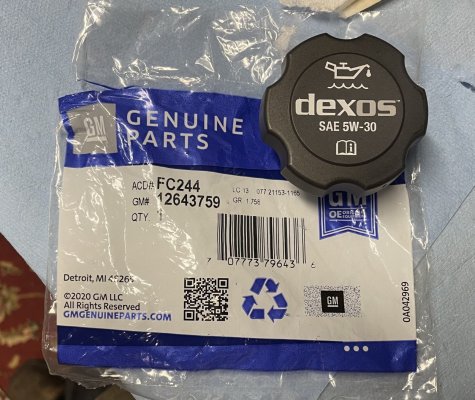
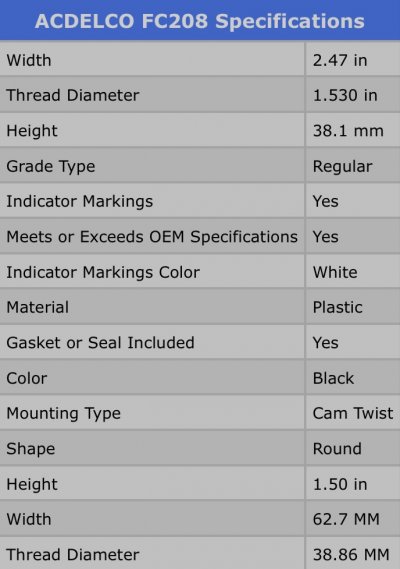
1st Design
(Labeled SAE 5W30)
- ACDelco FC208

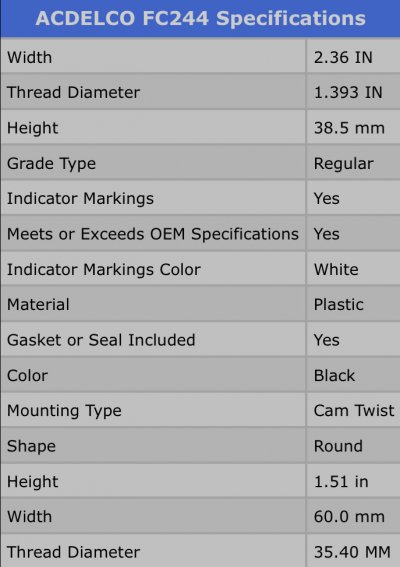
2nd Design
(Labeled dexos SAE 5W-30)
- ACDelco FC244 (GM 12643759)

Update was a slightly different design, much cleaner feeling overall than the original version. Seems to seat nicer, whereas the original version sometimes felt like you were going to unscrew the entire fill tube when you tried removing the cap. Plus an updated o-ring and a change to the text/logo as mentioned above.


E9B36421-B9E2-47EC-A8DD-5F0532E28B6A.jpeg

EBF1D654-305B-44A7-A9A9-2CE06122D27B.jpegB2C5B308-C13A-4C00-AC08-A37CAC7D9976.jpeg
 
Last edited:

alpha_omega

Full Access Member
Joined
Mar 15, 2017
Posts
986
Reaction score
1,737
Location
Michigan
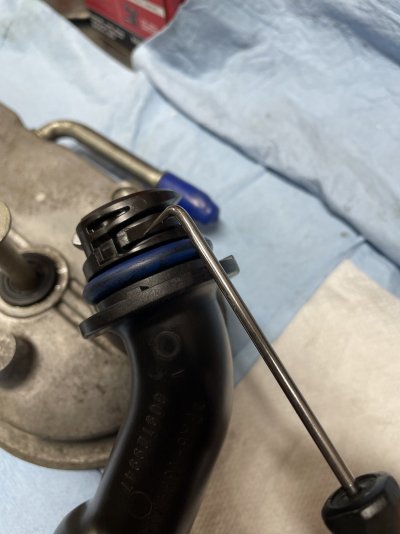
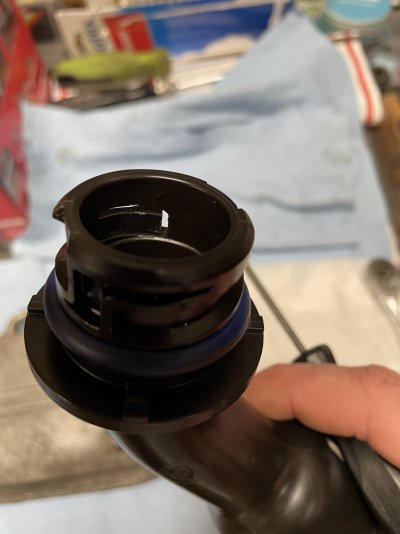
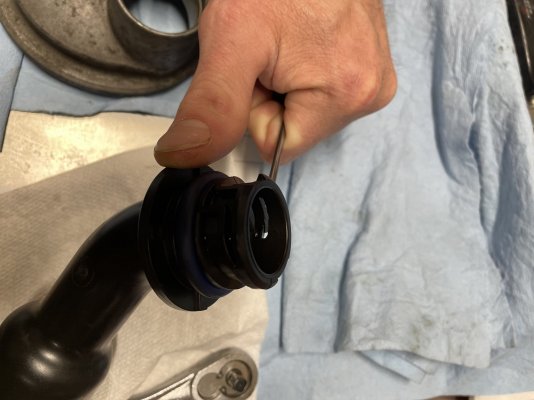
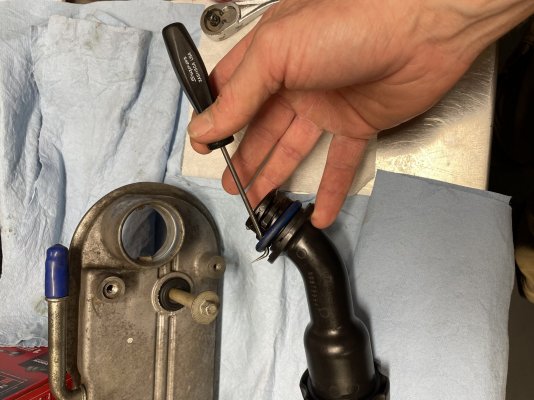
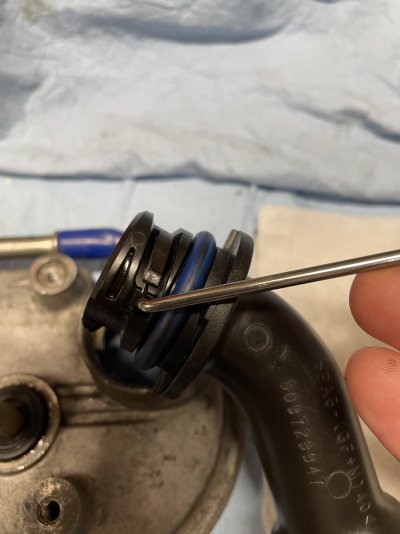
For those who have not done an engine oil filler tube replacement or the engine oil filler tube gasket/o-ring, here are some photos showing why you need to remove it only AFTER removing the valve cover, otherwise you will damage the plastic cam portion of the tube and potentially mar or mangle up the gasket.

Also, here is a quick way to remove the o-rings (any o-ring for that matter) without damaging it or the part you are removing it from. The key is to get under it from above and then gently apply slight pressure upwards while rolling your pick or small flathead around the ring. Leaning your tool on the lip of the part it’s being removed from ensures your don’t slip and gouge the part or ding/scratch/tear the o-ring. Unless you no longer need it, in which case a pair of electronic snips works just fine.

*note that I put the gasket/o-ring back in place after removing the filler tube from the valve cover. In order to remove the oil filler tube you must first remove the valve cover, then the o-ring, then twist CCW to line up the cam release slot and in order to remove the tube. Installation is the reverse procedure.

7B0D7D57-0736-470E-B34D-53DA0657ADF4.jpegF46FE0A4-405D-4B7A-AE40-E5921C4E58EF.jpegA1E0051B-6525-4224-98ED-D6E5141C9267.jpeg86955BA5-F44B-4D97-9068-67D7F9A9A21B.jpeg
 

Attachments

  • 99F0AC7A-3171-4A68-8D94-8A56960CCDA3.jpeg
    99F0AC7A-3171-4A68-8D94-8A56960CCDA3.jpeg
    183.5 KB · Views: 24
Joined
Apr 11, 2018
Posts
7,124
Reaction score
14,375
Location
St. Louis
x2 on the volt meter. It’s hard to diagnose from here without knowing what readings your getting from the aforementioned locations (you could also check the Tech2 and see if you’re getting any faults for those items).

What was the update on the fill cap?
*Check


1st Design
(Labeled SAE 5W30)
- ACDelco FC208

2nd Design
(Labeled dexos SAE 5W-30)
- ACDelco FC244 (GM 12643759)

Update was a slightly different design, much cleaner feeling overall than the original version. Seems to seat nicer, whereas the original version sometimes felt like you were going to unscrew the entire fill tube when you tried removing the cap. Plus an updated o-ring and a change to the text/logo as mentioned above.


View attachment 347503

View attachment 347508View attachment 347509
Was this for your '02, because my 2012 cap looks like this updated version?
 

89Suburban

Bull in the china shop
Space X Supporting Member
Joined
Jan 10, 2013
Posts
17,826
Reaction score
50,782
Location
SE PA
For those who have not done an engine oil filler tube replacement or the engine oil filler tube gasket/o-ring, here are some photos showing why you need to remove it only AFTER removing the valve cover, otherwise you will damage the plastic cam portion of the tube and potentially mar or mangle up the gasket.

Also, here is a quick way to remove the o-rings (any o-ring for that matter) without damaging it or the part you are removing it from. The key is to get under it from above and then gently apply slight pressure upwards while rolling your pick or small flathead around the ring. Leaning your tool on the lip of the part it’s being removed from ensures your don’t slip and gouge the part or ding/scratch/tear the o-ring. Unless you no longer need it, in which case a pair of electronic snips works just fine.

*note that I put the gasket/o-ring back in place after removing the filler tube from the valve cover. In order to remove the oil filler tube you must first remove the valve cover, then the o-ring, then twist CCW to line up the cam release slot and in order to remove the tube. Installation is the reverse procedure.

View attachment 347510View attachment 347512View attachment 347513View attachment 347514


Look at the difference in our locking tabs on the valve covers. You have 2 at 3 and 9 o'clock and I only have one at 6 o'clock. Mine sucks trying to find the right filler tube to fit snug.

IMG_3065.JPG
IMG_3066.JPG
 

89Suburban

Bull in the china shop
Space X Supporting Member
Joined
Jan 10, 2013
Posts
17,826
Reaction score
50,782
Location
SE PA
Got a volt meter? Start checking for voltage starting at the window motor, then the switch, then wherever the switch gets it's power from?
Yes this is next. Anybody have a wire diagram so I know what wires and circuits to trace and test?
 

Rocket Man

Mark
Supporting Member
Joined
Dec 25, 2014
Posts
26,678
Reaction score
52,943
Location
Oregon
For those who have not done an engine oil filler tube replacement or the engine oil filler tube gasket/o-ring, here are some photos showing why you need to remove it only AFTER removing the valve cover, otherwise you will damage the plastic cam portion of the tube and potentially mar or mangle up the gasket.

Also, here is a quick way to remove the o-rings (any o-ring for that matter) without damaging it or the part you are removing it from. The key is to get under it from above and then gently apply slight pressure upwards while rolling your pick or small flathead around the ring. Leaning your tool on the lip of the part it’s being removed from ensures your don’t slip and gouge the part or ding/scratch/tear the o-ring. Unless you no longer need it, in which case a pair of electronic snips works just fine.

*note that I put the gasket/o-ring back in place after removing the filler tube from the valve cover. In order to remove the oil filler tube you must first remove the valve cover, then the o-ring, then twist CCW to line up the cam release slot and in order to remove the tube. Installation is the reverse procedure.

View attachment 347510View attachment 347512View attachment 347513View attachment 347514
Interesting. I have removed mine from above by pushing down hard to compress the o-ring and then twisting counterclockwise until it releases. But that’s on my 02. I notice the SM states to replace it with a new one if you remove it., nothing about what you’re saying. I notice it says the same for my 08. They designed it as a one time use part I guess.
 

Just Fishing

Can't fix stupid
Joined
Aug 30, 2020
Posts
4,492
Reaction score
10,096
Location
Utah
Look at the difference in our locking tabs on the valve covers. You have 2 at 3 and 9 o'clock and I only have one at 6 o'clock. Mine sucks trying to find the right filler tube to fit snug.

View attachment 347530View attachment 347531

I should have gotten some pictures of what i did.
But a combination of painting the valve covers, and making sure i coated down in the hole a good 3/4 of an inch, and adding an extra o-ring made my fill tube extra tight.

It was something that just sorta happened when i put it together.
But i ordered a few multi size quality oring kits off of amazon since i hate never having orings on hand when i need them.

One of the larger sized, yet thinner orings from one of the kits was perfect to tighten up the fitment.

If you still need it, i can grab the oring kit i used.
 

Just Fishing

Can't fix stupid
Joined
Aug 30, 2020
Posts
4,492
Reaction score
10,096
Location
Utah
Interesting. I have removed mine from above by pushing down hard to compress the o-ring and then twisting counterclockwise until it releases. But that’s on my 02. I notice the SM states to replace it with a new one if you remove it., nothing about what you’re saying. I notice it says the same for my 08. They designed it as a one time use part I guess.

When i originally removed mine back in like December, i was greeted by the breaking tab.

The replacement i received was not as tight.
Second time around i took my time and used a pick to remove it.

Luckily i still had my old one, it took some careful precision to find and lift the tab.
Not totally straight forward unless you know where that locking tab sits.

Or maybe the lighting just sucked.
 

Rocket Man

Mark
Supporting Member
Joined
Dec 25, 2014
Posts
26,678
Reaction score
52,943
Location
Oregon
For those who have not done an engine oil filler tube replacement or the engine oil filler tube gasket/o-ring, here are some photos showing why you need to remove it only AFTER removing the valve cover, otherwise you will damage the plastic cam portion of the tube and potentially mar or mangle up the gasket.

Also, here is a quick way to remove the o-rings (any o-ring for that matter) without damaging it or the part you are removing it from. The key is to get under it from above and then gently apply slight pressure upwards while rolling your pick or small flathead around the ring. Leaning your tool on the lip of the part it’s being removed from ensures your don’t slip and gouge the part or ding/scratch/tear the o-ring. Unless you no longer need it, in which case a pair of electronic snips works just fine.

*note that I put the gasket/o-ring back in place after removing the filler tube from the valve cover. In order to remove the oil filler tube you must first remove the valve cover, then the o-ring, then twist CCW to line up the cam release slot and in order to remove the tube. Installation is the reverse procedure.

View attachment 347510View attachment 347512View attachment 347513View attachment 347514

Interesting. I have removed mine from above by pushing down hard to compress the o-ring and then twisting counterclockwise until it releases. But that’s on my 02. I notice the SM states to replace it with a new one if you remove it., nothing about what you’re saying. I notice it says the same for my 08. They designed it as a one time use part I guess.

When i originally removed mine back in like December, i was greeted by the breaking tab.

The replacement i received was not as tight.
Second time around i took my time and used a pick to remove it.

Luckily i still had my old one, it took some careful precision to find and lift the tab.
Not totally straight forward unless you know where that locking tab sits.

Or maybe the lighting just sucked.
And I should have known after reading all this and the SM. I just went and checked and mine's all crooked. So I ordered an OEM one. I swear when I installed it, it was tight and straight.
 

Just Fishing

Can't fix stupid
Joined
Aug 30, 2020
Posts
4,492
Reaction score
10,096
Location
Utah
@89Suburban

more,


Power Windows Description and Operation
Power Window System Components
The power window system consists of the following components:

• Driver Door Switch (DDS)

• Passenger Door Switch (PDS)

• Body Control Module (BCM)

• Rear door power window switches

• Power window motors in each of the doors (circuit breaker protected)

Power Window System Controls
The power window system will operate anytime the retained accessory power (RAP) system is active or when the ignition switch is in the ACCY or ON position.

The driver and passenger door lock and side window switches are integrated control module switch assemblies. The driver door switch (DDS) driver and front passenger window switches are normally open, 3 position rocker type switches, with detents for up, down, and express down. The DDS rear passenger window switches are normally open, 2 position rocker type switches, with detents for up and down. The DDS rear window lockout switch is a push button type switch that provides an active signal to the DDS whenever pressed. Whenever the rear window lockout switch is pressed the DDS will activate or deactivate the rear window lockout function depending on the current state, and illuminate the switch indicator whenever the function is active.

The passenger door switch (PDS) contains a single power window switch that is an integral component. Closing of this normally open, rocker switch provides the PDS with a request for the front passenger power window operation. The switch for the front passenger window has 3 positions Up, Down and Express Down. Each of these switch positions is a direct input to the PDS.

The rear passenger door power window switches are normally open, 2 position rocker type switches, with detents for up and down. Each switch incorporates up and down window motor relays that can be energized by the rocker switch or through body control module (BCM) control circuits.

Driver Power Window Operation
The switch for the driver power window has 3 positions Up, Down and Express Down and its position is a direct input into the driver door switch (DDS). Upon receiving a request for power window operation (switch activation), the DDS supplies voltage to the power window motor left front up or down circuit and grounds the opposite and the power window motor runs to move the window up or down.

Front Passenger Power Window Operation
The switch for the front passenger power window has 3 positions Up, Down and Express Down, and its position is a direct input into the passenger door switch (PDS). Upon receiving a request for power window operation (switch activation), the PDS supplies voltage to the power window motor right front up or down circuit and grounds the opposite and the power window motor runs to drive the window up or down.

The front passenger power window can also be operated from the driver door switch (DDS). The front passenger window switch on the DDS has 3 positions Up, Down and Express Down and its position is a direct input into the DDS. Upon receiving a request for front passenger power window operation, the DDS transmits a GMLAN message indicating the changed switch position. When the PDS receives this message, the PDS supplies voltage to the power window motor right front up or down circuit and grounds the opposite and the power window motor runs to move the window up or down.

Rear Passenger Power Window Operation
The rear passenger power window switches are supplied battery voltage through 25A circuit breakers in the IP fuse panel. The rear door window switch up and down relays control power and ground to the window motors through the motor control circuits. The rear window switch relays can be energized by the integrated rocker switch or by the body control module (BCM) through the up and down signal circuits. While a rear window switch is in an inactive state both of the window motor control circuits are grounded through the up and down relays. When an up or down relay is energized the battery supply circuit is closed to the corresponding motor control circuit while the other control circuit remains grounded through the de-energized relay. The BCM supplies the rocker switches with accessory/retained accessory power (RAP) voltage through the lockout control circuit while the lockout function is inactive. The supply side of all the window up and down relays receive voltage through the battery voltage supply circuit and the lt door or rt door circuit breakers respectively.

The rear passenger power windows can also be operated from the driver door switch (DDS) through a GMLAN message to the BCM. The rear passenger window switches on the DDS have 2 positions Up and Down their position is a direct input into the DDS. When the BCM receives a command to operate a rear window up or down the appropriate signal circuit is used to energize the up or down relay in the rear door window switch.

Rear Power Window Lockout Operation
NOTE: Power window lockout switch disables REAR passenger window switches only and has no effect on the operation of the FRONT passenger window switch.

The rear window lockout function is operated from the driver door switch (DDS) through a GMLAN message to the body control module (BCM). When the BCM receives an active lockout command, the rear door power window switches are disabled. The lockout control circuit from the BCM supplies the accessory/retained accessory power (RAP) voltage to the rear window switches while the lockout function is inactive and removes the supply voltage to activate the function. Once activated, the lockout feature will remain in effect until the ignition switch is cycled or the DDS receives another power window lockout switch activation.

 

wsteele

Full Access Member
Joined
Dec 26, 2020
Posts
1,731
Reaction score
2,355
Really need some guidance guys. Like I mentioned earlier, my D/S front window won't go up or down. All the other windows, door locks, mirror controls etc work fine. I bought a new window regulator assembly and installed it tonight. Same thing. Nothing. I checked fuses, relays. Wiring. I know it has to be something stupid now that the new regulator didn't work. Wiggled the door harness between the door jamb and door. Pulled and checked the switch assembly. Relays under the dash. Fuse box under the hood. Really getting frustrated but trying to stay level headed and think it out.

Really need help with troubleshooting, wiring diagrams and such so I can trace the issue down.
I have the whole shop manual chapter on window diagnostics in PDF (including all the stuff JF just posted, diagrams, etc.), I can send you if that will be helpful?
 
Joined
Apr 11, 2018
Posts
7,124
Reaction score
14,375
Location
St. Louis
Replaced the driver's side valve cover on my 2014 Tahoe PPV. Only to discover it already had the new valve cover.

At least it was as easy as the videos showed.

This makes me wonder if the AFM diverter has also been changed. I'm not going to open up the oil pan just to look.
I think the factory started using the updated valve cover in 2011, or somewhere around that year
 

alpha_omega

Full Access Member
Joined
Mar 15, 2017
Posts
986
Reaction score
1,737
Location
Michigan
Was this for your '02, because my 2012 cap looks like this updated version?
No. This was for my 2011. They may have already updated it by 2012. Hell…for all I know they may have updated it by Jan of 2011.


When i originally removed mine back in like December, i was greeted by the breaking tab.

Not totally straight forward unless you know where that locking tab sits.
Locking tab! Damn. That’s the whole point of that damn attempted “write-up”. I knew I was leaving something out, but 4am brain was not functioning at the same rate my 11pm brain was the other night when I took the photos.
 

Forum statistics

Threads
137,705
Posts
1,990,113
Members
102,699
Latest member
moto
Back
Top