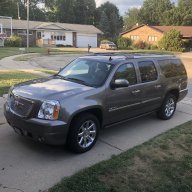

Nope. Neither did my 07 or 08. Your block had ports in it for AFM under the flat valley cover but that was it.We have a 2008 Denali without AFM. I rebuilt the engine...it did not have AFM components.

Disclaimer: Links on this page pointing to Amazon, eBay and other sites may include affiliate code. If you click them and make a purchase, we may earn a small commission.
Nope. Neither did my 07 or 08. Your block had ports in it for AFM under the flat valley cover but that was it.We have a 2008 Denali without AFM. I rebuilt the engine...it did not have AFM components.
I thought over the AFM question before we bought a vehicle without it. Best I could tell, AFM helped GM meet EPA combined emissions requirements but the benefits for the most part end there. On paper, the bean counters must have been satisfied that it would get out of extended warranty for nearly 100% of vehicles with few issues. What happens at 120k or 150k miles?
Overcoming the friction of four cylinders is not free of charge. Perhaps this is why many see little to no efficiency benefit from AFM.
High mileage vehicles, especially those not getting proper and frequent oil changes tend to be problematic. Will you be buying a vehicle with 50k miles? 100k or more? How many miles will you put on the vehicle? Higher mileage vehicles are better off without AFM, in my opinion.
Really, we each should look for SAE research papers to give us hard facts.
Welcome to the forum from Iowa.
If you can avoid AFM, that is preferable. If you need to get one, get a newer model (2013 or 2014). If you can find a ‘07 or ‘08 and possibly ‘09 Yukon Denali with the 6.2, they don’t have it.
Worst case if you get one with AFM is you can do a tune delete where it turns it off or a full delete where you remove the AFM parts altogether and get a tune.
Or, you can do what I’m doing. Change the oil regularly and hope it doesn’t act up.
The mode of failure on the AFM lifters are when they don't fully pressurize in the split second that they have before the cam lobe comes around and they get jammed up or fully collapse. This delay in pressurization is due to a few things.I think that is pretty accurate analysis.
Knowing the details of each model year’s failure results might be really helpful.
In my case, I have an ‘07 Yukon (original owner, anally maintained), which after 80K or so started burning oil. By 95K the rings were stuck enough that GM’s EFI cleaner bath procedure didn’t help and new pistons, rings, updated valve cover and relief valve deflector were installed. The engine now uses no appreciable oil and runs great (30K+ miles).
My dilemma now is the potential for one of the AFM lifters failing in a way that results in a larger issue. It would be really helpful to know the actual reliability profile of the AFM lifters versus normal lifters, in an engine that otherwise was well maintained (regular/filter changes, oil levels always maintained, etc.).
Without that actual data, it leads me to want to dump those lifters and delete AFM as a prophylactic measure for reliability.
Would I buy say a used ‘14 Yukon with 120K miles? If it checked out mechanically and the seller had all the service records? I probably would, but the deal would still have to be good enough to pay for an AFM delete kit install, just because I don’t know if the AFM lifters are actually less reliable in a well maintained engine that came with the updated valve cover and relief valve deflector new.
Sorry for the long post, it is hard to cover the nuances if you are a challenged writer.
I see a 7 mpg difference with AFM only when using 91 octaneI thought over the AFM question before we bought a vehicle without it. Best I could tell, AFM helped GM meet EPA combined emissions requirements but the benefits for the most part end there. On paper, the bean counters must have been satisfied that it would get out of extended warranty for nearly 100% of vehicles with few issues. What happens at 120k or 150k miles?
Overcoming the friction of four cylinders is not free of charge. Perhaps this is why many see little to no efficiency benefit from AFM.
High mileage vehicles, especially those not getting proper and frequent oil changes tend to be problematic. Will you be buying a vehicle with 50k miles? 100k or more? How many miles will you put on the vehicle? Higher mileage vehicles are better off without AFM, in my opinion.
Really, we each should look for SAE research papers to give us hard facts.
The mode of failure on the AFM lifters are when they don't fully pressurize in the split second that they have before the cam lobe comes around and they get jammed up or fully collapse. This delay in pressurization is due to a few things.
1) The VLOM is sluggish due to debris in the valves and ports
2) The VLOM is sluggish due to low pressure due to the VLOM bolts being loose or the orings not sealing the ports properly
3) The lifters have sludge in them that slows their pressurization.
By tuning out the AFM, you reduce the chances of #1 & #3 contributing to failures, but #2 can still be a cause so some folks have pulled the intakes and put in new orings, tightened the bolts properly and I think they have an improved VLOM design as well, but don't quote me on that.
I have had non-AFM lifters lock up and scrub the cam twice on my 2007. The first time resulted in a crate motor install at 150K. The second time was at 270K and I was able to just replace the cam and lifters, along with all the other "while I'm in there" stuff like the VVT phaser and actuator, timing chain, oil pick-up o-ring, etc.
The biggest thing you can do, no matter if you keep AFM active, do a tune delete or a full on AFM delete with cam and lifters, is keep your oil clean.

I had the 6.2 in my Denali so it had the VVT and the crate came with the VVT as well. The crate had a 100K warranty and the lifter gave up the ghost at 120K. I got a quote of $3000 just to diagnose and confirm it was a bad lifter so I did the work myself and it was the #5 intake lifter that locked up and chewed through the hard candy shell and into the soft nougaty center of the cam shaft. Ended up costing me $2000 by the time I got the new cam, new timing chain, tensioner, VVT stuff, lifters, head bolts, gaskets, etc. Got to buy the VVT phaser twice due my butter fingers dropping the first one and having it grenade all over my garage floor.Boy, that is some bad luck with lifters.
I didn’t think my ‘07 (LMG) came with VVT. Did you get the VVT with the crate motor?
I had the 6.2 in my Denali so it had the VVT and the crate came with the VVT as well. The crate had a 100K warranty and the lifter gave up the ghost at 120K. I got a quote of $3000 just to diagnose and confirm it was a bad lifter so I did the work myself and it was the #5 intake lifter that locked up and chewed through the hard candy shell and into the soft nougaty center of the cam shaft. Ended up costing me $2000 by the time I got the new cam, new timing chain, tensioner, VVT stuff, lifters, head bolts, gaskets, etc. Got to buy the VVT phaser twice due my butter fingers dropping the first one and having it grenade all over my garage floor.
I think your plan is solid and understand the motivation/initiative thing.Got it, I probably knew that and just forgot it along the way. Catching up to all this stuff is like drinking from a fire hose.
My alternative plan is to leave the engine be, leave the Range deleter in and do a reman crate if things go bad down the road. I have the tools and probably enough mechanical skill to pull off pretty much any type of repair, what I lack is the initiative when I can just tell that young bright tech, “let’s put that crate motor in”. I think bending over an engine bay for more than a day or two, might not be in the cards.
Who did you go with on the reman?
I think your plan is solid and understand the motivation/initiative thing.
As for the reman crate, I went through GM as I had the work done at a GMC dealer. The motor took a crap on my wife and I was out of town and the dealership was only a block away so I asked them to take a look. First time I used them but they are stand up guys and have had them work on my SUV's anytime I need a dealer do something.
Understand completely.I have always been one of those that assumed the dealer service department was an overpriced training ground for techs, at the customer expense. When we moved to Idaho, I didn't know any good shops and needed a few minor things taken care of, so tried the local GM dealer. Wow, what a difference. They are pretty darn competent, very honest (more than once they have told me I didn't need what I thought I needed, with a pennies on the dollar fix.). Their prices are always competitive (I can't change my own oil/filter for less than they charge and they cheerfully throw in a front to back rotation when I ask).
I am pretty sure I can do quite a bit better using one of the highly rated shops I have found around me, with one of the other reman suppliers, versus using my GM dealer (the other shops are a lot closer as well), but if the situation calls for me to use the dealer (like the truck is already there), I wouldn't hesitate to use them and a genuine GM engine. I know the GM engine would be more, but I would bet all the money in my pocket, the labor would be a wash and the quality of workmanship, just as good or better.
Where does VVT fall on this list?When I looked at all the engine/transmission changes throughout the years along with the efficiency numbers, the biggest changes seemed to come from, in order of most effective to least:
1) 4 speed to 6 speed to 10 speed transmissions
2) direct injection
3) DOD
My impressions is that DOD moderately helps when driving at highway speeds under 60 mph on flat land with no wind. Any moderate hills, acceleration to pass, winds, loads will require more power. It will be interesting to see if AFM is a significant improvement (GM's Active Fuel Management which allows finer control over cylinder deactivation).
Remember that hard acceleration enriches the fuel mixture which is really bad for fuel economy. With a transmission able to choose gear ratios better matched to the engine, the engine can operate staying closer to its ideal fuel mixture.

When I looked at all the engine/transmission changes throughout the years along with the efficiency numbers, the biggest changes seemed to come from, in order of most effective to least:
1) 4 speed to 6 speed to 10 speed transmissions
2) direct injection
3) DOD
My impressions is that DOD moderately helps when driving at highway speeds under 60 mph on flat land with no wind. Any moderate hills, acceleration to pass, winds, loads will require more power. It will be interesting to see if AFM is a significant improvement (GM's Active Fuel Management which allows finer control over cylinder deactivation).
Remember that hard acceleration enriches the fuel mixture which is really bad for fuel economy. With a transmission able to choose gear ratios better matched to the engine, the engine can operate staying closer to its ideal fuel mixture.
Where does VVT fall on this list?
On another note, do these engines have roller lifters?
Sent from my SM-G930V using Tapatalk
AFM is DOD. Displacement on demand was the term coined decades ago for the "8-6-4" Cadillac in '81. Active Fuel Management is just the modern day proper name for the displacement on demand system. Due to the flop the Caddy engine was, I don't blame them for NOT keeping the DOD term for the newer iteration. There is no difference in operation between the system introduced in the 2007 year models through the 2018 year models. There have been improvement to the components, though, starting in 2010 or 2011. 2019 brought Dynamic Fuel Management, which is the progression of AFM. It has 17 different cylinder modes that can engage or disengage any of all eight cylinders as needed rather than just manipulate four exclusive cylinders.
Your impression is correct. For most real-world driving instances outside of GM's closed testing course(s), AFM is rarely engaged so its minute benefits are far outweighed by the cost of repairing it. With my mods, I'm getting the same or better MPG as I did babying it with AFM.
Oh - Not knocking what you said. Not at all. Just trying to give you some props man. I am not a big fan of AFM either, just haven't gotten to the point that I want to dig into it on our 2013 yet. That whole DOD crap back in the day was a joke as well, for sure.Hey, I tried to give AFM its fair due! I quickly determined that it didn't have any.