Used engine flush, now rear main seal leaking.

Disclaimer: Links on this page pointing to Amazon, eBay and other sites may include affiliate code. If you click them and make a purchase, we may earn a small commission.

Rayyy

Full Access Member
Joined
Jun 4, 2020
Posts
299
Reaction score
136
Location
Northern California
Wondering if someone can shed some light…

I used a can of Liqui Moly engine flush before an oil change, the oil came out goopy and super black, so it seems like it did clean out gunk/sludge from the engine.

However, now my rear main seal is dripping big time, and I’ve read disclaimers that engine flush treatments can damage the seals??

Is the dripping temporary? Or is my seal actually damaged?

Anything I can do to at this point?
 

MassHoe04

Full Access Member
Joined
Nov 4, 2021
Posts
1,588
Reaction score
2,842
Location
Western MA
I don't know, but my Jeep 4.0 had been running traditional dinosaur oil it's whole life and was not certain how well it was cared for in terms of oil changes. I never leaked a drop.

I am thinking all the deposits that were allowed to build up might have actually been helping to keep all the oil in where it belonged.

I figured if it wasn't leaking and was running great on regular old 10W-30, I didn't dare try the old "just run some auto tranny fluid before you dump the oil..." trick or engine flushes of any kind.
Maybe those methods are perfectly safe, but I was scared sh1tlesss to even think of trying any things like that.

I did not leak. Others had. Coincidence? Maybe...

Sorry you had that happen. I can't explain for you what happened, but maybe there is something to the idea of not trying to get old engines free of deposits and squeaky clean.
As seals wear, maybe it is possible the buildup pf sludge and deposits help fill the gaps. ??

Only theory, so don't beat me up too bad.

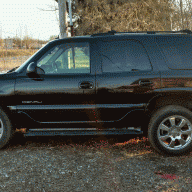
Anyway, my 04 Tahoe hit 212K, runs 5w-30 (whatever is on sale). Maybe it weeps tiny bits here or there, but not enough to drip on the driveway. No flushes for me. Just frequent oil and filter changes. I don't always hit the target, but I shoo for every 3k miles to the extent possible.
 

Alex_M

Full Access Member
Joined
Sep 27, 2021
Posts
380
Reaction score
686
The flush did not damage the seal, but it did uncover that it was worn. I am personally anti engine flush. Breaking free stuck on gunk that is not currently causing any issues can have no good come from it. At best, parts you will never see "look" cleaner. At worst, you uncover seal issues like yours or you knock loose chunks or particulates which are now suspended in your oil running thru your engine instead of being stuck in one place not doing any harm. Oil filter hopefully catches most of those, but they are still running thru your oil pump first wearing the pump.

Do your next couple oil changes in short intervals to get as much of the newly suspended contaminants out, use high quality filters. Mobil or Wix XP.

Your rear main is probably just going to leak now. If you use synthetic oil, switch to conventional - sometimes helps.

Sludge and gunk, once it exists, is best being left where it's at.
 

nonickatall

Full Access Member
Joined
Nov 19, 2022
Posts
824
Reaction score
1,533
Location
Germany
With oil pan gaskets, it sometimes helps to simply tighten the screws a little. Of course, be careful not to overdo the torque and destroy the threads.
Otherwise changing the oil pan gasket is no magic and the O-ring of the oil pump pipe can be changed directly in the process, which is a weak point in the engines.
 

BMPNUGLS

Full Access Member
Joined
Apr 5, 2015
Posts
238
Reaction score
116
Location
Mid-MO
I’ve always been one to maintain low mileage oil changes and stick with the same type oil (full synthetic for recent vehicles) with not many additives used - with the exception of some Marvel Mystery Oil in crankcase and gas tank once every other oil change…seems to work well.

BUT, I’ve seen many people swear the below additive really works to revive old seals, gaskets, etc and stop or minimize leaks…might give it a try before looking at replacing the rear main seal.

ATP Automotive AT-205 Re-Seal Stops Leaks, 8 Ounce Bottle https://a.co/d/hzTbrZu
 

Sam Harris

Elite Member
Supporting Member
Joined
Sep 26, 2018
Posts
7,445
Reaction score
14,977
Location
Texas
I’ve always been one to maintain low mileage oil changes and stick with the same type oil (full synthetic for recent vehicles) with not many additives used - with the exception of some Marvel Mystery Oil in crankcase and gas tank once every other oil change…seems to work well.

BUT, I’ve seen many people swear the below additive really works to revive old seals, gaskets, etc and stop or minimize leaks…might give it a try before looking at replacing the rear main seal.

ATP Automotive AT-205 Re-Seal Stops Leaks, 8 Ounce Bottle https://a.co/d/hzTbrZu
I’ve heard this as well, but don’t have any experience with it. Although I do have a bottle on the shelf. Lol. Interested to hear any thoughts on it. Also, adding more if it than directed definitely causes problems. I watched a video of a trans tear down where all the seals were swelled up, causing massive problems, due to adding a lot of this type stuff.
 

nonickatall

Full Access Member
Joined
Nov 19, 2022
Posts
824
Reaction score
1,533
Location
Germany
I’ve heard this as well, but don’t have any experience with it. Although I do have a bottle on the shelf. Lol. Interested to hear any thoughts on it. Also, adding more if it than directed definitely causes problems. I watched a video of a trans tear down where all the seals were swelled up, causing massive problems, due to adding a lot of this type stuff.
I would never pour something like that in my engine. What closes leaks, also closes oil channels and orifice. Oil leaks are way too versatile. Torn seals, improperly tightened oil pans, worn oil seals.

But even worse is cooler tight. Anyone who has ever taken apart an engine with stuff like that in it, would never pour something like that into their engine.

And never ever put something like this in an automatic transmission.
 
Last edited:

Sam Harris

Elite Member
Supporting Member
Joined
Sep 26, 2018
Posts
7,445
Reaction score
14,977
Location
Texas
I would never pour something like that in my engine. What closes leaks, also closes oil channels and orifice. Oil leaks are way too versatile. Torn seals, improperly tightened oil pans, worn oil seals.

But even worse is cooler tight. Anyone who has ever taken apart an engine with stuff like that in it, would never pour something like that into their engine.

And never ever put something like this in an automatic transmission.
This was my line of thinking.. which is why I never used it, and it sits on a shelf. (After I bought it of course..) Maybe it will be good to help start a bonfire.
 

nonickatall

Full Access Member
Joined
Nov 19, 2022
Posts
824
Reaction score
1,533
Location
Germany
I actually saw adding brake fluid to engine oil, swell up a rear main seal on a Ford van and get us home from the Lake of the Ozarks. It was pouring out more than I had seen before and I saw the leak slow way down and get us home. Amazed me.
Ok on a Ford you can do this. I talked about engines and cars, not about Ford.:Big Laugh:

As I always said:
No cars with F. No Ford, no Fiat, no French cars...

:cool:
 
Last edited:
OP
OP
Rayyy

Rayyy

Full Access Member
Joined
Jun 4, 2020
Posts
299
Reaction score
136
Location
Northern California
Well, good news… After a few days of dripping after each drive, the leak has completely stopped. There is no more dripping.

Something to note… I did add a can of Ceratec with the oil change, so maybe that helped?

I have also been doing a lot of highway driving this last week, so not sure if this has something to do with it, but it appears that the seal has resealed itself.

Engine runs smooth as a sewing machine though.

I’ll update if it starts leaking again.
 

rockola1971

Full Access Member
Joined
Dec 29, 2016
Posts
2,862
Reaction score
4,084
Location
Indiana (formerly IL)
What likely happened is the engine flush additives cause the rear main seal to shrink or expand. Which of course leaves gaps and leaks. After heat cycles and plenty of oil coming in contact with the seal lips and has reversed what was done to them. Myself I would plan on a rear main seal soon and not expect it to be good to go until then.

This is also why I dont recommend a tranny flush on a high mileage tranny.
 

nonickatall

Full Access Member
Joined
Nov 19, 2022
Posts
824
Reaction score
1,533
Location
Germany
Was wahrscheinlich passiert ist, ist, dass die Motorspülzusätze dazu führen, dass die hintere Hauptdichtung schrumpft oder sich ausdehnt. Was natürlich Lücken und Undichtigkeiten hinterlässt. Nach Wärmezyklen und viel Öl, das mit den Dichtlippen in Kontakt gekommen ist und das, was ihnen angetan wurde, rückgängig gemacht hat. Ich selbst würde demnächst eine Heckhauptdichtung einplanen und nicht damit rechnen, dass es bis dahin gut läuft.

Aus diesem Grund empfehle ich auch keine Transenspülung bei einer Transe mit hoher Laufleistung.
I really appreciate your posts, but this is where you are wrong. In an automatic transmission, bad oil is the first problem for poor functions and the basis for wear.

This is because the hydrocarbon chains from which oil is formed, mechanically wear between the gears, pistons and clutches and lose their lubricity. Additional there is increasing wear of the clutches which are fine Partikels keep swimming in the oil. The fiber made filters in automatic transmissions do not filter this fine wear out.

I have had many automatic transmissions that were in older cars and shifted poorly and after an oil change they shifted like in a new car.

However, I've had a few people come to me with poorly shifting transmissions and I told them the first thing is: You can do is change the oil. And if this does not improve the switching behavior then you already have a mechanical issue.

And that just the only reason why automatic transmission die after an Oilchange, because they were already on end of lifetime.

But that seals fail, because of new oil is fantasy. How should that work?

A seal is built to be chemically compatible with the respective oil. Now the oil changes himself over time, because it's old and used up and full of suspended matter that doesn't belong there. And then the seal changes chemically and can no longer tolerate new oil?

That is probably very unlikely and why do the seals of the same design tolerate regular engine oil changes, but shouldn't tolerate an automatic transmission oil change?

That is also not plausible and does not correspond to my many years of workshop experience.

I do overhaul off automatic transmission and I fully understand how an automatic transmission is working, mostly they fail, because of wear of the clutches, wear inside of the valve housing, or failure of bearings, sometimes because of brocken gears, but never because of failed sealings, if you refill the lost oil.

I hope you don't get me wrong. Just a technical discussion between gmt800 afficinados...

Best regards in respect from Germany

 

NickTransmissions

Sin City
Supporting Member
Joined
Mar 9, 2023
Posts
1,370
Reaction score
3,517
Location
The transmission bench
I really appreciate your posts, but this is where you are wrong. In an automatic transmission, bad oil is the first problem for poor functions and the basis for wear.

This is because the hydrocarbon chains from which oil is formed, mechanically wear between the gears, pistons and clutches and lose their lubricity. Additional there is increasing wear of the clutches which are fine Partikels keep swimming in the oil. The fiber made filters in automatic transmissions do not filter this fine wear out.

I have had many automatic transmissions that were in older cars and shifted poorly and after an oil change they shifted like in a new car.

However, I've had a few people come to me with poorly shifting transmissions and I told them the first thing is: You can do is change the oil. And if this does not improve the switching behavior then you already have a mechanical issue.

And that just the only reason why automatic transmission die after an Oilchange, because they were already on end of lifetime.

But that seals fail, because of new oil is fantasy. How should that work?

A seal is built to be chemically compatible with the respective oil. Now the oil changes himself over time, because it's old and used up and full of suspended matter that doesn't belong there. And then the seal changes chemically and can no longer tolerate new oil?

That is probably very unlikely and why do the seals of the same design tolerate regular engine oil changes, but shouldn't tolerate an automatic transmission oil change?

That is also not plausible and does not correspond to my many years of workshop experience.

I do overhaul off automatic transmission and I fully understand how an automatic transmission is working, mostly they fail, because of wear of the clutches, wear inside of the valve housing, or failure of bearings, sometimes because of broken gears, but never because of failed sealings, if you refill the lost oil.

I hope you don't get me wrong. Just a technical discussion between gmt800 aficionados...

Best regards in respect from Germany
Correct...NOT changing/flushing the fluid often enough (lack of maintenance) is among the top three killers of transmissions, the other two being frequent high RPMs and heat.
 

OR VietVet

GMT800 2005 Tahoe Z71
Navy Supporting Member
Joined
Oct 8, 2014
Posts
23,775
Reaction score
44,301
Location
Willamette Valley
I want to understand what @nonickatall and @NickTransmissions are saying. Scenario:

I was in and ran shops for 35+ years. I have seen a vehicle come in the shop for a second opinion of a recommended transmission flush for aged and dirty fluid and after a road test it was determined that the auto transmission functioned fine, shifted as it should and after talking to the owner, they said the same and was just in for an engine oil change and the previous shop had presented him with the transmission flush recommendation.

We agreed that the fluid was dirty looking, light brownish color and the owner did not know the last time the fluid and filter had been done. He trusted our shop and the recommendation was bothering him so he asked us to do the filter change and the fluid flush. We did it and within a week, the shifting norms changed and vehicle was back in the shop with even worse looking fluid than when it was originally offered to us the week before.

To be fair, I myself had cautioned the owner of the flush because I had heard, I am not an auto transmission specialist, from transmission friends in the business that doing a flush can at times be a shock to the clutches and cause later problems. This scenario was repeated at least a half dozen times in my career in shops. Each time a pre flush road test was done and each time the owner said the transmission gave them no concern except that they were warned of dirty fluid.

Are you saying that each time the transmission was actually in the middle of failing and the owner and shop tech did not know it or feel it? I just gotta know because I still do work on the side and have done a few transmission services but have not done and will not be doing any flushes here.
 

NickTransmissions

Sin City
Supporting Member
Joined
Mar 9, 2023
Posts
1,370
Reaction score
3,517
Location
The transmission bench
I want to understand what @nonickatall and @NickTransmissions are saying. Scenario:

I was in and ran shops for 35+ years. I have seen a vehicle come in the shop for a second opinion of a recommended transmission flush for aged and dirty fluid and after a road test it was determined that the auto transmission functioned fine, shifted as it should and after talking to the owner, they said the same and was just in for an engine oil change and the previous shop had presented him with the transmission flush recommendation.

We agreed that the fluid was dirty looking, light brownish color and the owner did not know the last time the fluid and filter had been done. He trusted our shop and the recommendation was bothering him so he asked us to do the filter change and the fluid flush. We did it and within a week, the shifting norms changed and vehicle was back in the shop with even worse looking fluid than when it was originally offered to us the week before.

To be fair, I myself had cautioned the owner of the flush because I had heard, I am not an auto transmission specialist, from transmission friends in the business that doing a flush can at times be a shock to the clutches and cause later problems. This scenario was repeated at least a half dozen times in my career in shops. Each time a pre flush road test was done and each time the owner said the transmission gave them no concern except that they were warned of dirty fluid.

Are you saying that each time the transmission was actually in the middle of failing and the owner and shop tech did not know it or feel it? I just gotta know because I still do work on the side and have done a few transmission services but have not done and will not be doing any flushes here.
Automatics are extremely vulnerable to dirty, contaminated and/or excessively aged or worn fluid. Over time, fluid breaks down and begins to lose its hydraulic and lubricative properties hence why it’s so important to change it at factory-prescribed intervals or more frequently if usage patterns are more intense.

Ultimately once the fluid breaks down enough it also loses its ability to promote clutch/steel adhesion which, combined with apply pressure driven clamping force, keeps clutch packs from slipping under load.

Lastly, fluid accumulates particulate contaminants as friction elements undergo normal wear and this contamination begins to wear valves and bores in the valve bodies, pump and anywhere else valving is located. Sealing rings and lip seals begin to harden and then begins the chain reaction to failure.

To answer your final question, in brief- yes. As long as there is just enough meat on the bone, friction-wise the clutch pack will still hold but once it goes, its done. Most of my customers describe their transmission failures as “it was working fine then suddenly i had no third gear” or something to that effect. Same with gear train components-as long as the fluid can still sufficiently lubricate, gears/shafts and other hard parts will survive. But once it cannot, they’re on short, borrowed time.

The idea that changing fluid is actually harmful to the transmission (assuming correct fluid is used) is a myth propagated throughout the industry over time, though I don’t know the exact origins.

Hope that helps but if not, let me know what i can clarify or expand upon
 

OR VietVet

GMT800 2005 Tahoe Z71
Navy Supporting Member
Joined
Oct 8, 2014
Posts
23,775
Reaction score
44,301
Location
Willamette Valley
I need clarity on why, in all the scenarios I had laid out, the vehicles transmissions shifted and performed fine for the vehicle owner and the tech during road tests, and then right after the flush of fluid the transmission started having problems. It is hard for me to fathom that each one of these transmissions were actually "failing" for the owner and the tech but they did not experience it and that the flush had nothing to do with it.

In your explanation, the damage is already done and no one feels it. I know that owners that drive the vehicle every day can just get used to the performance of a vehicle's functions and assume all is ok when in fact it is not, but for a tech to not experience any problems during their "new to them" road tests seems like a strange outcome.

I am also not talking about dirty, "looks like motor oil" transmission fluid. I am talking about a hint of brown color on the dipstick. I don't doubt your experience and expertise at all but I do remember all the scenarios I speak of because they all had the same outcome. It sticks in a manager's memory even after all the time that has gone by.
 

NickTransmissions

Sin City
Supporting Member
Joined
Mar 9, 2023
Posts
1,370
Reaction score
3,517
Location
The transmission bench
I need clarity on why, in all the scenarios I had laid out, the vehicles transmissions shifted and performed fine for the vehicle owner and the tech during road tests, and then right after the flush of fluid the transmission started having problems. It is hard for me to fathom that each one of these transmissions were actually "failing" for the owner and the tech but they did not experience it and that the flush had nothing to do with it.

In your explanation, the damage is already done and no one feels it. I know that owners that drive the vehicle every day can just get used to the performance of a vehicle's functions and assume all is ok when in fact it is not, but for a tech to not experience any problems during their "new to them" road tests seems like a strange outcome.

I am also not talking about dirty, "looks like motor oil" transmission fluid. I am talking about a hint of brown color on the dipstick. I don't doubt your experience and expertise at all but I do remember all the scenarios I speak of because they all had the same outcome. It sticks in a manager's memory even after all the time that has gone by.
I can’t begin to tell you how often we cant replicate or observe a condition as described by the customer until whatever breakdown is happening “finishes” and the trans fails.

If you’re seeing a “hint” of brown on the dipstick, that fluid is already seriously bad and pan should be promptly removed to inspect for burnt clutch material, etc…Remember, heavier contaminants sink to the bottom so wont show up on the dipstick. The dipstick only inserts down to the dipstick stop, which is typically only as far as the valve body. So just looking at fluid on the dipstick by itself isnt the best way to assess fluid overall condition though if its anything but bright red and smelling like trans fluid, to me calls for further inspection. If it stinks and is dark, you’re measuring the trans’ remaining life expectancy in terms of miles or at most tens of miles for that unit.

Why Do you think the engineers and scientists at GM, Ford, Chrysler et al specify the fluid service intervals that they do, especially for pre-synthetic era transmissions?

Other side of the coin - Explain to me how a fluid flush would harm a transmission

Overall, the idea that flushes are behind transmission failures is a case of mistaking correlation for causation.
 
Last edited:

Forum statistics

Threads
137,809
Posts
1,992,713
Members
102,794
Latest member
Drewphil

Latest posts

Back
Top