Slow cranking due to battery cable?

Disclaimer: Links on this page pointing to Amazon, eBay and other sites may include affiliate code. If you click them and make a purchase, we may earn a small commission.

DaveO9

Full Access Member
Joined
Oct 25, 2022
Posts
353
Reaction score
750
Location
Vancouver, WA
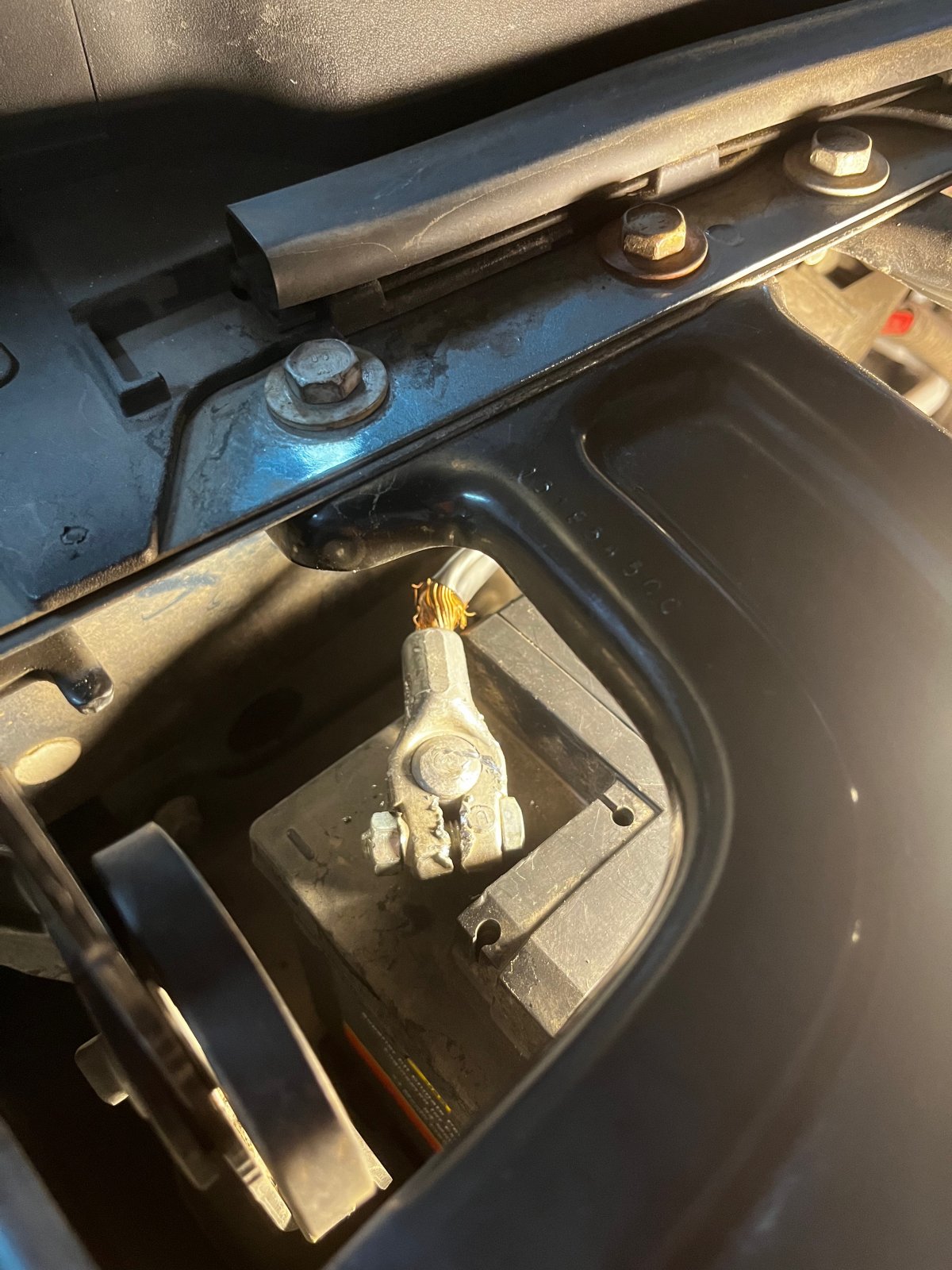
My 2009 Tahoe, 5.3, cranks slow, especially when cold. It's been that way since I've owned it, but that's only been about 2 months. I had the battery load tested - tested good and it's only 2 years old. Battery shows 12.3V with key and engine off. Engine running I see 14.7 or so at the alternator and about 14.3 at the battery. Seems like that could be enough voltage drop to cause a slow crank condition? I noticed my negative battery cable is looking pretty sketchy at the post terminal. Even if it's not causing the slow crank, I'm going to replace it. I don't have any other electrical anomalies, though.

Thoughts? Would the starter itself be going bad?

IMG_3633.jpeg
IMG_3634.jpeg
 

Geotrash

Dave
Supporting Member
Joined
Feb 16, 2018
Posts
7,849
Reaction score
20,428
Location
Richmond, VA
My 2009 Tahoe, 5.3, cranks slow, especially when cold. It's been that way since I've owned it, but that's only been about 2 months. I had the battery load tested - tested good and it's only 2 years old. Battery shows 12.3V with key and engine off. Engine running I see 14.7 or so at the alternator and about 14.3 at the battery. Seems like that could be enough voltage drop to cause a slow crank condition? I noticed my negative battery cable is looking pretty sketchy at the post terminal. Even if it's not causing the slow crank, I'm going to replace it. I don't have any other electrical anomalies, though.

Thoughts? Would the starter itself be going bad?

View attachment 384202View attachment 384203
That battery cable absolutely needs replacing. Might as well do "the big 3". Lots of posts on here about how to do it and which cables to buy. But if time and money are tight, replacing just the negative cable in your case will probably solve your woes.
 

Joseph Garcia

Elite Member
Supporting Member
Joined
Aug 2, 2018
Posts
10,520
Reaction score
15,263
While you are at it, check the grounds on the engine block and any other grounds in the engine well. A corroded ground is common on these trucks.
 

OR VietVet

GMT800 2005 Tahoe Z71
Navy Supporting Member
Joined
Oct 8, 2014
Posts
23,906
Reaction score
44,603
Location
Willamette Valley
Yes, what has been said so far and the voltage drop is fine. IMO, do both cable assembles and read thru threads here and do the Big 3 asap, especially if live in a state with salt on the roads. If you want to have a little fun. Get a helper and crawl under the engine and measure the voltage at the starter now. Then do the cables replacement and measure again. Please report back here with results. Plus, if you can afford it, replace the starter since it is likely the original. I did mine, had no problems with it, because I knew eventually it would give me a problem when away from home. https://www.rockauto.com/en/moreinfo.php?pk=4394409&cc=1442911&pt=4152&jsn=927

Pay attention to all choices for the battery cables because Genuine GM cables have a few options.
 

Tonyv__

Full Access Member
Joined
Apr 18, 2018
Posts
4,616
Reaction score
10,810
Location
Bucks county PA
I feel like this topic has came up a couple times this year alone. It seems the common culprit is the starter dying. I don’t wanna tell you to just throw money at your starter. But i experienced it this year too. Replaced my battery for no reason just to find out my starter was dying

My Yukon only had about 60k miles when it happened
 
OP
OP
DaveO9

DaveO9

Full Access Member
Joined
Oct 25, 2022
Posts
353
Reaction score
750
Location
Vancouver, WA
Thanks for input, everyone. I'm assuming the "Big 3" are positive and negative batt cables plus the braided ground strap from engine to firewall on drivers side? I've looked at the connections for all of those and the only visible issue is the negative cable at the post (pics that I posted above). There's not a spec of corrosion on any of them. So I'm going to replace the negative cable first and see what that does. I'll replace the starter if I need to, but not without first trying the cables. I'm in SW Washington, bought the rig in Portland OR - neither state salts the roads so corrosion is not as big a problem as it is for other areas.

Here's the cable I'm purchasing, AC Delco.
 

OR VietVet

GMT800 2005 Tahoe Z71
Navy Supporting Member
Joined
Oct 8, 2014
Posts
23,906
Reaction score
44,603
Location
Willamette Valley
Thankfully, yes, no salt on roads here in the Willamette Valley, Eugene, Or.


Many more info threads to be read.

Go to top right where it says, SEARCH with the little magifying glass, click on it and type in Big 3 Upgrade and hit enter and scroll.
 
OP
OP
DaveO9

DaveO9

Full Access Member
Joined
Oct 25, 2022
Posts
353
Reaction score
750
Location
Vancouver, WA
Thankfully, yes, no salt on roads here in the Willamette Valley, Eugene, Or.


Many more info threads to be read.

Go to top right where it says, SEARCH with the little magifying glass, click on it and type in Big 3 Upgrade and hit enter and scroll.
Got it, thanks. I had no idea the "Big 3" mod was such a BIG deal for these trucks. I thought it was just a colloquial term amongst a small group here and an actual search wouldn't turn anything up. Guess I should have tried first! All over this site and every other forum dealing with these rigs.
 

Geotrash

Dave
Supporting Member
Joined
Feb 16, 2018
Posts
7,849
Reaction score
20,428
Location
Richmond, VA
Got it, thanks. I had no idea the "Big 3" mod was such a BIG deal for these trucks. I thought it was just a colloquial term amongst a small group here and an actual search wouldn't turn anything up. Guess I should have tried first! All over this site and every other forum dealing with these rigs.
Geez, man. I even gave you the quotes around it for the search term! :p

But I'm also with the others here that your starter is likely nearing its end as well. It's easy to replace on these. Just gotta take the right front fender liner out and remove the heat shield from the exhaust manifold on that side. The starter is held in by 2 bolts from the bottom. Took me maybe an hour to do it on my '07. You gotta get in there anyway to replace the cable that runs to the starter, so it's as good a time as any to replace it.
 

Doubeleive

Wes
Supporting Member
Joined
Nov 7, 2017
Posts
30,698
Reaction score
48,334
Location
Stockton, Ca.
My 2009 Tahoe, 5.3, cranks slow, especially when cold. It's been that way since I've owned it, but that's only been about 2 months. I had the battery load tested - tested good and it's only 2 years old. Battery shows 12.3V with key and engine off. Engine running I see 14.7 or so at the alternator and about 14.3 at the battery. Seems like that could be enough voltage drop to cause a slow crank condition? I noticed my negative battery cable is looking pretty sketchy at the post terminal. Even if it's not causing the slow crank, I'm going to replace it. I don't have any other electrical anomalies, though.

Thoughts? Would the starter itself be going bad?

View attachment 384202View attachment 384203
the proper way to test the cables is to do a voltage drop test
put a lead on the battery ground and a lead on the starter positive connection and check the voltage reading it should be the same as the battery or very close to it.
then have a helper start the engine and watch the voltage while the starter is engaged
if the voltage drops below 10.5v then replace the cable
I would check the ground ohms also from starter body to battery negative.
usually low voltage will just make the starter make a clicking noise or not even engage at all.
as others noted it could be the starter is tired. If you end up replacing it I would get oem or better (higher kilowatts)
 

Joseph Garcia

Elite Member
Supporting Member
Joined
Aug 2, 2018
Posts
10,520
Reaction score
15,263
The members of this Forum are here for you. LOTS of first-hand learned experience here with these folks.
 

Dustin Jackson

Full Access Member
Joined
Aug 9, 2018
Posts
1,788
Reaction score
2,065
When my negative battery cable was broken internally I would have intermittent failure to start BUT when it DID start it was strong cranking
 

OR VietVet

GMT800 2005 Tahoe Z71
Navy Supporting Member
Joined
Oct 8, 2014
Posts
23,906
Reaction score
44,603
Location
Willamette Valley
Got it, thanks. I had no idea the "Big 3" mod was such a BIG deal for these trucks. I thought it was just a colloquial term amongst a small group here and an actual search wouldn't turn anything up. Guess I should have tried first! All over this site and every other forum dealing with these rigs.
Geez, man. I even gave you the quotes around it for the search term! :p

But I'm also with the others here that your starter is likely nearing its end as well. It's easy to replace on these. Just gotta take the right front fender liner out and remove the heat shield from the exhaust manifold on that side. The starter is held in by 2 bolts from the bottom. Took me maybe an hour to do it on my '07. You gotta get in there anyway to replace the cable that runs to the starter, so it's as good a time as any to replace it.
The Big 3 is likely one of the single most important "must do's" on these rigs. If you plan on keeping the rig and want "peace of mind", do the damn thing. Again, since I am a "thousandaire", I did the upgrade and a new Interstate AGM battery and a new alternator and new starter and all grounds and and and....and now, never a problem. Was a little bit overkill but I wanted to deal with it just once.
 
Last edited:
OP
OP
DaveO9

DaveO9

Full Access Member
Joined
Oct 25, 2022
Posts
353
Reaction score
750
Location
Vancouver, WA
The Big 3 is likely one of the single most important "must do's" on these rigs. If you plan on keeping the rig and want "peace of mind", do the damn thing. Again, since I am a "thousandaire", I did the upgrade and a new Interstate AGM battery and a new alternator and new starter and all grounds and and and....and now, never a problem. Was a little bit overkill but I wanted to deal with it just once.
I understand the need to restore grounds and cables to factory conditions, but why the need for upgrading conductor size and capacity so much from factory? Or is "Big 3" just replacing cables, not upgrading? (When googling "Big 3 upgrade" in a general sense you get tons of returns on high power car audio systems) I'm not into booming car stereos, kazillion candle-power lighting systems, winches or hydraulics, so I'm not sure I see any need to go beyond OEM. Same with battery and alternator.

I'll replace starter when/if I know it's necessary, but only then. I don't replace parts if I don't have to. I have plenty of experience with GM starters of old: '91 suburban and '76 vette. For the burb, I found a 1972 full cast-iron Delco and rebuilt it with new brushes, bearings, and solenoid. That beauty worked better than any junk parts store reman ever could. I should have kept it when I sold the burb and put it on the Vette.

Can these starters be rebuilt? I didn't see any kits available on RockAuto, but I didn't look much further than that.
 

Doubeleive

Wes
Supporting Member
Joined
Nov 7, 2017
Posts
30,698
Reaction score
48,334
Location
Stockton, Ca.
I understand the need to restore grounds and cables to factory conditions, but why the need for upgrading conductor size and capacity so much from factory? Or is "Big 3" just replacing cables, not upgrading? (When googling "Big 3 upgrade" in a general sense you get tons of returns on high power car audio systems) I'm not into booming car stereos, kazillion candle-power lighting systems, winches or hydraulics, so I'm not sure I see any need to go beyond OEM. Same with battery and alternator.

I'll replace starter when/if I know it's necessary, but only then. I don't replace parts if I don't have to. I have plenty of experience with GM starters of old: '91 suburban and '76 vette. For the burb, I found a 1972 full cast-iron Delco and rebuilt it with new brushes, bearings, and solenoid. That beauty worked better than any junk parts store reman ever could. I should have kept it when I sold the burb and put it on the Vette.

Can these starters be rebuilt? I didn't see any kits available on RockAuto, but I didn't look much further than that.
yes they are remanufactured all the time by probably a handful of company's getting the parts may require a bit of digging.
as far as doing the big3 yes that is often done by people doing audio upgrades but it is also just a good idea since these vehicles are prone to having electrical gremlins they are very finicky with low voltage 10.5v is the cutoff, the oem grounds are minimal. some issue's that crop up can be attributed to poor electrical connections.
It's a good idea to at least add a ground from the alternator mounting bracket to the frame and increase the alternator charging wire gauge from the alternator to the battery terminal. you can call it the big2 lol.
 

Geotrash

Dave
Supporting Member
Joined
Feb 16, 2018
Posts
7,849
Reaction score
20,428
Location
Richmond, VA
I understand the need to restore grounds and cables to factory conditions, but why the need for upgrading conductor size and capacity so much from factory? Or is "Big 3" just replacing cables, not upgrading? (When googling "Big 3 upgrade" in a general sense you get tons of returns on high power car audio systems) I'm not into booming car stereos, kazillion candle-power lighting systems, winches or hydraulics, so I'm not sure I see any need to go beyond OEM. Same with battery and alternator.

I'll replace starter when/if I know it's necessary, but only then. I don't replace parts if I don't have to. I have plenty of experience with GM starters of old: '91 suburban and '76 vette. For the burb, I found a 1972 full cast-iron Delco and rebuilt it with new brushes, bearings, and solenoid. That beauty worked better than any junk parts store reman ever could. I should have kept it when I sold the burb and put it on the Vette.

Can these starters be rebuilt? I didn't see any kits available on RockAuto, but I didn't look much further than that.
I have a couple of reactions to this that I hope are helpful. There is of course nothing wrong with delaying replacement or replacing the factory big 3 wiring with new factory parts if you're not in need of better performance because the problems people are seeing are mainly the product of age and exposure - especially wet weather and road salt. But to Wes's point, the factory parts are minimal because they don't maintain the performance level that the sensitive electronic systems on these cars require for the life of the vehicle, in many cases. So the argument for upgrading to bigger/more weather-resistant components is to ensure that you're unlikely to experience the problem again. For those who keep their cars a loooong time, as I do, that's beneficial.

As for the starter, my rationale for replacing it before it fails with a new OEM part is based on not wanting to be stranded somewhere far away from home (we take trips often). And thanks to this forum, I've learned that on the GMT900 platform at least, the average life of a starter is somewhere between 120K and 160K, depending on driving habits of course. So I have a new starter on the shelf that I plan to install in our 2012 XL Denali with 132K on it in the next couple of months. I've already replaced the one in our '07 XL Denali this fall.

I have a spreadsheet in which I track all maintenance and parts replacement. In it I also have dates and mileages for when I should plan to replace common failure items proactively, based on what I've learned here. I learned this habit from owning an aircraft. While it's legal for private aircraft owners to replace parts 'on condition', commercial aircraft must have certain parts replaced after a specified time in service (hours or calendar months). What those limits are is evidence-based from past service experience. This is also true for ALL helicopters, regardless of whether it's privately or commercially owned. They do this to ensure absolute reliability and to limit the risk of failure.

It's slightly more expensive to maintain my vehicles this way, but far less expensive than a new vehicle, and cheaper than hotels, tow trucks, and a ruined vacation. And my wife and kids are usually in it with me, so I feel I owe it to them to do the best I can afford to keep them safe. So far, knock-on-wood, I have only had one vehicle strand me in 34 years of vehicle ownership. It was a Land Rover that developed a bad fuel gauge that unbeknownst to me read 1/4 tank when it was actually empty. I sold it shortly thereafter.

 

OR VietVet

GMT800 2005 Tahoe Z71
Navy Supporting Member
Joined
Oct 8, 2014
Posts
23,906
Reaction score
44,603
Location
Willamette Valley
I have a couple of reactions to this that I hope are helpful. There is of course nothing wrong with delaying replacement or replacing the factory big 3 wiring with new factory parts if you're not in need of better performance because the problems people are seeing are mainly the product of age and exposure - especially wet weather and road salt. But to Wes's point, the factory parts are minimal because they don't maintain the performance level that the sensitive electronic systems on these cars require for the life of the vehicle, in many cases. So the argument for upgrading to bigger/more weather-resistant components is to ensure that you're unlikely to experience the problem again. For those who keep their cars a loooong time, as I do, that's beneficial.

As for the starter, my rationale for replacing it before it fails with a new OEM part is based on not wanting to be stranded somewhere far away from home (we take trips often). And thanks to this forum, I've learned that on the GMT900 platform at least, the average life of a starter is somewhere between 120K and 160K, depending on driving habits of course. So I have a new starter on the shelf that I plan to install in our 2012 XL Denali with 132K on it in the next couple of months. I've already replaced the one in our '07 XL Denali this fall.

I have a spreadsheet in which I track all maintenance and parts replacement. In it I also have dates and mileages for when I should plan to replace common failure items proactively, based on what I've learned here. I learned this habit from owning an aircraft. While it's legal for private aircraft owners to replace parts 'on condition', commercial aircraft must have certain parts replaced after a specified time in service (hours or calendar months). What those limits are is evidence-based from past service experience. This is also true for ALL helicopters, regardless of whether it's privately or commercially owned. They do this to ensure absolute reliability and to limit the risk of failure.

It's slightly more expensive to maintain my vehicles this way, but far less expensive than a new vehicle, and cheaper than hotels, tow trucks, and a ruined vacation. And my wife and kids are usually in it with me, so I feel I owe it to them to do the best I can afford to keep them safe. So far, knock-on-wood, I have only had one vehicle strand me in 34 years of vehicle ownership. It was a Land Rover that developed a bad fuel gauge that unbeknownst to me read 1/4 tank when it was actually empty. I sold it shortly thereafter.
Exactly why, in my build thread, you have seen me replace so many items/parts/systems before they give me grief.
 

Forum statistics

Threads
138,037
Posts
1,997,601
Members
102,974
Latest member
kikeap
Back
Top