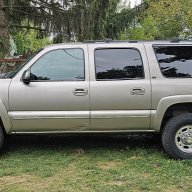
The past two days have pretty much been a wash. Other responsibilities and rain have kept me away from my Escalade. However, I did get a brief chance to start to learn how to use my new borescope. I was able to look in cylinder #3 with the piston near BDC.
#3 cylinder walls and piston. I 'think' this is all OK for an engine that is still breaking in. I do see some light vertical scratches, but nothing can be done now. Piston crown has some carbon build up, but nothing excessive like oil burning.
(Ignore the date/time stamp. I had not yet properly set the date/time.)
Intake valve and combustion chamber.
Exhaust valve and combustion chamber.
I have been doing alot of thinking, some of it in circles...
Engine started 'knocking' after approximately 60 miles. Engine ran fine the entire time, no issues or check engine light. Sound was more pronounced after 100 mile oil change. Old oil showed no obvious contamination or excessive wear. Same with cutting open the oil filter.
Mechanic's stethoscope found no sound at top of engine, nor underneath at the bellhousing. Sound was firmly under the oil pan. More noticeably at the front of the oil pan. Though the volume of oil in the rear sump could have been dampening the sound some.
Removed oil pan, found no debris or glitter in oil pan.
Inspected bottom end, no obvious visual issues. Engine turned over by hand smoothly with no noise, notchiness, clicking, etc...
Thrust bearing clearance was exactly as when I had assembled the engine.
Removed all 8 rod caps, all bearings and journals showed no damage of any kind. No rod bolts were loose.
Unbolted torque converter from the flexplate. Bolts were tight. Torque converter spun smoothly, showed no damage or discoloration.
Flexplate was tight against the crankshaft flange, no looseness of any kind felt.
Removed both valve covers, inspected valve train, no obvious visual issues. Removed 12 of 16 rocker arms and pushrods. Found no issues other than excessive preload.
Sound is from something rotating or reciprocating.
Timing chain rotates. Sound could be timing chain slapping from a broken tensioner. Engine still has VVT. Timing chain must be tensioned for VVT to operate correctly. HOWEVER: if the chain was slack, and VVT wasn't operating correctly, that 'should' end up throwing a code of some kind. And, with the crankshaft turning the camshaft, once the VVT shifted position, the chain would be tensioned again. Meaning, this would be an intermittent sound, based upon engine load and speed. Sound I heard was steady and rhythmic.
Camshaft rotates. HOWEVER: I am not sure how the camshaft rotating could make that noise. Unless a bearing has failed. During assembly, I noted that sliding the camshaft through each bearing 'felt' the same amount of tightness. If that makes any sense...
Oil pump rotates. HOWEVER: a damaged oil pump should show some debris in the bearings and/or show fluctuations in oil pressure.
Crankshaft pulley rotates. HOWEVER: pulley ran true while running, and was replaced in December of 2023 with a new GM unit.
Water pump rotates. HOWEVER: pulley ran true while running, mechanic's stethoscope found no sound from it, and was replaced in December of 2023 with a new GM unit.
Accessories rotate. HOWEVER: I fell down that hole back in September of last year when all this started. The PS pump was 'clicking' so I went through the effort to replace it. Only to not make the tapping lifter sound go away. And realize that the 'clicking' I was hearing was the vanes in the pump rotor clicking as I spun the pump by hand.
Meaning I am not sure how any of the accessories could cause the sound I was hearing from the oil pan.
Piston pins reciprocate. HOWEVER: All 8 pins felt tight in all 8 connecting rod small end bushings. No discernible play. Same with the pistons. To the point, the pin bores were tight in two of the pistons. My machinist had to hone them until the pins fit smoothly.
I can't think of anything else that rotates or reciprocates on an LS engine.
Something else to think about: engine temperature does not have an effect on the sound. I heard the sound when the engine was warm. Next morning, I did a cold start. Sound was there.
Even though I found no issues with the rod bearings and journals, and the crankshaft thrust clearance had not changed, I almost have myself talked into pulling the crankshaft main caps one at a time. To inspect the bearings and journals, and if nothing else, verify they are not the problem.