
Going down a rabbit hole here, but an injector balance test with a scanner might show if there is uneven injector metering. That's maybe a ways away, though.

Disclaimer: Links on this page pointing to Amazon, eBay and other sites may include affiliate code. If you click them and make a purchase, we may earn a small commission.
What kind of trims are we talking about?Fuel trims are negative at idle, climb up upon acceleration.
Short term trims were around -2 at idle. Long term trims were in the positive 5's if I remember correctly. I did smell the vapor return line next to the solenoid, no smell of gas.What kind of trims are we talking about?
Seems like fuel could only get in from the injectors (injecting too much, since they aren't leaking?)
Or being drawn in from the evap.. (which you said did not smell like fuel.)
I was tempted to apply 12 volts to the injectors, but refrained wandering if they work at 5 volts instead. I have the setup out, so I can still do it. At this point, with no visible injector leak and the fuel vapor return line dry, I'm starting to think of sabotage. Last fall I took the truck to a shop for safety inspection. I was mistreated at that place and walked out with a 14 point list of defects that looked more like an intentional flunk. Returning home was normal, no noises at all. I parked the truck and a month later I idled the engine, it was cold and some noise came out, like that of a bad pulley. I turned off the engine and a month later I idled it again, this time made more noise and the low oil pressure warning came up, but no engine light. I turned off the engine and left it alone until this spring, when I noticed gas smell on the dipstick. I drained the oil and it was very diluted. The new oil does not smell like gas, but I have not run it for longer than a couple minutes, with the exception of one spin around the block, which felt just fine until the low pressure oil warning came up. So here I am, with a riddle and unable to register the truck.Since you already have a set up to supply 100 PSI fuel. Get an injector electric connector, OReilly sells them, set your connector up so you can apply 12V power. With the fuel pump pressurized you can test your injectors one at a time and see the fuel spray pattern.
If they don't have a good spray pattern clean them and try again. There are Youtube videos showing how to clean injectors. It takes time but is simple. Or take them to a shop for a professional cleaning.
What about fuel trims driving around?Short term trims were around -2 at idle. Long term trims were in the positive 5's if I remember correctly. I did smell the vapor return line next to the solenoid, no smell of gas.
Looks like '07 has no FPCM, just power to it, must have a regulator, but since some hose wasn't connected, maybe was running at higher pressure?First question:
How was the previous generation fuel pump rigged?! The 07+ use the fuel pressure module to regulate the pump duty cycle via PWM, right?
I seem to have dual separate issues, both critical. Im handling the fuel in the crankcase first. Its just coincidence that the fuel in oil came after the ispection shop experience. The car drove 250 km when I bought it, no issues.What about fuel trims driving around?
Is it possible the new fuel pump fixed the gas in oil, but now you have a seperate issue? (and/or new injector o-rings will help with trims once installed)
Low oil pressure plus noise is not a great sign.. I believe the pressure must be in low single digits to turn on the light at idle.. And if just a faulty sensor, shouldn't make noise. Might be worth overfilling the oil if it's the pickup tube o-ring..
If you have that 14 point list, post it.
It does sound like a lot, but it's also hard to believe they would go through the trouble to sabotage your truck..
(maybe the wrong pump threw things off enough that they suspected other issues, and had to list all the possibilities)
After the 250 clicks coming home when I bought it, I drained the oil which came out black and thin, much like strong cofee. I dismissed it as old 5w30 or 5w20 and I did not smell it. I wander if the engine would have been able to run 250 clicks with diluted oil. I then flushed it twice, then poured in new 5w30 along with a new filter. Months went by while I was doing brake work, abs and changing the rear wheel seals plus some cosmetics. It was the end of the fall when I took it to the inspection shop. Winter came and one cold day it made what sounded like pulley noise when I started it. The noise disappeared a few seconds later and I let it idle for a few minutes. A month later it did the same thing, plus flashed a low oil pressure warning. I stopped the engine immediately. Another 6 weeks went by and I took the truck out of storage, parked it in the garage. This is when I checked the oil and found it to be diluted. I was going to replace the oil pump and the o'ring at the pick up tube, but the oil dilution has stolen the show.OK, but you said oil smelled like fuel when you got it home, double flushed it and it smelled like fuel again later. (maybe after shop visit) Driving 250km doesn't mean there was no fuel in oil?
(unless you mean shop sabotaged your oil pressure)
But it sounds like you still have fuel in oil after new fuel pump, so who knows.. things can suddenly give up..
Did you change oil filter the last time you changed oil? (that might leave enough gassy oil?) Or if your rings are toast or cylinders are glazed, perhaps mixture is blowing past? idk
The truck is not driveable now, as I removed the intake to test the injectors and replace the oil pressure sensor. Will report on fuel trims as soon as I can take a spin. I wander if disconnecting the battery will reset the ethanol percentage data and the fuel trims.Put a good scanner on it and read the short- and long-term fuel trims. It may be overfuelling.
One cause of this -- if it's a flex fuel engine -- is that the PCM thinks it's running fuel with a high ethanol content (E85), and commands more fuel.
A good scanner will show you what it thinks the ethanol/alcohol percentage is, and that should roughly match the ethanol content of the gas you're putting in the tank (e.g., E0, E10, E15, E85). If you find out that there's a wild difference, the same scanner will likely allow you to reset the ethanol percentage, and the long-term fuel trims.
Please let us know what you find out. Video below for info specific to the cause and remediation.
I also wander if my truck has the AFM high pressure pump that is known to leak fuel into the crancase. As far as I know, 2014 was the first year with that system, but Google AI insists ...
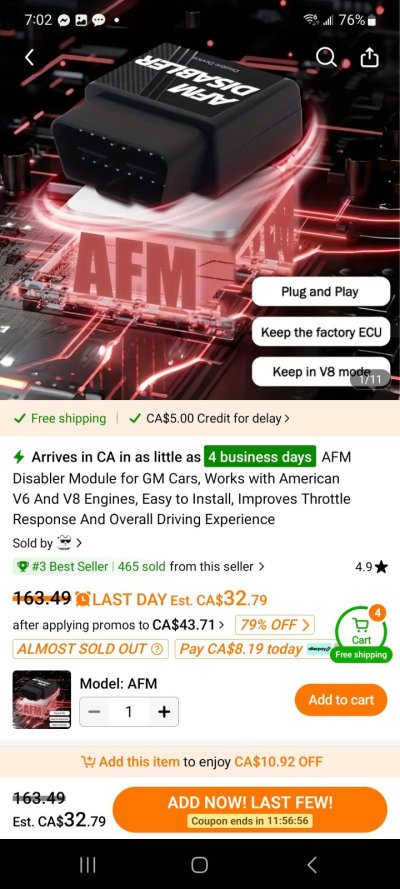
I wander what happens with the injectors when their cylinder gets deactivated. Does the ecm shuts them down? I was also looking at a DOD deactivator module that plugs into the obd socket. It is also supposed to regulate the fuel injection patterns for increased fuel economy. Has anyone had any experience with the electronic DOD deactivator?I don't think the ethanol content and long-term fuel trims get reset with a battery disconnect. Short-term trims get reset on an ignition cycle.
If ethanol content was to reset, think about how crappy the engine could run if it had to figure that out every time the battery was disconnected. Should be able to read the "calculated" ethanol content without starting the engine, so anytime is good.
I wander what happens with the injectors when their cylinder gets deactivated. Does the ecm shuts them down? I was also looking at a DOD deactivator module that plugs into the obd socket. It is also supposed to regulate the fuel injection patterns for increased fuel economy. Has anyone had any experience with the electronic DOD deactivator?
YES, that's the whole point, to shut down the fuel to (as well as closing both valves of) cylinders 1, 4, 6, & 7.I wonder what happens with the injectors when their cylinder gets deactivated. Does the ecm shuts them down?
So far as most of us know, all they do is prevent the ecm from using less than 8 cylinders; they are not known for altering fuel injections patterns.I was also looking at an AFM deactivator module that plugs into the obd socket. It is also supposed to regulate the fuel injection patterns for increased fuel economy.
Just as crappy as when you get to empty and fill up with alternate gas? Not saying they reset forsure, but I don't think it would be any worse?If ethanol content was to reset, think about how crappy the engine could run if it had to figure that out every time the battery was disconnected.
Just as crappy as when you get to empty and fill up with alternate gas? Not saying they reset forsure, but I don't think it would be any worse?
Thx for that piece of inte Mike, in my ruminations, failure of the ecm to deactivate the injectors of the 1,4,6 &7 cylinders could be the cause of my gas-in-the-oil tragedy. By the way, I measured the resistance across the pins on each of the injectors. I got 3.5 to 4.5 ohms across the team of injectors. In another wavelenght, I ordered one DOD deactivator from Temu and the listing description stated that fuel patterns are optimized. I may have swallowed bait, hook, line and sinker huh? Ill take a screen shot for you guys and eventually will be able to report the results.YES, that's the whole point, to shut down the fuel to (as well as closing both valves of) cylinders 1, 4, 6, & 7.
So far as most of us know, all they do is prevent the ecm from using less than 8 cylinders; they are not known for altering fuel injections patterns.
If this is not the case, please show info to that effect.