petethepug
Michael
A new 5.3L V8 with a 10 SP, direct injection, DFM, running on adaptive cruse and 17.5 mpg on Reg fuel isn’t bad at all. Not sure what rims and tires you’re running or how hard a/c was working.

Disclaimer: Links on this page pointing to Amazon, eBay and other sites may include affiliate code. If you click them and make a purchase, we may earn a small commission.
I find it interesting that, after decades of Corporate Average Fuel Economy testing,... window sticker values don't really reflect real world (75MpH speed limit) driving.
When I go 65 mph for appreciable amount of time I can easily meet and usually exceed the window sticker values.
Doesn't the Denali have the 6.2? I heard the 6.2 does better on the highway than the 5.3.2024 Yukon Denali XL with upgraded 22" wheel package. About 2500 miles at this point in time.
Above 65-70 MPH MPG starts to tank. Also depends A LOT of how flat the roads are. Just pul up the Fuel Ecomony display that shows Instant MPG and you will see what the throttle does to fuel consumption.
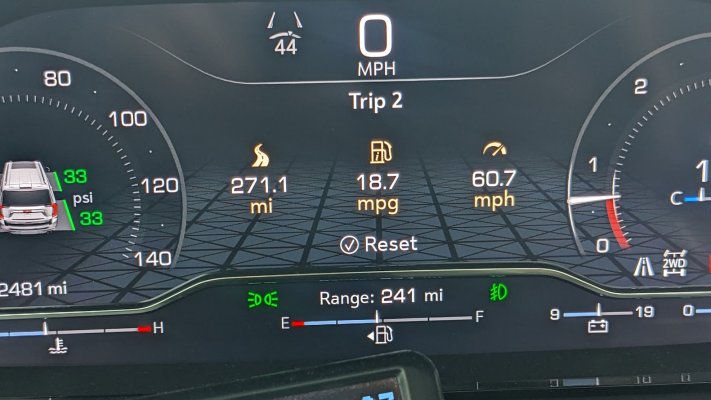
From trip yesterday. About 30 miles was in town driving for the complete trip.
Yes, Denali has the 6.2l. Forgot to add that in, just included it in the post.Doesn't the Denali have the 6.2? I heard the 6.2 does better on the highway than the 5.3.
I have a picture from the trip at 80mph it was 1750 rpmYes, Denali has the 6.2l. Forgot to add that in, just included it in the post.
With the torque the 6.2l has along with the 10 speed transmission, it seems that the engine RPM's are pretty low at cruising and you do not need much throttle to keep speed up unless the road has more of an incline. Even with a slight incline if the transmisson drops from 10th to 9th gear, the engine does not wind up. This gets better fuel economy than my 2005 6.0l Denali XL. I used to dead criuse control in the 2005 when I hit and incline. The Torque Converter Clutch would disable and the trans would drop from 4th to 3rd gear and the engine RPM would double!!! Not this 2024 on the same route, I can leave the cruise on and the inclines are easily conquered without any drama.
Engine RPM was around 1500 RPM at 70 MPH in the picture I took. I think this is pretty typical, only driving the truck 2500 miles so far.
Not sure what the 5.2l RPM is at 70 on typical configurations, might be spinning a few more RPMs?
This statement no longer applies, now that O2 sensors force a 14.7 AFR whenever the driver presses down on the go-pedal.The larger displacement doesn't need as rich an Air/Fuel ratio to get enough power to climb small hills or overcome headwinds.
How do O2 sensors force an A/F ratio?This statement no longer applies, now that O2 sensors force a 14.7 AFR whenever the driver presses down on the go-pedal.
(When lifting off, it COULD go as lean as 15.0 in rare situations,
and if load is high enough, it'll go into Power Enrichment to cool the combustion chamber and keep NOx low.)
With a 10speed, I'd not be surprised if a 6.2L would get equal or better MpGs than a 5.3L, under 70MpH at least.
Brand new vehicles typically run richer for a predetermined number of miles to aid in the break-in process. There are MANY components that are all finding their groove so to say, give it until 5k and see where you're at.
Also, cruise control will never give as good MPG as a well trained right foot in my experience over many years and miles of driving long distances.
It's what Closed Loop does, it's what O2 sensors are for.How do O2 sensors force an Air/Fuel ratio?

It's what Closed Loop does, it's what O2 sensors are for.
ecm has predictive maths tables that help it make very close guesses as to how much fuel to add
for how much air has been measured, split second by split second.
These guesses are never quite as correct as the automaker or the environmentalists would prefer, so,
once the engine is warm enough, O2 sensors refine those guesses by reacting to pre-cat exhaust gas composition.
Even O2 sensors are not quite perfect, but if the goal is between 14.667 and 14.68,
O2 sensor readings help refine the guesses so that the credibly repeatable goal at nearly every operating condition
when the driver is using the go-pedal normally is between 14.6 & 14.8.
If the vehicle is decelerating / coasting while the driver is 'lifting', the Air/Fuel ratio will likely be 14.7-14.8.
If the vehicle is accelerating 'normally', 14.6-14.7.
Overarching goals are to keep the catalytic converters alive as long as possible (why oil has less zinc today),
and to reduce NOx as much as possible, by keeping Air/Fuel ratios very close to 14.7 whenever reasonably possible.
If the o2 sensor is only sensing the contents of exhaust how can it “force” a specific af ratio?
It is a legit question for someone who thinks that the oxygen sensor sets the af ratio, or “forces” it.Are you trolling / trying to argue semantics ,,,or is this a legit question?
Because it's kind of basic 101 level stuff he's talking about, and most people that know what an air fuel ratio is, also know what Marky Dissod is talking about.
Sure arguments could be made that its not the sensor itself controlling the air fuel ratio, but the input the sensor gives the PCM but really, arguing over semantics like that is like Range Technology arguing that zero cylinder is not part of DFM, so their device technically disables DFM even though it still allows the lifters to collapse on every drive.
...
It is a legit question for someone who thinks that the oxygen sensor sets the af ratio, or “forces” it.
Hardly semantic issue when confusing inputs and outputs in feedback control loops.
As you said 101 stuff here so it should be easy to explain.
I used to do engine development and that was a common practice. I can't say for certain that all manufacturers do it, but it's a way to ease the new motors into life because you can't be certain people will treat a new engine properly right off the bat.How did you determine that, “Brand new vehicles typically run richer for a predetermined number of miles to aid in the break-in process”?