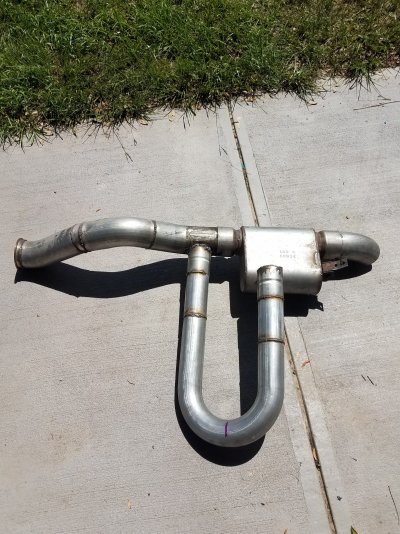
Since the whole idea is to reflect a sound wave back onto itself (at least a "part" of it), focus on it more from a mechanical perspective. Two waves have to crash into each other, and a direct blow would be more effective than a glancing blow. Or, picture one car traveling on a highway being T-***** by another car 1/4 the size. Now, picture that same 1/4-sized car NOT hitting it as a direct T-bone, but more of a glancing blow, almost a sideswipe. Which will be more effective at transferring energy? Now, to add in the baffles of the muffler: Picture two or more cars on the highway of various sizes (the main exhaust traveling through the system and muffler). How are you to determine what car would be 1/4 of the size of, well, multiple sized cars? At best, you could average the size of the cars and create a car 1/4 the size of that. But, the effectiveness of that one 1/4-sized car is spread among a few variously-sized cars so they all are less effected when it T-bones or even just grazes them.
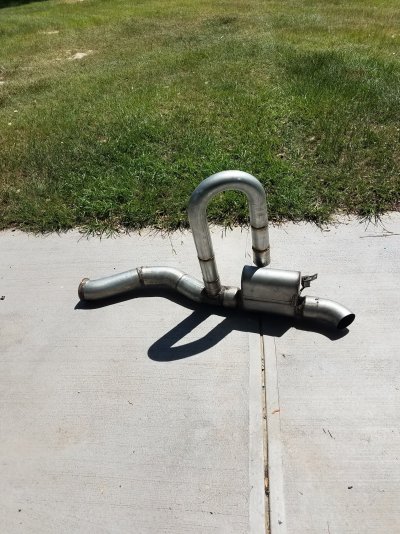
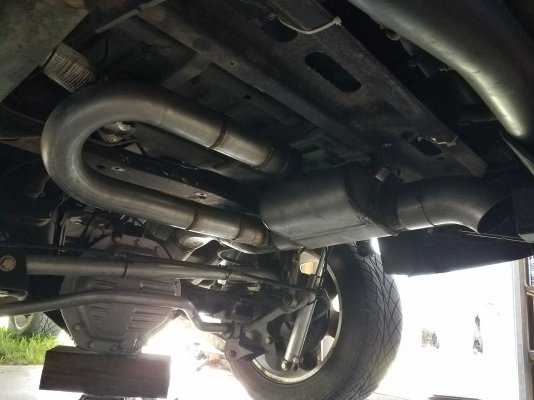
The Gibson uses a bit of the Helmholtz effect by letting the sound waves escape through the holes where they collide with the remaining ones that course through the tubes and chambers.
You said the drone is strongest at 1,500 but comes back around 2,100. That's a 600 RPM difference. So, do you hear any remnants of it at 900 RPM? Keep in mind engine load plays a role in this. So, your throttle angle may reveal or hide the drone at various RPM. Being a wave produced by pulses, it should repeat in multiples (1,500 RPM, 3,000 RPM, 4,500 RPM, etc.). It'll change due to engine load (viewed as the density of the air through the pipe at a given RPM) and not purely just the frequency of those pulses.
Go for the kill and size your pipe for the worst of it and reassess.