Help with cylinder 5 misfire P0305 (sorry, long post... but stumped)

Disclaimer: Links on this page pointing to Amazon, eBay and other sites may include affiliate code. If you click them and make a purchase, we may earn a small commission.

mckpaul

TYF Newbie
Joined
Jun 7, 2018
Posts
14
Reaction score
14
Location
Houston, Texas
Hey folks, I’m new here. I’ve been reading post for a while, my vehicle before the 2010 Tahoe I now have was an ’03 Tahoe.

I’m looking for input on a problem I can’t wrap my mind around. A quick bit of info about me, I’m one of those older guys from the days of points and condensers and manually setting your timing (1970’s era) etc. I never built ‘hot rods’ so I never got deep into the technical side of things, but I have rebuilt 3 or 4 engines over the years and usually do all my own repairs. I’m not into engine modifications, pretty much an OEM spec kind of guy. I do commercial low voltage electronic systems for a living, so I have no problem with automotive electrical, and have a decent understanding of module control of inputs and outputs. I’m not a pro at this by any means, but I’m also not a newbe. No doubt you can get over my head if you happen to be a pro and have some input, but hopefully you won’t have to candy coat it too much.

So back in November, I traded my ’03 Tahoe in for a 2010 LT Z71 Tahoe with a 5.3 and 120,000 miles. I plugged in my cheap code reader and there were no codes and all the monitors were ready, and it ran fine, so, no need to fix what’s not broken. I wasn’t real pleased with the mileage, it averaged a little better than 13.5 mpg, but figured I’d work on that as time went on. I did put new plugs and plug wires in the first month.

Back in April it started idling rough, but didn’t throw any codes. Knowing it’s 8 years old with over 120,000 miles, and not knowing the history, I don’t have a problem replacing parts so I’ll know what I have, especially anything that will help gas mileage. I replaced the throttle body and position sensor (along with the accelerator pedal w/position senor), and once the idle speed settled down it was still rough, and threw a P0305 code (cylinder 5 misfire). I’ve been fighting that code ever since. I have a scan tool, I can see the misfire counter add up on cylinder 5, and it seems to be only at an idle. I moved plugs, plug wires, coils and injectors to other cylinders, but the misfire at idle stays on cylinder 5. I researched the hell out of Active Fuel Management, which I have, and I know all the lifter issues and problems they can have, but AFM is on cylinders 1, 4, 6 and 7, and my misfire is on cylinder 5. It’s not consuming oil like the ones with the AFM lifter problem. I’ve replaced the Mass Air Flow sensor, MAP sensor, water temp sensor was replaced when I changed the water pump back in February (shaft bearing was starting to squalk), I changed the oil pressure sensor (and the VLOM screen underneath it) just to be sure the oil pressure reading I was seeing was accurate. I changed the vapor canister purge valve and vapor canister vent valve (problem with gas pump handle disengaging while filling the tank), I changed both the crank and cam position sensors (and did the crank position relearn), still have the misfire.

I’ve checked compression with all the plugs out, over 180 pounds on every cylinder, including cylinder 5. I checked vacuum (inserting a ‘T’ at the brake booster vacuum connection) 19 inches at idle, goes to 17 inches if the AC is on.

I have a noticeable loss in power, most of the time it feels like I’m towing a pontoon boat. My gas milage is down around 12 mpg or less.

I noticed on my scan tool the long term fuel trim on bank 2 was running about +12 at idle, but would go down to about +1 while driving, while not the same bank as cylinder, assumed I had a vacuum leak on bank 2. I also noticed O2 sensor Bank 1 Sensor 2 constantly stayed around 810 mV regardless of what the others were doing. Thinking the O2 sensors may be the original ones I went ahead and changed them. I suspected that if they were getting old and slow and sending bad info to the ECM, that when it was open loop (with a vacuum leak) and then going closed loop and seeing bogus info from the O2 sensors and making fuel adjustments for that that it was constantly changing fuel mixture as it bounced in and out of open and closed loop mode, which I thought may be why it was so sluggish.

I decided to change the intake gaskets, went with Felpro. While I had the intake off I went ahead and changed the fuel injectors. The long term fuel trim is back down low again so apparently I did have some vacuum leaks. And now I feel better about the fuel injectors actually delivering what the ECM thinks they are delivering. But, still have the misfire on cylinder 5 and recurring P0305 within two drive cycles.

I can pull the injector electrical connector off cylinder 5 while idling and it really doesn’t change the idle speed. At that point I was suspecting maybe the ECM is stuttering on the pulses to the cylinder 5 injector. I put a noid light on the injector connector for cylinder 5 and at an idle (when the scan tool is steadily counting misfires on cylinder 5) I’m seeing a nice steady light pulse not missing a beat. I put a spark indicator on the spark plug, same thing, steady light pulse, not missing a beat.

Now, off with the valve cover. Cranking the engine over I can see both valves on cylinder 5 open and close as they should. I put #5 at TDC and removed the rocker arms, no visible damage, no cracks, no wear. Pulled the push rods, not plugged, you can clearly see light thru them and their walls just like looking through a new straw. Both valve springs look fine, neither is broken, both seem to be keeping the valve closed tightly. That didn’t satisfy me, so (after reinstalling the rockers) I hung the coil pack with some string, reconnected the harness and plugs and started the motor to watch the rockers in action. Neither valve missed a beat, both opening and closing the same amount as the other valves by just watching them (I’m sure there’s probably a scientific way to measure that, but with the naked eye they appear to be working just fine) Both pushrods are pushing out oil on top of the rock arm, not tapping any louder than the other, so I’m thinking the lifters are. I got my stethoscope and listened to the fastening nut on all 8 rocker arms. I will say this. On seven of the eight rocker arms you can hear that whirring sound of the engine and a slight tapping sound as the valve operates, but the exhaust valve of cylinder 5 was a little louder and sounded kind of rattley in between taps. Not extremely louder than the others with the stethoscope, but enough to notice it was not as smooth and quite as the others. BUT, still opening and closing the valve and pumping oil. And with the naked ear, it’s no louder than any of the others.


I found a TSB (#11-06-04-007B) about changing the throttle position sensor that said for Tahoes from ’08-’10 if you put a new throttle position sensor that you MUST reflash the ECM with he latest software, but from ’11 up the reflash was not required. Mine is a 10 and I have changed the throttle body/throttle position sensor as and assembly, so I put the old one back on for now just to be sure that’s not causing an issue.

So I’m at a loss. I’ve used all ACDelco parts (except for the Felpro intake gaskets) I’ve eliminated every external thing I can think of that could cause a misfire, I have compression, vacuum, fuel pressure running 58-60 psi key on and engine off, and stays around 58 psi at idle, no vacuum leaks. The one and only thing I’ve found wrong with cylinder 5 is a little extra noise on the exhaust rocker are when listening with a stethoscope. I may be wrong, but I can’t believe THAT is enough to cause a constant misfire since the valve is opening and closing as expected.

The only thing I haven’t changed is the knock sensors. Starting in ’07, they moved them from underneath the intake to down on each side of the of the lower block. Easy to get to now, and ironically the one on the left side is about where the #5 cylinder is. The scan tool shows no knock on any cylinder. I really don’t thing a bad knock sensor would cause a cylinder specific misfire, but they are less than $8 each at Rockauto, so I ordered a couple of them.

On a side note, I’ve also ran some Seafoam in the oil for about 200 miles thinking if the problem was a lifter it would loosen up. I haven’t tried Marvel Mystery Oil yet.

If you have any input that would help I would appreciate it. I’ve seen posts about misfires on discussion boards, but most of the time there is no follow up post if they fixed the problem. If I find a solution I will absolutely post what I did to resolve it.

Thanks for reading if you got this far, sorry it’s so long.
 
Last edited:

swathdiver

Full Access Member
Joined
May 18, 2017
Posts
21,315
Reaction score
30,312
Location
Treasure Coast, Florida
Hey Paul, I think you got a bad lifter and or a wiped lobe on the camshaft. I also think your cat on the driver's side is no good. At this mileage, they both probably need replacing.


I was having steadily worsening mileage right after I bought my truck last year. After all the fussing around it was the cats. I replaced them with a Magnaflow Y-pipe and cats. Mileage is back. Truck never seemed down on power, just mileage.

Sometimes, a bad cat can cause a misfire on a weak cylinder. I think you're going to need to fix both. Do the cats first and then the camshaft and lifter if needs be.

Welcome to the forum btw! Lots of fellas on here from Houston!
 
OP
OP
M

mckpaul

TYF Newbie
Joined
Jun 7, 2018
Posts
14
Reaction score
14
Location
Houston, Texas
Hey James,

Thanks for the reply. I thought about the lobe on the cam while listening to it. I don't know if the lifters have rollers on the bottom, but wondered about that too. Either way, if it's not bad yet, it's making unusual noise so it'll probably go eventually.
I don't know a lot about the scan tool readings yet except that it looks to the O2 sensors and uses that data to determine what it needs to do with the fuel mixture. I read you can tell the health of your cats looking at sensor 1 vs sensor 2 readings, but I'm not sure I have stable enough readings at this point to make any sense of them. I read another post where someone replaced the y pipe/cats and really improved things.

I'm hoping it's not the lifter and or cam mostly because of the cost if I have it repaired. I could do it, but getting to the age that I just don't want to. Or have the time to laundry list and buy all the parts and research everything.

But you're probably right, it'll probably end up being a major repair. My brain is just screaming "No there must be a way around it!"...probably wishful thinking.
 

swathdiver

Full Access Member
Joined
May 18, 2017
Posts
21,315
Reaction score
30,312
Location
Treasure Coast, Florida
Hey James,

Thanks for the reply. I thought about the lobe on the cam while listening to it. I don't know if the lifters have rollers on the bottom, but wondered about that too. Either way, if it's not bad yet, it's making unusual noise so it'll probably go eventually.
I don't know a lot about the scan tool readings yet except that it looks to the O2 sensors and uses that data to determine what it needs to do with the fuel mixture. I read you can tell the health of your cats looking at sensor 1 vs sensor 2 readings, but I'm not sure I have stable enough readings at this point to make any sense of them. I read another post where someone replaced the y pipe/cats and really improved things.

I'm hoping it's not the lifter and or cam mostly because of the cost if I have it repaired. I could do it, but getting to the age that I just don't want to. Or have the time to laundry list and buy all the parts and research everything.

But you're probably right, it'll probably end up being a major repair. My brain is just screaming "No there must be a way around it!"...probably wishful thinking.

My pleasure Paul. These motors have roller lifters. When underway, the upstream O2 sensors will cycle quickly up and down and the downstream sensors will be more steady if they're in good shape. If they're cycling a lot it is an indicator of a bad cat. Hope I remembered that right! If none of the sensors move a whole lot, act lazy, that's a sign that they're (the sensors) going/gone bad. There are places in town and just north of Austin in Georgetown is Texas Speed and Performance. They could do the AFM delete if needs be.

More will chime in tonight after they get home and have dinner. I have read on here that bad cats have caused cylinder(s) to misfire.
 

gpracer1

Full Access Member
Joined
Jun 16, 2011
Posts
914
Reaction score
374
Location
Phoenix
In order f least to most expensive I would go plugs, wires and then lifters.
Looks like you have almost covered everything.
 
OP
OP
M

mckpaul

TYF Newbie
Joined
Jun 7, 2018
Posts
14
Reaction score
14
Location
Houston, Texas
I've read a couple of posts about the plastic retainer that holds the lifters allowing a lifter to rotate so the lifter roller isn't rolling on the cam, but instead the roller is dragging sideways on the cam. Does anyone know if this is a common thing? The posts I read said when it happened it was a pretty violent misfire. The misfire on mine is pretty subtle. I can feel it lightly when in gear and stopped, but in neutral it's not noticeable. And once moving it's not noticeable. I would imagine if a lifter were rotated, when listening the way I did with the stethoscope on the rocker arm nut that it would have been very loud with a heavy grinding sound. But, to face the truth, the fact that that one exhaust valve sounded different at all makes it a ticking time bomb about to fail.

I've paid closer attention to drivability since I originally posted. From a dead stop on a straight road I'd rate the acceleration as OK. On the road, going say 45-50 at a steady pace, if I go to accelerate, it hesitates some and I have to give it a little more pedal than I would expect, but it will accelerate. Where it's feels like it's dragged down is after turning a neighborhood corner, or pulling out of a parking lot for example, and by the time you get turned and straigt and need to step on it (after it moves up to 2nd while turning) is when it feels like the timing is off, or like you're pulling a large load. It will go if you really put your foot in it after it hesitates.

I've watched the estimated mileage on the dash go from 13.8 to 13.5 etc gradually down to 12 mpg. No doubt I'm gradually plugging the cats. If so it's not bad enough yet to have enough back pressure to make it undrivable, but I have a feeling it's getting there. Tonight I'm going to get on the road and set the cruise and see if I can get a picture of a graph that shows B1S1 and B2S2 compared on one graph, and the same for bank2. I've tried that at an idle but the pre-cat sensors don't seem to produce a steady sine wave type graph. (keep in mind they are new, just installed new ACDelco )2 sensors less than a week ago)
 

David Smith

Full Access Member
Joined
May 2, 2017
Posts
415
Reaction score
268
Location
Savannah, GA
In order f least to most expensive I would go plugs, wires and then lifters.
Looks like you have almost covered everything.
I have actually had a brand new plug be bad before. Replaced all the plugs on my old truck and it misfired. Replaced the "new" plug with another "new" plug, and no more misfire...definitely worth replacing them before any serious money is spent.
 
OP
OP
M

mckpaul

TYF Newbie
Joined
Jun 7, 2018
Posts
14
Reaction score
14
Location
Houston, Texas
I'll definitely swap a couple of plugs around again to be sure it doesn't follow before going further. While I had the driver side coil pack assembly off this weekend to get the valve cover off, I realized there is a wiring harness on the four-coil assembly where the main engine wiring harness plugs in and then it splits off to the four coils. That little wiring assembly has 4 dedicated coil trigger wires in it, but the other three wires on each coil are common to each other (power ground etc). Under the plastic cover on the little harness are three factory splices. I googled the harness and there is only one part number that works for both driver and passenger side, so that told me I could swap the entire four-coil assembly from side to side. So I put the driver set of coils on the passenger side and vise-versa. If one of those splices was loose I thought maybe the problem would transfer to cylinder 6, plus that put still a different coil on cylinder 5. But...no cigar. So that eliminates at least some of the wiring and the probability of it being a weak coil. As frustrating as it is, this process continues to be educational.
 

swathdiver

Full Access Member
Joined
May 18, 2017
Posts
21,315
Reaction score
30,312
Location
Treasure Coast, Florida
The photos I've seen of lifters turning sideways took out the cam lobe and there were metal shavings on the magnet and everywhere else. If your oil is clean you can almost rule that out.
 

Rocket Man

Mark
Supporting Member
Joined
Dec 25, 2014
Posts
26,679
Reaction score
52,954
Location
Oregon
There is a TSB that might relate to this which concerns the valvetrain:

#PIP4138Q: SES Light, Misfire, DTC P0300, And/or A


Chirp, Squeak, Squeal, Or Tick Noise - Potential Valvetrain

Concern - (Jan 24, 2018)

Subject: SES Light, Misfire, DTC P0300, And/or A Chirp, Squeak, Squeal, Or

Tick Noise - Potential Valvetrain Concern

Brand: Model:

Model Year: VIN:

Engine: Transmission:

from to from to

Buick

Allure

(Canada

Only)

2008-2009 All All V8 ALL

Buick LaCrosse 2008-2009 All All V8 ALL

Buick Rainier 2004-2007 All All V8 ALL

Cadillac CTS-V 2006-2018 All All V8 ALL

Cadillac Escalade 2002-2018 All All V8 ALL

Chevrolet Avalanche 2002-2013 All All V8 ALL

Chevrolet

Caprice

PPV

2011-2018 All All V8 ALL

Chevrolet Colorado 2009-2012 All All V8 ALL

Chevrolet Camaro 2010-2018 All All V8 ALL

Chevrolet Corvette 2005-2018 All All V8 ALL

Chevrolet Express 2002-2018 All All V8 ALL

Chevrolet Impala SS 2006-2009 All All V8 ALL

Chevrolet

LCF

Models

2016–2018 All All V8 ALL

Chevrolet

Monte

Carlo SS

2006-2007 All All V8 ALL

Chevrolet SSR 2003-200©6 2018 GeneralA Mllotors. All riAglhlts reservedV. 8 ALL

Document ID: 4956036 Page 1 of 5

https://gsi.ext.gm.com/gsi/showDoc.do?docSyskey=4956036&from=nb 1/29/2018

Brand: Model:

Model Year: VIN:

Engine: Transmission:

from to from to

Chevrolet Silverado 2002-2018 All All V8 ALL

Chevrolet

Silverado

HD

2002-2018 All All V8 ALL

Chevrolet Suburban 2002-2018 All All V8 ALL

Chevrolet Tahoe 2002-2018 All All V8 ALL

Chevrolet TrailBlazer 2003-2009 All All V8 ALL

GMC Canyon 2003-2009 All All V8 ALL

GMC Envoy 2003-2009 All All V8 ALL

GMC Savana 2002-2018 All All V8 ALL

GMC Sierra 2002-2018 All All V8 ALL

GMC Sierra HD 2002-2018 All All V8 ALL

GMC

Yukon

Models

2002-2018 All All V8 ALL

Hummer H Models 2003-2010 All All V8 ALL

Pontiac G8 2008–2010 All All V8 ALL

Pontiac GTO 2005–2006 All All V8 ALL

Pontiac

Grand

Prix GXP

2005–2008 All All V8 ALL

Saab 9-7X 2005-2009 All All V8 ALL

Supersession Statement

This PI was superseded to update Model Years. Please discard PIP4138P.

The following diagnosis might be helpful if the vehicle exhibits the symptom(s) described in this PI.

Condition/Concern

Some customers may complain of a SES light, engine misfire, and/or engine noise.

If the SES light is on, the technician will find a P0300-P0308 DTC with misfires counting on a

single cylinder that may or may not be felt.

This may occur consistently, or it may occur intermittently.

Document ID: 4956036 Page 2 of 5

https://gsi.ext.gm.com/gsi/showDoc.do?docSyskey=4956036&from=nb 1/29/2018

If a noise is verified, it will not be eliminated by canceling fuel injectors and the noise will occur at

camshaft speed (half of crankshaft speed).

The noise may be described as a chirp, squeak, squeal, or tick noise and may increase off of idle.

In either case, the cause of this concern may not be isolated after following SI diagnosis. This PI

is written for technicians who experience this concern and follow SI diagnosis without isolating the

cause of this concern.

Recommendation/Instructions

If SI diagnosis does not isolate the cause of this concern, it may be the result of any of the

following:

1. Worn camshaft lobe and/or lifter roller

2. A sticking valve

3. Valve leakage

4. A broken valve spring

5. A collapsed AFM (Active Fuel Management) lifter.

If SI diagnosis does not isolate the cause of this concern, review the information below, determine

which description best matches the vehicle you are working on, and perform the suggestions as

necessary, starting with the easiest ones first:

1. Worn Cam Lobe and/or Lifter Roller:

Generally, a worn cam lobe on this engine family will create a consistent chirp, squeak, squeal, or

tick noise at camshaft speed and/or a misfire with a P0300-P0308 DTC. The misfire may or may

not be felt and the misfire could occur at all RPM or just a specific RPM, such as idle only or only

at high RPM. If a noise is present, it will not be eliminated by cancelling fuel injectors and

generally, the static compression and cylinder leakage will be similar on all cylinders.

The following suggestions may help determine if a worn cam lobe and/or lifter is causing this

concern:

• Use a wooden hammer handle to apply pressure to the following locations of the rocker

arms during the noise to determine which one is making noise: valve side, push rod side,

and side of the rocker. If the noise is changed by applying pressure to the valve side of the

rocker, this is most likely the result of a lifter and/or cam lobe concern on that cylinder.

Sometimes this works, sometimes it does not - it seems to depend on the amount of cam

lobe wear.

• Disconnect the coils and injectors on one bank of the engine, run the engine with the

related valve cover removed, and back off the related rocker arm a couple of turns and

listen for a change in the noise. If necessary, both rockers and push rods can also be

removed one cylinder at a time with the related coil and injectors disconnected. If the noise

is eliminated and there is no problem found with the valve spring, push rod, or rocker arm,

this is most likely the result of a worn lifter roller and/or cam lobe.

• Measure the cam lobe lift at the push rod side of the rocker arm. The lift in this location will

differ from the SI specification but it should be similar as compared with other rockers on

the same bank. The misfiring/ticking cylinder should obviously have less lift than the

comparison cylinders if this is the result of a worn lifter roller and/or cam lobe. Another

possibility of no/low lift on cylinders 1, 4, 6, or 7 on an AFM engine would be a collapsed

AFM lifter. If a collapsed AFM lifter is found, refer to the latest version of PIP4568 for

additional information.

• On engines with AFM (active fuel management), you can command AFM on with the scan

tool, which will unlatch the lifters on cylinders 1, 4, 6, and 7 and stop opening the related

valves. If the noise is eliminated, there is a good chance that the noise is coming from the

valvetrain of cylinders 1, 4, 6, or 7. If there is no problem found with the push rods,

Document ID: 4956036 Page 3 of 5

https://gsi.ext.gm.com/gsi/showDoc.do?docSyskey=4956036&from=nb 1/29/2018

rockers, or valve springs, the noise is most likely coming from a worn lifter roller and/or

cam lobe on cylinders 1, 4, 6, or 7.

Note: The above step will not work on 2017 and 2018 models.

• If the tests above do not isolate the cause of this concern, it may be necessary to visually

inspect the lifter rollers and cam lobes for obvious damage, such as flat spots, pits, grooves,

scoring, gouging, flaking, rusting, etc...It is very easy to overlook a damaged cam lobe

when inspecting them through the lifter bores and just because the lifter rollers are not

worn, does not mean that the related cam lobes are okay. Both pieces need to be carefully

inspected. It may help to use a bore scope or pen light when inspecting the cam lobes

through the lifter bores. In some cases, the worn cam lobe may not be discovered until the

camshaft is physically removed from the engine and inspected for the issues mentioned

above.

Notice: Follow SI procedures to replace the camshaft and all lifters if a worn camshaft lobe

or lifter roller is found. Also replace the plastic lifter guide for the lifter that had the

damaged cam lobe and/or lifter roller (For 2010 Model Year, replace all of the

plastic lifter guides). On AFM engines, also replace the VLOM (Valve Lifter Oil

Manifold) filter screen that is under the oil pressure sensor.

2. Sticking Valve:

Generally, a sticking valve on this engine family will cause an engine misfire that may or may not

be felt and it may occur consistently or intermittently. It is unlikely that any engine noise will be

present. It may be temperature sensitive and it may be more apparent during certain operating

conditions, such as driving up a grade, cresting a hill, or during hard acceleration. A good

indicator of a sticking valve is if engine misfires continue to count on an aggressive deceleration

with engine braking. If the misfire occurs consistently, a static compression test, running

compression test or cylinder leakage test may isolate the sticking valve. However, it is unlikely

that any of these tests will isolate the sticking valve if the misfire only occurs while driving at

specific conditions.

The following suggestions may help determine if a sticking valve is causing this concern:

Follow SI procedures to remove the valve springs and seals from the valves of the misfiring

cylinder. Before removing the air pressure from the cylinder, tightly wrap a rubber band or tie

strap around the tip of each valve stem to prevent the valves from dropping into the cylinder.

Release the air pressure from the cylinder and work the valve up and down in the guide while

turning the valve 360 degrees.

If any binding is felt, a stem to guide clearance concern exists and should be repaired by following

SI procedures.

If okay, rotate and snap the valve onto the valve seat to make sure that it easily comes off of the

seat again. If you have to use force to tap the valve off of the seat, excessive carbon build up

exists, which may be repaired by decarboning the engine.

Notice: Refer to the latest version of PIP4753 for decarboning instructions.

3. Valve Leakage:

Generally, valve leakage on this engine family will cause a consistent engine misfire that may or

may not be felt and is more apparent at idle or low RPM. Normally, no engine noise will be present

and in most cases, a static compression test or running compression test will not reveal anything

abnormal unless the leakage is very high.

Typically, the Cylinder Leakage Test outlined in SI should isolate valve leakage by finding

excessive leakage past an intake or exhaust valve, as compared with others.

Notice: If a valve sealing concern is found, it should be repaired by following SI repair

procedures.

Document ID: 4956036 Page 4 of 5

https://gsi.ext.gm.com/gsi/showDoc.do?docSyskey=4956036&from=nb 1/29/2018

4. Broken Valve Spring:

Generally, a broken valve spring on this engine family will cause a tick noise and/or an engine

misfire. In either case, the concern may occur consistently or intermittently. If it is causing an

engine misfire, it may or may not be felt and it may only occur at specific operating conditions,

such as high RPM driving, etc...

In some instances, a static compression test, running compression test, and/or cylinder leakage

test may isolate the broken valve spring, while in other instances; it may not if the spring remains

stacked together during the tests. As a result, it may be necessary to visually inspect the valve

springs by closely examining them. Sometimes, the two broken pieces of the spring will remain

stacked together so it may be hard to detect when visually inspecting them. As a result, it may

help to lightly push on different places on the springs with a small hammer handle.

Notice: If a broken valve spring is found, replace the broken valve spring as necessary.

5. Collapsed AFM Lifter (Engines with AFM Only):

Some customers may comment on an SES light, engine misfire, and/or tick noise. This may be

the result of an AFM lifter that unlocks as soon as the engine is started or one that is mechanically

collapsed/stuck.

If an AFM lifter unlocks as soon as the engine is started, a SES light and DTC P0300 will be

experienced with engine misfires on cylinder 1, 4, 6, or 7 but it is unlikely that any noise will be

experienced. If an AFM lifter is mechanically collapsed/stuck, a consistent valve train tick noise,

SES light, and DTC P0300 will be experienced with engine misfires on cylinder 1, 4, 6, or 7.

Notice: If either of these AFM lifter concerns is suspected, please refer to the latest version of

PIP4568 for additional information.

Notice: If there is an AFM lifter concern on RPO's L83, L86, LT1 and LT4 follow 15-06-01-002E.

Warranty Information

For vehicles repaired under warranty, please use the appropriate warranty labor operation based

on the actual cause and repair.

Please follow this diagnostic or repair process thoroughly and complete each step. If the condition

exhibited is resolved without completing every step, the remaining steps do not need to be

performed.

GM bulletins are intended for use by professional technicians, NOT a "do-it-yourselfer". They are written to inform these

technicians of conditions that may occur on some vehicles, or to provide information that could assist in the proper service of a

vehicle. Properly trained technicians have the equipment, tools, safety instructions, and know-how to do a job properly and

safely. If a condition is described, DO NOT assume that the bulletin applies to your vehicle, or that your vehicle will have that

condition. See your GM dealer for information on whether your vehicle may benefit from the information.

WE SUPPORT

VOLUNTARY

TECHNICIAN

CERTIFICATION

Document ID: 4956036 Page 5 of 5

https://gsi.
 
OP
OP
M

mckpaul

TYF Newbie
Joined
Jun 7, 2018
Posts
14
Reaction score
14
Location
Houston, Texas
James - Yeah that's kind of what I was thinking. I didn't notice any metal shavings in my last oil change. Now I'm wishing the when I did the intake manifold gaskets that I would have pulled the VLOM manifold to take a peek under it. From what I've seen in pictures you can see the bottom of the lifters where they ride on the cam. Not sure if you can see both intake and exhaust, but looked like there were small openings just big enough to see a little bit of the cam and lifter. But I agree, I don't think there's a rotated lifter. I think that would make enough noise to be heard without the stethoscope , and I also think it would have been REALLY loud through the stethoscope.

Mark - That TSB had a lot of info in it. I'm going to see if I can find a pdf of it online and save it, or copy and paste to WORD. Of course the links to side procedures said I didn't have authority to open them, but that gave me some things to check on that exhaust rocker. I looked at the valve springs on the sides I could see and felt around the back sides, nothing looked or felt unusual, but if...(or more likely,when).. I get back into the valve cover I'll get a close look all the way around. I have one of those flexible gooseneck USB inspection cameras that will give me a view of the back sides up close. Looks like that TSB just came out in January. Obviously some of it is about the AFM system and luckily at the moment my issue doesn't involve any of those cylinders. I have to wonder if all that is just a problem waiting to happen, but then again as I researched the AFM stuff it kind of looked like most of the vehicles with issues were from the earlier years of the AFM technology, didn't see as many newer year vehicles with problems. But...that could be because they haven't been on the road as long.

If it comes to breaking into the engine for lifters and cam, I may do the AFM delete. I have to wonder how much mileage a fully functional AFM system really adds and if it's worth keeping, replacing the VLOM manifold and such during the repair.

There's a ton of info on the web about the 5.3 engines up to '07. There are several changes made in '07. When I was looking for intake manifold bolts I found that starting in '07 they no longer have the crush washer on the bolts. The knock sensors are no longer under the intake and now on the sides of the engine (I guess because of the VLOM being under the intake instead) The cam position sensor is moved to the timing chain cover. Just saying, when searching for youtube videos for various procedures (to learn from other peoples mistakes lol) there aren't as many out there for the '07 & up Tahoes.

I appreciate the input on all this. I don't have to get inspected until November, but right now if I had to, I couldn't. And this is my daily driver...that I'm paying a car note on...and it's driving me crazy and running me in circles. I've never had this much trouble solving a problem. On one hand it seems so minor, you really almost can't feel the miss, only at stop lights, it's not audible tapping noises, the drivabilitiy is down some, but not a major, but looking more and more like the heads need to come off and the cam pulled out. On a side note, still haven't ruled out the cats. I found some info that said a quick way to get an idea if the cats are contributing to the problem is to pull the upsteam O2 sensors (basically venting the exhaust before the cat) and see if things improve, but sounds like that would cause just as many or more issues when the ECM loses it's input. I guess if I did it on a cold start when it's running open loop and check for misfires it might do some good, but I have my doubts.
 
OP
OP
M

mckpaul

TYF Newbie
Joined
Jun 7, 2018
Posts
14
Reaction score
14
Location
Houston, Texas
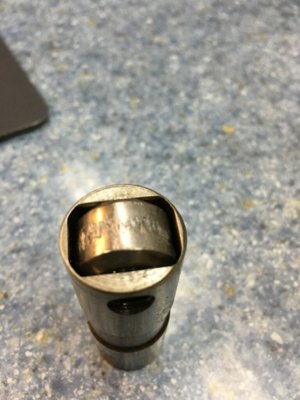
Well, I gave up and dropped the truck off at a GM certified shop near me. After a couple of days messing with it he called and said he was pretty sure it was a lifter so I told him to go ahead and dig in. He found the exhaust lifter on #5 to have a roller that was kind of chewed up and the cam was damaged as well. I attached a pic of the lifter, I hope it's visible. It's frustrating because No. 5 not even an AFM cylinder. He said the plastic lifter tray wasn't cracked and it didn't appear the lifter had rotated, not sure why it did what it did. However I'm not the original owner, it was a trade in vehicle at a Ford dealership when I purchased it back in November. It may have had repairs prior to me buying it that were done poorly just to make it run to trade it in.

So of course that meant new cam and all new lifters. I made sure he got the newest updated GM lifters, replace the plastic lifter trays, and had him change the VLOM to the newer updated version. Knowing he was going to have the timing chain cover off and would be looking at the oil pump, I had him replace that too.

The truck now idles quietly and smoothly, no misfires, and has the throttle response of a new truck.

On a side note, a week prior to the repair I put new y-pipe/cats on the truck, bought it online from AB Catalytic, exact bolt up replacement. Since I got the truck back it threw a P430 code, poor cat performance bank 2. The cats are literally 3 week old and only ran a limited amount on the engine with the bad lifter before the repair. I know the cats are good. I don't want to continue on that topic on this thread, I'm going to start a new one on just that subject. Just wanted to say thanks to all who shared their thoughts, and post the solution to the P0305 misfire in hopes it helps someone who finds this discussion later.

No 5 exhaust lifter.jpg
 
OP
OP
M

mckpaul

TYF Newbie
Joined
Jun 7, 2018
Posts
14
Reaction score
14
Location
Houston, Texas
Sorry...this was a duplicate of the one above..computer locked up and I accidentally posted twice but couldn't find a way to delete.
 

Forum statistics

Threads
138,039
Posts
1,997,651
Members
102,975
Latest member
jkhuntzinger

Latest posts

Back
Top