I don't know what these are supposed to pull, but I would assume 18-21 inHg.
Can you elaborate more on the history....how long have you owned it, and after you purchased it, what have you done to it and what if any problems were present at time of purchase and did the problems start before or after any service you performed.
Was it acting up when you bought it?
We definitely need to see what the PCM is seeing in regards to alcohol content. Could have alot of E85 in it and maybe it's not a flex vehicle.
Hey DK, sorry for the delay. I still have to check vacuum at idle. Been a inundated with other projects and had to put this one down.
I'm going to do a leak down of the injectors tomorrow. I was thinking connect scanner, look at fuel pressure. Turn key to on, and watch what it does after I hear the fuel pump stop priming right? I'll see and get back to you.
So the history, as I know it:
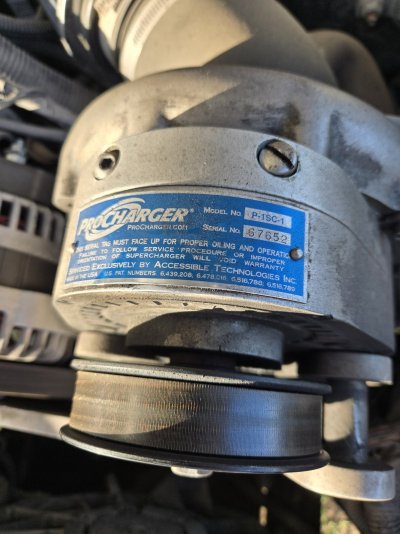
1) It's got a procharger kit making 7-8lbs of boost.
2) 2 bar map.
3) new AC Delco (Denso) 02s.
4) New spark plugs and wires.
5) Long tube headers.
6) Dual catch can setup. Clean side free flowing and ported to intake of procharger, dirty side check valved and ported to top port on intake.
7) purge valve delete (unplugged purge valve and capped intake port, but left everything else running in evap system)
When I started this thread it was running lean and I found a huge vacuum leak at the MAP sensor. LTFTs were in the +15% - +18%s. When I swapped MAP sensors, I did the smoke check and found no leaks.
But after that the LTFTs swung the opposite direction, to -15% - 18%s. Averaging, of course.
During both situations, and this sorta confuses me, the 02s were lazy and hanging in the high end of the voltage too long. So it would swing down to ~200 mV and immediately switch back to ~800 mV and stay there a while, then switch to low and quickly back to high again and stay there a while. So it wasn't switching consistently or quickly.
It's been tuned since then and it's running way better. My tuner says the MAF frequency was way off, that the injectors were tuned incorrectly and a slew of other things. He drove it around a while after his last write and it ran well.
I got it back and it ran well for a couple days until I got the same codes for lazy and insufficient switching of 02s. Checked it again and the 02s were behaving the same way as welhen I gave it to the tuner.
I really kicked myself in the ass that I didn't check the 02s immediately after getting it back from him. I suspect that perhaps he didn't catch it, but he insists that it was fine.
Since then I've been chasing the trims and trying to get the 02s to work properly.
Does anyone have a tune file for this setup that I could look at? Someone out there has to have this procharger kit installed on their 6.2. or maybe not lol.