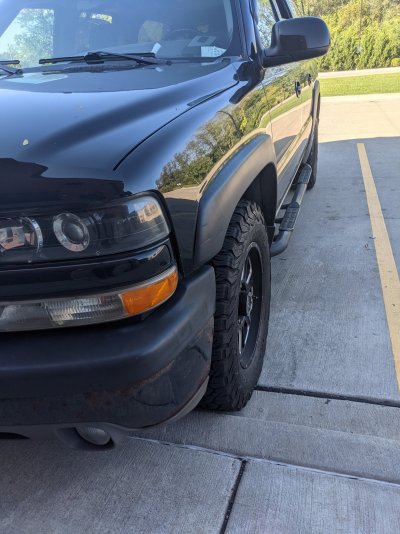
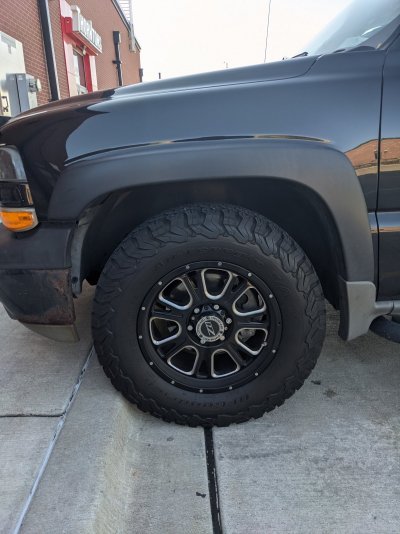
I’m considering a 2” leveling kit to assist with a little more clearance but nothing crazy. Looking like 32” is going to be my max diameter without any offset changes.
32" is the diameter of the stock tire size. With a lift, you could go a little taller. You can't get too crazy with tire size because then gear ratio would be a factor. But, it sounds like "crazy" isn't in your plans.
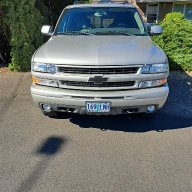
You can start out small and cheap, and I'll use mine as an example: For about a year before I lowered it, my Tahoe was lifted. I did this just as a cheap way to change it up from stock and because I had some all-season tires that looked more like an all-terrain, so lifting fit the theme. I had a 2" lift in the front with a spacer and a 1" lift in the rear, also with a spacer. No other suspension mods and I didn't even need to adjust the alignment. Since it went up, I wanted it to go "out" for it to remain proportional to my eyes, so I added 1.5" spacers (I was running the stock LTZ wheels). I don't off-road and it's a 2WD, so this was purely just for looks and to not be stock. But, I often drive everything like it's a sports car and I didn't withhold from my lifted Tahoe. No issues at all with the spacers. IMO, 1.5" is about as far as I'd go with wheel spacers.
As
@Rocket Man mentioned, hub-centric spacers are a must (if you use spacers). I bought a budget-priced set off Amazon that looked to be identical to a much pricier popular brand, just without that brand's logo. I drove my Tahoe just as hard as ever with them then put them on my brother's 4WD Sierra when I lowered mine and lifted his. He regularly goes off road and often tows a trailer with his RZR, 4-wheeler and camping gear. Never an issue. Just install them properly.
For the lift, again, I bought a budget set of strut spacers off Amazon. All this type of lift is, is a set of blocks and longer bolts. Rough Country's spacer is a polymer ("plastic"), and I'm sure is perfectly fine. But, for around $25, you can get some machined billet aluminum blocks. Metal just made me feel better and it was cheaper. They come with Grade 5 hardware, which should be fine. But, I grabbed some Grade 8 hardware from Lowe's for the cheap peace of mind. The front spacers install in about an hour and slipping the spacers under the rear coils is about another hour. "Simple, cheap and harmless" is what I'd consider this lift. IMO, a 2" spacer-only lift (front and rear) is about as high as I'd go and not give it a second thought. *EDIT* Here's an example of the lift spacers, but these look to include Grade 8 bolts:
https://www.amazon.com/dp/B0851KD6Y...9Y2xpY2tSZWRpcmVjdCZkb05vdExvZ0NsaWNrPXRydWU=
These look like the ones I used, but say they come with Grade 12.9 bolts. Like those above, they show to include nylock nuts. At $21, you can get Grade 8 hardware if their included hardware is junk and still be at half the price of RC's spacer kit:
https://www.amazon.com/dp/B091JT2P1...jbGlja1JlZGlyZWN0JmRvTm90TG9nQ2xpY2s9dHJ1ZQ==
As far as fitment, I only had rubbing at full lock. The far outside shoulder of the tire tread would rub a plastic rivet that secured the fender liner. Backing the wheel off a couple of degrees resolved it. It was so minor that a tire with a different tread profile likely would've prevented the contact. It was harmless and that setup was only temporary for me, so it wasn't worth changing tires, etc.
If you want to change the wheels, just base everything off the key points of the stock wheel and tire package- the overall tire diameter, tire width, the offset and/or backspacing of the wheels, wheel width, etc.
The type of tire will make the most difference in your off-road and/or snow capability, though. With a small lift, I'd just lift the front to level it with the rear and focus the rest of my efforts on tire selection. Unless I wanted different wheels, of course. Also, you may find that you only need 1"-1.5" to level it, and there are smaller spacers for this. For a number of functional reasons, you really shouldn't make the front higher than the rear. My suggestion is to measure the fender lip to the ground, then jack up the front until it sits where you like it. Step back and look at it because the body lines and windows affect how it looks. Measure the difference and order your lift accordingly. Just because a lift kit says "leveling" doesn't mean your truck will sit level no matter what. These things varied in their heights just as they came off the assembly line. 2" might be too much lift and 1" might not be enough.