Replacing Transmission Checklist

Disclaimer: Links on this page pointing to Amazon, eBay and other sites may include affiliate code. If you click them and make a purchase, we may earn a small commission.

dwinters14

Member
Joined
Apr 10, 2020
Posts
89
Reaction score
66
So my 2-3 third gear is now slipping (flare shifting) and I'm pretty convinced the tranny needs to go. 200k miles on her.

I'm looking around and I think the cost of a new/refurb 4L60E isn't worth it for a '03 Yukon with 200k miles. I called a local junkyard and they offer a 90 day warranty for a used trans with "approx" 75k miles for $650.

Is there anything specific I should look for on the used trans? Upgrades I can perform to help extend the longevity?

 

S33k3r

Elite Member
Supporting Member
Joined
Aug 14, 2017
Posts
2,893
Reaction score
4,189
Location
Dallas, Texas
So my 2-3 third gear is now slipping (flare shifting) and I'm pretty convinced the tranny needs to go. 200k miles on her.

I'm looking around and I think the cost of a new/refurb 4L60E isn't worth it for a '03 Yukon with 200k miles. I called a local junkyard and they offer a 90 day warranty for a used trans with "approx" 75k miles for $650.

Is there anything specific I should look for on the used trans? Upgrades I can perform to help extend the longevity?
I'm not sure where you are from, but you might try a few other yards -- you might get a little more warranty. That said, there is a write-up on here (for which I am too lazy to search at the moment) for installing a transmission fluid filter. In addition to filtration, if you have a transmission fluid cooler, keeping your transmission cooler will make it last longer. Other than those things, and regular maintenance, I can't think of anything else. Good luck!
 

Bandit-66

Member
Joined
Aug 23, 2020
Posts
54
Reaction score
85
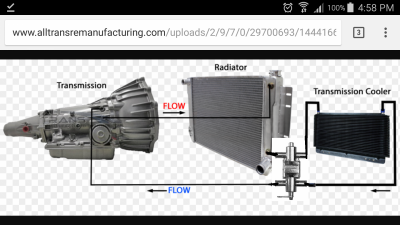
no matter if a new or used trans, I would always install an oil cooler, always pay attention to the installation direction, always in the return to the trans.
ideal is also to integrate a thermostat, as shown in the drawing, so that the trans quickly reaches its operating temperature, but never gets too warm.
as in our experience a temperature of 160 - 175 F is ideal, good working temperature, condensation water cannot form and the oil cannot burn
Getriebeölereinbindung1.png
the additionally drawn thermostat is a "Racimex 50100", which I have installed in all my cars.

https://www.amazon.de/Racimex-50100-Thermostat-Schlauch-Chrom/dp/B018LOES4K
 

Rocket Man

Mark
Supporting Member
Joined
Dec 25, 2014
Posts
26,679
Reaction score
52,954
Location
Oregon
no matter if a new or used trans, I would always install an oil cooler, always pay attention to the installation direction, always in the return to the trans.
ideal is also to integrate a thermostat, as shown in the drawing, so that the trans quickly reaches its operating temperature, but never gets too warm.
as in our experience a temperature of 160 - 175 F is ideal, good working temperature, condensation water cannot form and the oil cannot burn
View attachment 258996
the additionally drawn thermostat is a "Racimex 50100", which I have installed in all my cars.

https://www.amazon.de/Racimex-50100-Thermostat-Schlauch-Chrom/dp/B018LOES4K
That’s interesting considering GM started using thermostats in the new vehicles in order to increase fuel mileage which has resulted in more failures so people are now bypassing these thermostats. When you say “our experience” who are you referring to? I agree 100% with the cooler but not the thermostat unless you live in a very cold climate.
 

Bandit-66

Member
Joined
Aug 23, 2020
Posts
54
Reaction score
85
That’s interesting considering GM started using thermostats in the new vehicles in order to increase fuel mileage which has resulted in more failures so people are now bypassing these thermostats. When you say “our experience” who are you referring to? I agree 100% with the cooler but not the thermostat unless you live in a very cold climate.


the experience we gained in our german forum, because we also repair our trans ourselves (I have already done 2 of them) and have a specialist who repairs trans every day
the climate in germany may be a bit colder than yours, but it takes several miles until the temperature in the trans is optimal and if you go through the oil cooler it takes even longer.
so we install a thermostat and there have been no negative experiences yet
 

afpj

Full Access Member
Joined
Sep 16, 2009
Posts
820
Reaction score
392
Who is we? Are there that many 4L60s running around in Germany?
 

Rocket Man

Mark
Supporting Member
Joined
Dec 25, 2014
Posts
26,679
Reaction score
52,954
Location
Oregon
the experience we gained in our german forum, because we also repair our trans ourselves (I have already done 2 of them) and have a specialist who repairs trans every day
the climate in germany may be a bit colder than yours, but it takes several miles until the temperature in the trans is optimal and if you go through the oil cooler it takes even longer.
so we install a thermostat and there have been no negative experiences yet
Actually, the oil goes through the radiator first where it heats up along with the engine coolant. There’s a coil inside the factory radiator that’s bathed by the engine coolant. I’d like to know how you would determine if you’re doing harm. Anyway, adding a thermostat isn’t suggested over here unless you’re in the frigid north where it’s frozen for a good part of the winter. Be careful suggesting people do something that may actually shorten the life of their transmission which is the case in the newer vehicles with the factory thermostat, where owners here are deleting them instead of adding them. Here’s a YouTube video that explains the reasoning.
 
OP
OP
D

dwinters14

Member
Joined
Apr 10, 2020
Posts
89
Reaction score
66
Okay so I should be good to go then? I'm going to do some more research as well.
 

Rocket Man

Mark
Supporting Member
Joined
Dec 25, 2014
Posts
26,679
Reaction score
52,954
Location
Oregon
I would install a Tru-Cool 40k trans cooler and a Corvette servo since it’s easier to do the servo while the trans is out, and also while the trans is out I would replace the rear main seal and rear cover seal on the engine since the trans has to be removed to replace these. You can buy the rear cover/ main seal combo for that which is what I did when I was replacing my trans. It would be a shame to have the rear main start leaking in a few months after you had the trans out. There might be other stuff I’m forgetting, hopefully others will chime in.
 
OP
OP
D

dwinters14

Member
Joined
Apr 10, 2020
Posts
89
Reaction score
66
I would install a Tru-Cool 40k trans cooler and a Corvette servo since it’s easier to do the servo while the trans is out, and also while the trans is out I would replace the rear main seal and rear cover seal on the engine since the trans has to be removed to replace these. You can buy the rear cover/ main seal combo for that which is what I did when I was replacing my trans. It would be a shame to have the rear main start leaking in a few months after you had the trans out. There might be other stuff I’m forgetting, hopefully others will chime in.
Thanks Rocket Man.

Another question for you... as I was driving tonight I noticed the rough 1-2 shift and flare were somewhat inconsistent. The flare would be a 500-750 rpm jump at certain throttle inputs and then 250 at others. I also did a WOT pull and didn't notice any shift hesitation and got up to about 70MPH.

Before I go ripping the trans out, I'm wondering if the TPS or throttle body itself may be causing these issues?
 

Rocket Man

Mark
Supporting Member
Joined
Dec 25, 2014
Posts
26,679
Reaction score
52,954
Location
Oregon
Thanks Rocket Man.

Another question for you... as I was driving tonight I noticed the rough 1-2 shift and flare were somewhat inconsistent. The flare would be a 500-750 rpm jump at certain throttle inputs and then 250 at others. I also did a WOT pull and didn't notice any shift hesitation and got up to about 70MPH.

Before I go ripping the trans out, I'm wondering if the TPS or throttle body itself may be causing these issues?
I’m not a trans expert by any means but I doubt the TPS or TB would be causing any shifting issues like you’re experiencing. You can always take it in to a trans shop and get an opinion.
 

Bandit-66

Member
Joined
Aug 23, 2020
Posts
54
Reaction score
85
Actually, the oil goes through the radiator first where it heats up along with the engine coolant. There’s a coil inside the factory radiator that’s bathed by the engine coolant. I’d like to know how you would determine if you’re doing harm. Anyway, adding a thermostat isn’t suggested over here unless you’re in the frigid north where it’s frozen for a good part of the winter. Be careful suggesting people do something that may actually shorten the life of their transmission which is the case in the newer vehicles with the factory thermostat, where owners here are deleting them instead of adding them. Here’s a YouTube video that explains the reasoning.

Sorry, I think we have misunderstood something.
The Racimex thermostat does not stop the oil flow, like in your video of the 6L80E, but changes the way the oil flows.
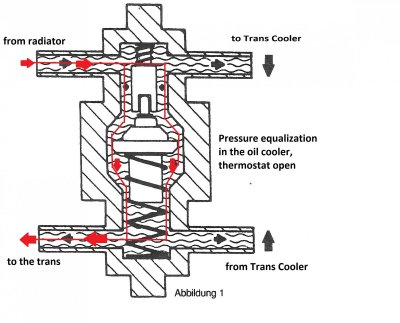
I have created 2 pictures and in picture 1 you can see how the oil flows (red line) when the temperature of the oil is below 167F.
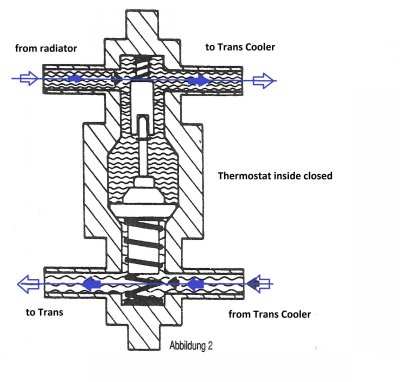
Figure 2 shows the path of the oil (blue line) when the temperature is above 176F.
When the cone valve is open ( picture 1 ), the oil presses through both supply lines to the radiator. Pressure and back pressure cancel each other out and the pressure equalization stops the oil flow through the Trans cooler. The Trans cooler is thus neutralized and the oil flows back to the Trans inside the thermostat.
At 167F the cone valve starts to close and interrupts this standstill. At approx. 176F the cone valve is closed (Fig. 2) and the oil must now flow via the trans cooler back to the trans.
When connecting the hoses, make sure that the radiator/trans hoses are mounted on one side of the thermostat and the hoses to the trans cooler on the other side.
This thermostat is not intended for cold areas, but to protect the trans from overheating when driving with a trailer in warm weather and under load.
And these are our experiences that we made here in Germany and whether this is an option for you, I cannot and do not want to decide, it should only serve as a suggestion how to realize it.

Raximex Offen .jpg

Racimex geschlossen.jpg
 

Bandit-66

Member
Joined
Aug 23, 2020
Posts
54
Reaction score
85
Who is we? Are there that many 4L60s running around in Germany?


There are already a lot of people here who drive a reasonable V8, whether GM, Dogde or Ford.
In our Chevy Forum we are about 2500 members and there is everything from GM represented, no matter what year of construction and there are a lot of 4L60E and also Th700R4, which is almost identical, only that it does not work with an ECU but the Governor and the Detent Cable takes over the work.
 

Rocket Man

Mark
Supporting Member
Joined
Dec 25, 2014
Posts
26,679
Reaction score
52,954
Location
Oregon
Sorry, I think we have misunderstood something.
The Racimex thermostat does not stop the oil flow, like in your video of the 6L80E, but changes the way the oil flows.
I have created 2 pictures and in picture 1 you can see how the oil flows (red line) when the temperature of the oil is below 167F.
Figure 2 shows the path of the oil (blue line) when the temperature is above 176F.
When the cone valve is open ( picture 1 ), the oil presses through both supply lines to the radiator. Pressure and back pressure cancel each other out and the pressure equalization stops the oil flow through the Trans cooler. The Trans cooler is thus neutralized and the oil flows back to the Trans inside the thermostat.
At 167F the cone valve starts to close and interrupts this standstill. At approx. 176F the cone valve is closed (Fig. 2) and the oil must now flow via the trans cooler back to the trans.
When connecting the hoses, make sure that the radiator/trans hoses are mounted on one side of the thermostat and the hoses to the trans cooler on the other side.
This thermostat is not intended for cold areas, but to protect the trans from overheating when driving with a trailer in warm weather and under load.
And these are our experiences that we made here in Germany and whether this is an option for you, I cannot and do not want to decide, it should only serve as a suggestion how to realize it.

View attachment 259149

View attachment 259150
No, I understand. Tru- Cool sells the same thing. It’s intended for cold climates only. We run without a thermostat over here for most of the country.
41pcU3nUlvL._AC_.jpg
 

Forum statistics

Threads
138,098
Posts
1,999,061
Members
103,024
Latest member
jpurdie

Latest posts

Back
Top