
You are using an out of date browser. It may not display this or other websites correctly.
You should upgrade or use an alternative browser.
You should upgrade or use an alternative browser.
Inverter ?
- Thread starter Shumif1
- Start date
Disclaimer: Links on this page pointing to Amazon, eBay and other sites may include affiliate code. If you click them and make a purchase, we may earn a small commission.


inverter's are hit-n-miss, even big brand names can produce junk ones.Hello , We go camping and was wondering if anyone ever uses a power inverter. I purchased a 2000 watt inverter and just wanted to see if anyone ever had any problems with them . Thanks
the trick is to get one that EXCEEDS your needs, one may say 1000w but that is peak and it is for intermittent power needs, that 1000w one may only produce 300w of usable power
you have to read the fine print on the specs to be sure you are getting what you need and be sure it is capable of powering your equipment.
also be sure to use good heavy gauge cables, thinner cables can actually melt and ruin your inverter or whatever they are touching.
- Joined
- Aug 2, 2018
- Posts
- 10,559
- Reaction score
- 15,333
As indicated above, be sure to use connection cables rated for the amperage that your inverter will be drawing from your truck's system. A safe rule of thumb for this is to plan on a peak current draw from your truck's system to be roughly equal to your inverter's peak wattage output, divided by 12.
thanksAs indicated above, be sure to use connection cables rated for the amperage that your inverter will be drawing from your truck's system. A safe rule of thumb for this is to plan on a peak current draw from your truck's system to be roughly equal to your inverter's peak wattage output, divided by 12.

swathdiver
Full Access Member
Hello , We go camping and was wondering if anyone ever uses a power inverter. I purchased a 2000 watt inverter and just wanted to see if anyone ever had any problems with them . Thanks
Had one years ago to run my laptop in the truck while working. Worked great until some loser broke the window and helped themselves to it. It had "clean" power to power electronic devices and had both a cigar lighter adapter and detachable battery cables. I think it was 1000 watts. All of our Pontiac Montana vans had them built in.
0 Gauge should be sufficient or welding wire is probably better, both generally run about $6-7 a foot a good hardware store will have it.I want to run a dual battery system. My question is I want to run cables to the cargo area and install the inverter there , What gauge wire should I run not to loose power going that length ?

HiHoeSilver
Away!
0 Gauge should be sufficient or welding wire is probably better, both generally run about $6-7 a foot a good hardware store will have it.
More than enough. #1 welding cable is rated to 250 amps, which would be 3000 watts at 12V
DougAMiller
Full Access Member
Depends on how much power you're expecting to pull through the inverter. I put in a 1500W peak inverter and by my calculations I decided 6 AWG would be sufficient. A 1500W peak inverter is only going to sustain about 750W, at 12V that's about 60 amps, and since it is converting to AC the average will be lower. Also, you really only need to run B+ to the inverter, you can run ground to the frame or body. The factory has several ground points scattered throughout the vehicle.
For mine, I put in a factory-type dual battery setup and tapped the inverter off the auxiliary battery through a 60 amp fuse. This way the inverter can't run down the main battery because the factory setup has an isolation relay that disconnects the auxiliary from the main if the engine is not running.
For mine, I put in a factory-type dual battery setup and tapped the inverter off the auxiliary battery through a 60 amp fuse. This way the inverter can't run down the main battery because the factory setup has an isolation relay that disconnects the auxiliary from the main if the engine is not running.
ivin74
05 NBS Nali
Depends on how much power you're expecting to pull through the inverter. I put in a 1500W peak inverter and by my calculations I decided 6 AWG would be sufficient. A 1500W peak inverter is only going to sustain about 750W, at 12V that's about 60 amps, and since it is converting to AC the average will be lower. Also, you really only need to run B+ to the inverter, you can run ground to the frame or body. The factory has several ground points scattered throughout the vehicle.
For mine, I put in a factory-type dual battery setup and tapped the inverter off the auxiliary battery through a 60 amp fuse. This way the inverter can't run down the main battery because the factory setup has an isolation relay that disconnects the auxiliary from the main if the engine is not running.
@DougAMiller
What size fuse do you think I need to run a 750w inverter?
DougAMiller
Full Access Member
It depends. Most inverters, especially the cheaper ones, advertise their peak rating. Continuous is about half that. So unless it says it is 750W continuous, you will only get about 375W max of normal use. A 30 amp fuse should handle that. The instructions should have a specs section where it should list both peak and continuous ratings. If it is truly 750W continuous, then you will need a 60 amp fuse to get its full capability.@DougAMiller
What size fuse do you think I need to run a 750w inverter?
ivin74
05 NBS Nali
It depends. Most inverters, especially the cheaper ones, advertise their peak rating. Continuous is about half that. So unless it says it is 750W continuous, you will only get about 375W max of normal use. A 30 amp fuse should handle that. The instructions should have a specs section where it should list both peak and continuous ratings. If it is truly 750W continuous, then you will need a 60 amp fuse to get its full capability.
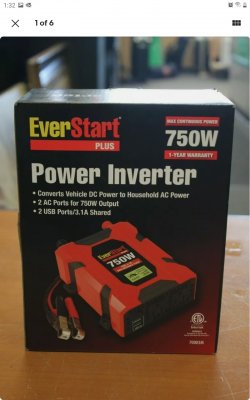
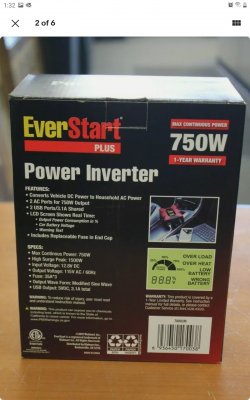
This is the one I have.
DougAMiller
Full Access Member
It claims 750W max continuous power. So if you are going to connect things to it that will pull that much power, you will need a 60 amp fuse, otherwise you'll be blowing fuses when everything else should able to handle it. If you are just occasionally connecting a laptop or similar things that are much lower power, then you wouldn't have any problems with a smaller fuse.
ivin74
05 NBS Nali
It claims 750W max continuous power. So if you are going to connect things to it that will pull that much power, you will need a 60 amp fuse, otherwise you'll be blowing fuses when everything else should able to handle it. If you are just occasionally connecting a laptop or similar things that are much lower power, then you wouldn't have any problems with a smaller fuse.
I'm going to install the 60am fuse then. Thx
ivin74
05 NBS Nali
@DougAMiller
Does the inverter drain the battery? I don't have anything hooked up to it and the battery is going dead after a couple of days. The only reason I noticed this is because I stopped driving it as often. The only thing I can think off that maybe draining it is the inverter. I disconnected it and in the process of charging the battery,
Does the inverter drain the battery? I don't have anything hooked up to it and the battery is going dead after a couple of days. The only reason I noticed this is because I stopped driving it as often. The only thing I can think off that maybe draining it is the inverter. I disconnected it and in the process of charging the battery,

Keanen55
Full Access Member
@DougAMiller
Does the inverter drain the battery? I don't have anything hooked up to it and the battery is going dead after a couple of days. The only reason I noticed this is because I stopped driving it as often. The only thing I can think off that maybe draining it is the inverter. I disconnected it and in the process of charging the battery,
Doesn't that inverter have a on/off switch?

Sparksalot
Elite Member
It may have enough parasitic draw to do that over time. Turn it off or disconnect it when you’re not using it.@DougAMiller
Does the inverter drain the battery? I don't have anything hooked up to it and the battery is going dead after a couple of days. The only reason I noticed this is because I stopped driving it as often. The only thing I can think off that maybe draining it is the inverter. I disconnected it and in the process of charging the battery,
ivin74
05 NBS Nali
Doesn't that inverter have a on/off switch?
Yes it does, it's on the off position.
It may have enough parasitic draw to do that over time. Turn it off or disconnect it when you’re not using it.
I always keep it in the off position. I'm going to keep it unplugged for a couple of days and see if that is the culpit to the parasitic draw.
Similar threads

- Replies
- 3
- Views
- 239

- Replies
- 5
- Views
- 357


