Head gasket replacement checklist

Disclaimer: Links on this page pointing to Amazon, eBay and other sites may include affiliate code. If you click them and make a purchase, we may earn a small commission.

Matahoe

Full Access Member
Military
Joined
Jan 27, 2016
Posts
510
Reaction score
261
Location
Grand Rapids, Michigan
Can anyone who has first hand exp. say approximately how much time to R&R the head gaskets on both sided takes start to finish? I am experienced but the time differs on separate makes..etc.

I have all required tools and replacement parts already on hand. I have also contacted my local machine shop and they assure me a quick 2 day turnaround with the head clean and crack check. I need to be speedy as its my only vehicle and I have the kids during the day. Thanks!
 

randeez

Full Access Member
Joined
Sep 29, 2017
Posts
7,816
Reaction score
24,806
Location
south florida
/\ that would be pretty accurate, but nothing ever goes as planned for me. broken exhaust bolts, stripped threads, broken sensors etc. with the downtime for getting the heads cleaned and checked you should be able to find anything you need in that time.
 

Chubbs

Full Access Member
Joined
Jun 24, 2017
Posts
636
Reaction score
396
I've had top end gasket kits sealed in the package come up short on quantity that held me up. You are supposed to get a cleaning tap, run all of the head bolt holes in the block, clean & degrease, then hit with compressed air holding a lint-free cloth over the area.


Cylinder Head Replacement - Left Side

  • Tools Required
  • J 36660-A | J 36660-A Torque Angle Meter

  • J 42385-200 | J 42385-200 Thread Repair Kit
Removal Procedure
  1. Remove the generator bracket. Refer to Generator Replacement (4.8L, 5.3L, and 6.0L Engines)| Generator Replacement (8.1L Engine) in Engine Electrical.

  2. Remove the intake manifold. Refer to Intake Manifold Replacement.

  3. Remove the coolant air bleed pipe. Refer to Engine Coolant Air Bleed Pipe Replacement (4.8L, 5.3L, and 6.0L Engines) in Engine Cooling.

  4. Remove the left exhaust manifold. Refer to Exhaust Manifold Replacement - Left Side (4.8L, 5.3L, and 6.0L Engines) | Exhaust Manifold Replacement - Left Side (8.1L Engine) in Engine Exhaust.

  5. Remove the pushrods. Refer to Valve Rocker Arm and Push Rod Replacement.

  6. 832957.gif


    Click to Enlarge


    NOTE
    Important

    The cylinder head bolts are NOT reusable.


    Remove and discard the cylinder head bolts (1, 2, 3).


  7. 832958.gif


    Click to Enlarge


    NOTE
    Notice

    After removal, place the cylinder head on 2 wood blocks in order to prevent damage to the sealing surfaces.


    Remove the cylinder head.

  8. 832962.gif


    Click to Enlarge
    Remove and discard the cylinder head gasket.

  9. If required, clean and inspect the cylinder head. Refer to Cylinder Head Cleaning and Inspection.
Installation Procedure


CAUTION
Caution

Wear safety glasses in order to avoid eye damage.


NOTE
Notice

Clean all dirt, debris, and coolant from the engine block cylinder head bolt holes. Failure to remove all foreign material may result in damaged threads, improperly tightened fasteners or damage to components.


NOTE
Important

  • Do not reuse the cylinder head bolts. Install NEW cylinder head bolts during assembly.

  • Do not use any type of sealant on the cylinder head gasket, unless specified.

  • The cylinder head gaskets must be installed in the proper direction and position.


  1. 832969.gif


    Click to Enlarge
    Clean the engine block cylinder head bolt holes, if required.

    Thread repair tool J 42385-107, found in J 42385-200 | J 42385-200 may be used to clean the threads of old threadlocking material.

  2. Use spray cleaner GM P/N 12346139, P/N 12377981, (Canadian P/N 10953463) or equivalent into the hole.

  3. Clean the cylinder head bolt holes with compressed air.

  4. Check the cylinder head locating pins for proper installation, location (a) 8.3 mm (0.327 in).

  5. 832963.gif


    Click to Enlarge
    When properly installed, with FRONT on the left side, the tab on the cylinder head gasket should be located left of center or closer to the front of the engine.

  6. 832962.gif


    Click to Enlarge
    Install the NEW cylinder head gasket.

  7. 832958.gif


    Click to Enlarge
    Install the cylinder head.

  8. 832957.gif


    Click to Enlarge
    Install NEW cylinder head bolts (1, 2, 3).

  9. 832971.gif


    Click to Enlarge


    NOTE
    Notice

    Refer to Fastener Notice | Fastener Notice | Fastener Notice in Cautions and Notices.


    Tighten the cylinder head bolts.


    Tighten
    1. Tighten the M11 bolts a first pass in sequence to 30 N·m (22 lb ft).

    2. Tighten the M11 bolts a second pass in sequence to 90 degrees using J 36660-A | J 36660-A.

    3. Tighten the M11 bolts (1, 2, 3, 4, 5, 6, 7, 8) to 90 degrees and the M11 bolts (9 and 10) to 50 degrees a final pass in sequence using J 36660-A | J 36660-A.

    4. Tighten the M8 bolts (11, 12, 13, 14, 15) to 30 N·m (22 lb ft). Begin with the center bolt (11) and alternating side-to-side, work outward tightening all of the bolts.
  10. Install the pushrods. Refer to Valve Rocker Arm and Push Rod Replacement.

  11. Install the left exhaust manifold. Refer to Exhaust Manifold Replacement - Left Side (4.8L, 5.3L, and 6.0L Engines) | Exhaust Manifold Replacement - Left Side (8.1L Engine) in Engine Exhaust.

  12. Install the coolant air bleed pipe. Refer to Engine Coolant Air Bleed Pipe Replacement (4.8L, 5.3L, and 6.0L Engines) in Engine Cooling.

  13. Install the intake manifold. Refer to Intake Manifold Replacement.

  14. Install the generator bracket. Refer to Generator Replacement (4.8L, 5.3L, and 6.0L Engines) | Generator Replacement (8.1L Engine) in Engine Electrical.
 

Chubbs

Full Access Member
Joined
Jun 24, 2017
Posts
636
Reaction score
396
Cylinder Head, right side


  • Tools Required
  • J 36660-A | J 36660-A Torque Angle Meter

  • J 42385-200 | J 42385-200 Thread Repair Kit
Removal Procedure
  1. Remove the oil level indicator. Refer to Oil Level Indicator Tube Replacement.

  2. Remove the intake manifold. Refer to Intake Manifold Replacement.

  3. Remove the coolant air bleed pipe. Refer to Engine Coolant Air Bleed Pipe Replacement (4.8L, 5.3L, and 6.0L Engines) in Engine Cooling.

  4. Remove the right exhaust manifold. Refer to Exhaust Manifold Replacement - Right Side (4.8L, 5.3L, and 6.0L Engines) | Exhaust Manifold Replacement - Right Side (8.1L Engine) in Engine Exhaust.

  5. Remove the pushrods. Refer to Valve Rocker Arm and Push Rod Replacement.

  6. 832959.gif


    Click to Enlarge


    NOTE
    Important

    The cylinder head bolts are NOT reusable.


    Remove and discard the cylinder head bolts (1, 2, 3).

  7. 832960.gif


    Click to Enlarge


    NOTE
    Notice

    After removal, place the cylinder head on 2 wood blocks in order to prevent damage to the sealing surfaces.


    Remove the cylinder head.

  8. 832965.gif


    Click to Enlarge
    Remove and discard the cylinder head gasket.

  9. If required, clean and inspect the cylinder head. Refer to Cylinder Head Cleaning and Inspection.
Installation Procedure


CAUTION
Caution

Wear safety glasses in order to avoid eye damage.


NOTE
Notice

Clean all dirt, debris, and coolant from the engine block cylinder head bolt holes. Failure to remove all foreign material may result in damaged threads, improperly tightened fasteners or damage to components.


NOTE
Important

  • Do not reuse the cylinder head bolts. Install NEW cylinder head bolts during assembly.

  • Do not use any type of sealant on the cylinder head gasket, unless specified.

  • The cylinder head gaskets must be installed in the proper direction and position.


  1. 832970.gif


    Click to Enlarge
    Clean the engine block cylinder head bolt holes, if required.

    Thread repair tool J 42385-107, found in J 42385-200 | J 42385-200 may be used to clean the threads of old threadlocking material.

  2. Use spray cleaner GM P/N 12346139, P/N 12377981, (Canadian P/N 10953463) or equivalent into the hole.

  3. Clean the cylinder head bolt holes with compressed air.

  4. Check the cylinder head locating pins for proper installation, location (a) 8.3 mm (0.327 in).

  5. 832967.gif


    Click to Enlarge
    When properly installed, with FRONT on the right side, the tab on the cylinder head gasket should be located right of center or closer to the front of the engine.

  6. 832965.gif


    Click to Enlarge
    Install the NEW cylinder head gasket.

  7. 832960.gif


    Click to Enlarge
    Install the cylinder head.

  8. 832959.gif


    Click to Enlarge
    Install the NEW cylinder head bolts.

  9. 832971.gif


    Click to Enlarge


    NOTE
    Notice

    Refer to Fastener Notice | Fastener Notice | Fastener Notice in Cautions and Notices.


    Tighten the cylinder head bolts.


    Tighten
    1. Tighten the M11 bolts a first pass in sequence to 30 N·m (22 lb ft).

    2. Tighten the M11 bolts a second pass in sequence to 90 degrees using J 36660-A | J 36660-A.

    3. Tighten the M11 bolts (1, 2, 3, 4, 5, 6, 7, 8) to 90 degrees and the M11 bolts (9 and 10) to 50 degrees a final pass in sequence using J 36660-A | J 36660-A.

    4. Tighten the M8 bolts (11, 12, 13, 14, 15) to 30 N·m (22 lb ft). Begin with the center bolt (11) and alternating side-to-side, work outward tightening all of the bolts.
  10. Install the pushrods. Refer to Valve Rocker Arm and Push Rod Replacement.

  11. Install the right exhaust manifold. Refer to Exhaust Manifold Replacement - Right Side (4.8L, 5.3L, and 6.0L Engines) | Exhaust Manifold Replacement - Right Side (8.1L Engine) in Engine Exhaust.

  12. Install the coolant air bleed pipe. Refer to Engine Coolant Air Bleed Pipe Replacement (4.8L, 5.3L, and 6.0L Engines) in Engine Cooling.

  13. Install the intake manifold. Refer to Intake Manifold Replacement.

  14. Install the oil level indicator
 
OP
OP
Matahoe

Matahoe

Full Access Member
Military
Joined
Jan 27, 2016
Posts
510
Reaction score
261
Location
Grand Rapids, Michigan
Chubbs, Thanks for that rather large amount of useful info. I have the Alldatadiy.com subscription so I'm set as well. My question was more geared towards people who have done this exact work before. Alldata has it listed as 10.5 hours work. It's interesting the results you get searching forums for a more precise answer. One guy even said that the installation was quicker than the removal. Umm..never seen that happen ever in my lifetime. Lol..ohh well. Also there is not one start to finish video on youtube. Brian's mobile1 has a video on just the intake gasket. Looking like this might be the first. Anyway...thanks guys. I have a fairly rough idea now.
 

Chubbs

Full Access Member
Joined
Jun 24, 2017
Posts
636
Reaction score
396
I didn't know if you were using a guide or not. but I mainly posted the info for the sake of the thread and adding useful content for others searching the subject. I just copy/paste so it's all legit and nothing to really question.

First HG job I researched for months, talked to 3-dif guys directly. Had them on speed dial/text and a workshop manual to walk me through, plus some forum threads with extra details, trials & tribulation of other's sagas in real time, kept up-2-date... and I didn't miss a lick on anything that was within my control. It took longer than I wanted but I worked slowly/methodically and updated many other components. I spent many hours cleaning pushrods and rebuilding the original lifters since they were all collapsed. I set up a rig and spray-tested all of the fuel injectors. Replaced the oil seals, polished the intake mani, surfaced and gasketed the TB and new coolant hoses that I bypassed from leakage. 1-thing after another.

From my experience, it's hard to put a time of completion for the average DIY. I don't even pay attention to the rec time since that's more for professional billing hours where a customer can be quoted labor charges. I just secure other means of transport in situations like this.

I had only been wrenching seriously for the 12-months I had owned that vehicle before that undertaking and now I replace tie rods on my 30-min lunch break today. There are just so many details involved with a dependable & secure HG R&R that it makes 99% of future repairs seem like elementary. But I still preview the WM for everything, nevertheless.

 
Last edited:
OP
OP
Matahoe

Matahoe

Full Access Member
Military
Joined
Jan 27, 2016
Posts
510
Reaction score
261
Location
Grand Rapids, Michigan
It has begun...

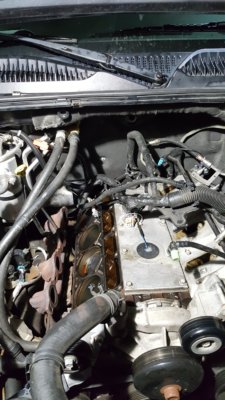
Here is the top end after 1.5 hours. Got this far using only an 8 and 10mm socket. The fuel rail to manifold hold downs required a torx bit. Notice the amount of oil in the runners. It's pretty bad. I had this all cleaned up last time I replaced the intake manifold gasket. I have the newer rocker covers so not sure what the deal is. It's sucking oil from the pcv orifice is my guess. Looks like my knock sensor rtv dam is holding up great. I've not gotten any water on the engine bay since so didn't expect any water in there anyway. This oil issue worries me a bit. Blowby from pistons or just a head issue?? Dunno. Any tips?

20180712_094407.jpg
20180712_094424.jpg
20180712_094437.jpg
20180712_094430.jpg
 

about20ninj45

Full Access Member
Joined
May 13, 2014
Posts
1,120
Reaction score
330
positive crankcase ventilation. The gases along with oil from the crankcase, gets sucked into the TB and via vacuum and ends up in the intake and runners. definitely get a catch can if you dont have one
 
OP
OP
Matahoe

Matahoe

Full Access Member
Military
Joined
Jan 27, 2016
Posts
510
Reaction score
261
Location
Grand Rapids, Michigan
positive crankcase ventilation. The gases along with oil from the crankcase, gets sucked into the TB and via vacuum and ends up in the intake and runners. definitely get a catch can if you dont have one

I've seen catch cans but I would rather not have another thing to service.

Dug a bit deeper this afternoon and realized that GM made a newer design valve cover for the 2007-2011 5.3/6.0. Part 12570427 but it is meant for AFM/DOD. I wonder if it would work similar on my LM7? Worth a shot maybe to solve the oil in the intake issue.

Aside from that both exhaust manifold heat shields are rotted. Oh yeah draining the coolant required removing lower radiator hose. That was messy to say the least.
 
OP
OP
Matahoe

Matahoe

Full Access Member
Military
Joined
Jan 27, 2016
Posts
510
Reaction score
261
Location
Grand Rapids, Michigan
Ahead of schedule, shoulda planned on throwing a cam in it :anitoof:

I actually thought about doing this. It would increase peak HP by about 50 or so from what ive seen. It would however more than likely hurt the low rpm torque. I don't know. I'll take a look at the numbers from a few manufacturers. Maybe try edelbrock, crower and compcams.
 

Justinj360

Senior Member
Joined
Jan 2, 2014
Posts
476
Reaction score
87
positive crankcase ventilation. The gases along with oil from the crankcase, gets sucked into the TB and via vacuum and ends up in the intake and runners. definitely get a catch can if you dont have one

You're not saying that's normal, are you? I'm planning on changing my intake manifold gasket soon and I don't want to find that under there.
 

about20ninj45

Full Access Member
Joined
May 13, 2014
Posts
1,120
Reaction score
330
You're not saying that's normal, are you? I'm planning on changing my intake manifold gasket soon and I don't want to find that under there.
Yes. It's normal because it's ducked into the intake and runners
 
OP
OP
Matahoe

Matahoe

Full Access Member
Military
Joined
Jan 27, 2016
Posts
510
Reaction score
261
Location
Grand Rapids, Michigan
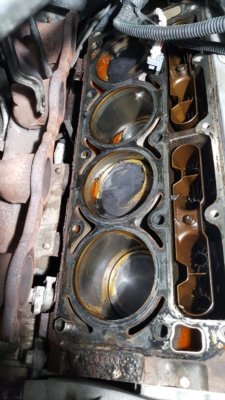
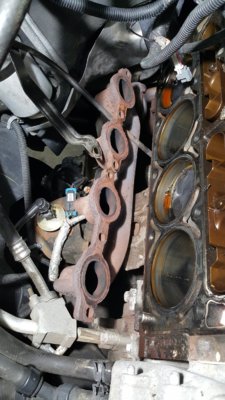
One head removed. It took me a bit longer as I wanted to try and keep the exhaust manifold connected. Didn't work as I planned as the head bolts are covered. I'll probably just replace both ex.manifolds anyway as they come with heat shields.

As you probably have guessed I took my time today. Wasn't in as much of a rush as I thought. It was 95F in my garage at noon. So I had to have a few beers slipped in there. Around 3pm I decided to use a fan. It was around then that the head came out.

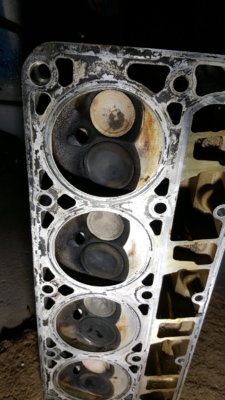
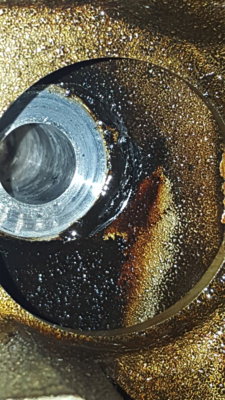
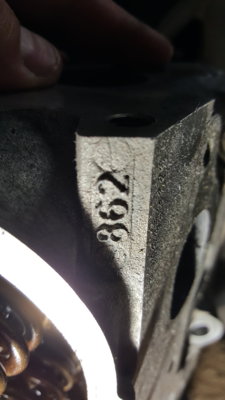
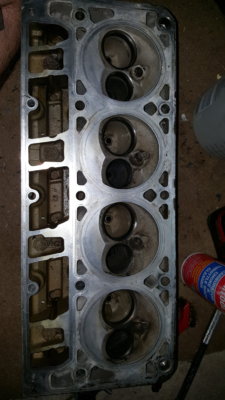
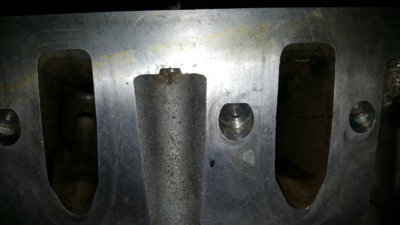
Tomorrow I will be contacting my engine shop. Will see what the estimate turns out to be. The valves, piston tops and chambers look good at first glance. Havent looked at the piston sleeves yet. The shop said cleaning and pressure testing is numero uno. I did see one tiny swiped clean area next to a head bolt (see pic). Lets hope its not a crack. Any ideas on how much the clean and test runs about?

20180713_005919.jpg 20180713_005928.jpg
20180713_005941.jpg 20180713_010013.jpg
20180713_010034.jpg
 
Last edited:
OP
OP
Matahoe

Matahoe

Full Access Member
Military
Joined
Jan 27, 2016
Posts
510
Reaction score
261
Location
Grand Rapids, Michigan
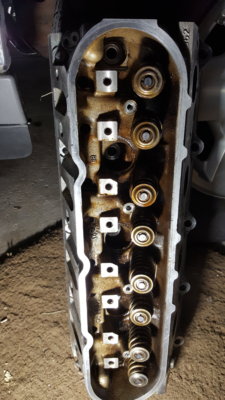
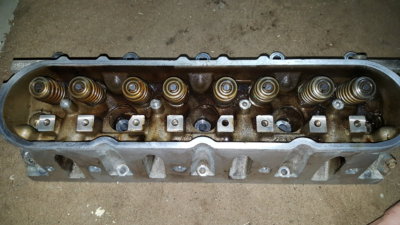
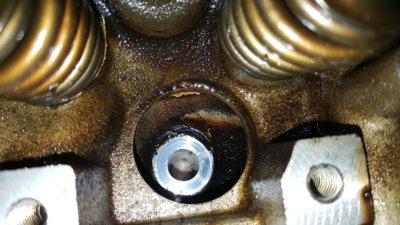
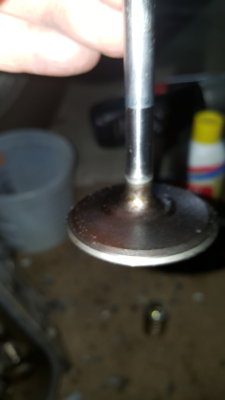
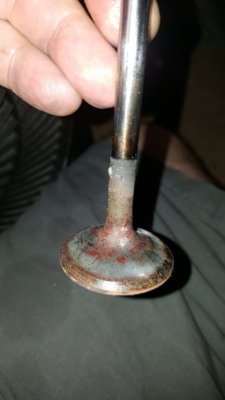
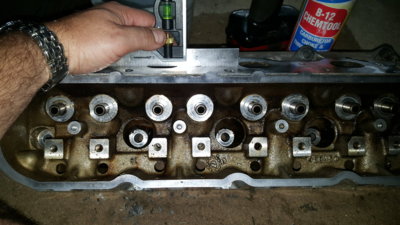
The valves were removed from head today. All intake valves seemed very clean. All exhaust valves were somewhat pitted and definitely contributed to lower than normal compression. I will be lapping all the valves after the head gets back from being cleaned and checked. Note that the spatter on the last picture exhaust valve is from when I arc welded a bead onto a broken exhaust bolt that was broken off in the head. A benefit of replacing head gaskets is that you can fix the broken exhaust bolts.

20180713_154331.jpg 20180713_154423.jpg View attachment 203363 20180713_154820.jpg 20180713_154836.jpg
 
Last edited:
OP
OP
Matahoe

Matahoe

Full Access Member
Military
Joined
Jan 27, 2016
Posts
510
Reaction score
261
Location
Grand Rapids, Michigan
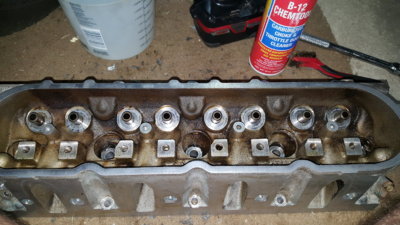
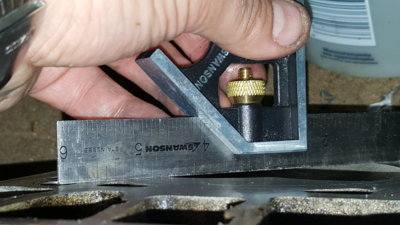
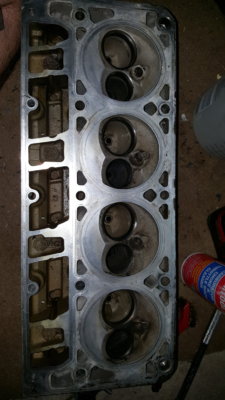
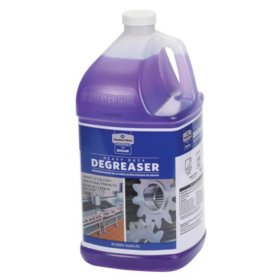
All mating surfaces are true and no warping or erosion noted. I'm almost tempted to skip the machine shop checking them and just clean, lap/reinstall valves and go. A brass brush and Berryman B-12 Chemtool works great at removing stubborn head gasket material. Last picture is my preliminary head / combustion chamber scrubbing. Will use some Purple Power and my pressure washer tomorrow. I've also had good luck with the purple Members Mark degreaser available at Sam's club. I think its made by Ecolab. It says it attacks carbon and works very well on engine parts.

20180713_154448.jpg 20180713_154715.jpg 20180713_154405.jpg 20180713_154423.jpg download.jpeg
 
Last edited:

swathdiver

Full Access Member
Joined
May 18, 2017
Posts
21,278
Reaction score
30,213
Location
Treasure Coast, Florida
Dug a bit deeper this afternoon and realized that GM made a newer design valve cover for the 2007-2011 5.3/6.0. Part 12570427

Compare yours with that part number and this number: 12642655. This is the updated one that was put on mine. The difference may be in the diameter of the fitting, not sure.

It would increase peak HP by about 50 or so from what ive seen. It would however more than likely hurt the low rpm torque. I don't know.

Only Crane Cams and Cam Motion offer camshafts made for trucks where no bottom end horsepower and torque is lost. Crane calls their three "Powermax" and Cam Motion calls theirs "Drop-In". Upgraded valve springs are not required.

https://www.hotrod.com/articles/ls-cam-test-comparison/

http://markenperformance.com/n-8673...-for-ls-stock-oe-valve-trains-4-8l-to-6l.html

http://www.cammotion.com/camshafts/5-3-stage-1-ls-truck-camshaft-200-204-114-3/

https://www.performancetrucks.net/f...tage-2-drop-cam-testing-results-depth-531293/

https://ls1tech.com/forums/dynamome...otion-5-3-drop-cam-results-41rwhp-22rwtq.html
 
OP
OP
Matahoe

Matahoe

Full Access Member
Military
Joined
Jan 27, 2016
Posts
510
Reaction score
261
Location
Grand Rapids, Michigan

Forum statistics

Threads
137,702
Posts
1,990,012
Members
102,698
Latest member
JamesinAbilene
Back
Top