A/C cooling issues

Disclaimer: Links on this page pointing to Amazon, eBay and other sites may include affiliate code. If you click them and make a purchase, we may earn a small commission.

JoeBoxer1130

TYF Newbie
Joined
Aug 1, 2025
Posts
9
Reaction score
0
2003 Chevrolet Tahoe,
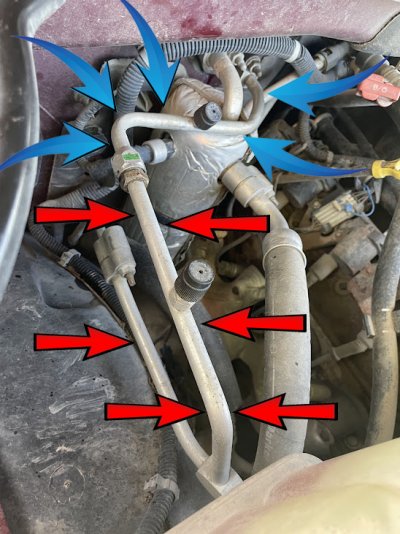
Does anyone know if the AC lines are supposed to be like this? I tried to photoshop the picture of my situation. BLUE arrows are COLD to the touch, and the RED arrows are HOT.
I'd like to know if this affects the temperature inside while the AC is working. I wanna assume the freon isn't empty because its blowing cool air but not COLD enough.
Any tips or help will be greatly appreciated.
 

Attachments

  • IMG_4327.jpg
    IMG_4327.jpg
    290.2 KB · Views: 2

justirv

Full Access Member
Joined
Dec 28, 2011
Posts
278
Reaction score
349
2003 Chevrolet Tahoe,
Does anyone know if the AC lines are supposed to be like this? I tried to photoshop the picture of my situation. BLUE arrows are COLD to the touch, and the RED arrows are HOT.
I'd like to know if this affects the temperature inside while the AC is working. I wanna assume the freon isn't empty because its blowing cool air but not COLD enough.
Any tips or help will be greatly appreciated.
So the temps are in the right location. Gauges are best in determining charge. Where that green line is defines where the orifice sits. High pressure liquid (red) enters the orifice and flashes to a gas in the blue line, which is your cooling effect. The blue line goes into your interior hvac system which contains the evaporator. This is like a radiator that removes heat from the interior (cooling the air that passes over). That cold line should feel like a cold beer, about 38°- 43°. Check your cabin filter behind the glove box, if it is clogged you get no air flow, then make sure your blend doors are working properly. The blower motor has multiple speeds, if it's stuck on low you could have a bad resistor.
 

LsHart

Senior Member
Supporting Member
Joined
Dec 31, 2025
Posts
586
Reaction score
558
There should be endentions on one of those lines. There is a filter in it. Replace with the same color. The shredder valves, both high and low leak over time. U can burp air out of the low side when truck is off. If fluid comes out then no more air is present. Top off with freon. Do not use stop leak!!!
 

nonickatall

Full Access Member
Joined
Nov 19, 2022
Posts
819
Reaction score
1,518
Location
Germany
Most common issue you is, you have not enough freon in your system. If the pressure drops, the spread between hot and cold reduces, that leads into insufficient cooling power. If pressure drops to low, A pressure switch detects this and shuts off the air conditioning.
 

TJ Baker

Full Access Member
Joined
Mar 5, 2018
Posts
249
Reaction score
284
Location
Colorado
Most common issue you is, you have not enough freon in your system

If there is not enough refrigerant in the system then there is a leak that should be located and repaired.

Refrigerant is not something that gets used up and needs to be replaced occasionally. If that were true then everyone would have to have their home refrigerators refrigerant topped off occasionally.
 

nonickatall

Full Access Member
Joined
Nov 19, 2022
Posts
819
Reaction score
1,518
Location
Germany
If there is not enough refrigerant in the system then there is a leak that should be located and repaired.

Refrigerant is not something that gets used up and needs to be replaced occasionally. If that were true then everyone would have to have their home refrigerators refrigerant topped off occasionally.
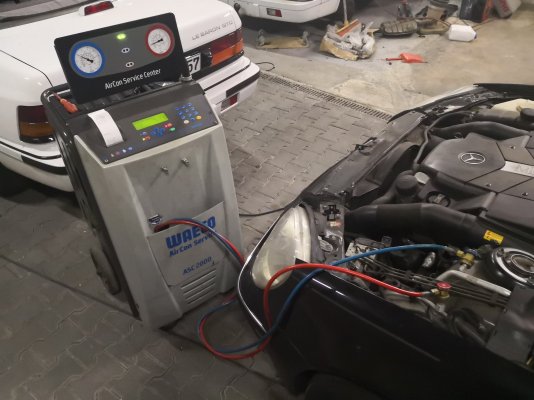
That is not correct. Freon diffuses through seals and pipes. An air conditioner isn't filled indefinitely; after a few years, enough refrigerant is lost and the unit stops working. If the unit is in good condition, this can last 10 to 15 years, but it can also happen after just one year.

You can't compare an air conditioner to a refrigerator, even though the basic principle is the same. A refrigerator is well-protected in a kitchen, not exposed to water, wind, or road debris, and is designed without large screw connections, because refrigerators aren't built around hot engines and driven at 100 km/h.

A refrigerator uses metal pipes; heat generation and cooling take place close together, allowing the entire system to be built compactly.

Cars are quite different: they use hoses to compensate for vibrations and movements, require interfaces, hoses are connected to each other, and lines have three or more connections, i.e., screw fittings with seals. Furthermore, cooling occurs at the front radiator, even though the cold is needed inside the car.

You can't compare a refrigerator within an AC off a passenger car.

I do AC service.
 

Attachments

  • IMG_20190726_220701.jpg
    IMG_20190726_220701.jpg
    254.5 KB · Views: 6
Last edited:

CrashTestDummy

Full Access Member
Joined
Feb 18, 2014
Posts
967
Reaction score
402
Location
Pearland, Texas
Refrigerant is NOT supposed to leak out. The molecules are big enough to not ooze through rubber lines, but with movement of those hoses, heat/cold cycling, people leaning on them checking the oil, etc., the hoses will get small cracks in them that will allow the refrigerant to leak. Service the system, and you run the risk of making the Schrader valves leak, too. It seems that the design of those quick-connect ports was not that good, and are prone to developing leaks over time. You'll need a special 5-point socket to change them out. They're not that expensive, but you can't change them with the system charged, so it's probably best to let a pro do it since they'll be able to recover the refrigerant, pull a vacuum on the system after the change out and have the special tools to swap them out.
 

nonickatall

Full Access Member
Joined
Nov 19, 2022
Posts
819
Reaction score
1,518
Location
Germany
Refrigerant is NOT supposed to leak out. The molecules are big enough to not ooze through rubber lines, but with movement of those hoses, heat/cold cycling, people leaning on them checking the oil, etc., the hoses will get small cracks in them that will allow the refrigerant to leak. Service the system, and you run the risk of making the Schrader valves leak, too. It seems that the design of those quick-connect ports was not that good, and are prone to developing leaks over time. You'll need a special 5-point socket to change them out. They're not that expensive, but you can't change them with the system charged, so it's probably best to let a pro do it since they'll be able to recover the refrigerant, pull a vacuum on the system after the change out and have the special tools to swap them out.
Who said. That it's supposed to leak..? :cool:

I say due to their size, their design, and the relatively large number of components with interfaces—allowing for the replacement of lines, condensers, compressors, dryer cartridges, or expansion valves—car air conditioning systems are much more prone to leaks and cannot be compared to refrigerators.

Air conditioning systems sometimes develop leaks as they age. If they require servicing every three years, that's to be expected. Of course, if the system runs dry after six months, you have to search for the leak, which can be quite time-consuming.

And having it done at a garage is probably very expensive, as replacing parts can easily cost $2,000, while a service every three years costs around €80, at least in Germany.

Refrigerators don't have this problem. Refrigerators easily last 20 years, and if they leak, they're essentially scrap.

Therefore, the statement that: Car air conditioning systems should be leak-proof is technically spoken correct.

. ... At the same time, it's also true that they often aren't.

When I get a vehicle into the workshop with a broken air conditioning system, the first thing I always check is the refrigerant level. Usually, it's low. If it's a third low, I figure it just needs a service, so I refill the refrigerant and that's that. Even with empty systems, I first create a vacuum and hold it for a while to check for leaks.

And if it's airtight, I refill the system.

Of course, if the customer says it only lasted three weeks, I look for the leak, and it's usually the condenser that's faulty; less often it's other components.

To make this diagnosis easier, I always add oil with a contrast agent so that when the system is empty after three weeks, I can use a UV lamp to see exactly where the leak came from.

The Schrader valves are very easy to replace. If one is leaking, you unscrew it with a special tool and screw in a new one. I have a whole box of that in stock.

 

Blackcar

Full Access Member
Joined
Mar 31, 2018
Posts
924
Reaction score
871
If the evacuation of system is required for repair and say freon has debris in it then put back in system worse someone else's wouldn't that be a problem just asking don't have a clue.
 

nonickatall

Full Access Member
Joined
Nov 19, 2022
Posts
819
Reaction score
1,518
Location
Germany
If the evacuation of system is required for repair and say freon has debris in it then put back in system worse someone else's wouldn't that be a problem just asking don't have a clue.
No, normally you do that with an air conditioning service unit. The air conditioning service unit extracts the refrigerant, separates the oil, filters the refrigerant, and then stored it for refill. No residue gets back into the system. Residue in the system isn't really a problem anyway, unless your compressor has mechanically disintegrated and introduced metal shavings into the system.

That's the worst-case scenario because then you have to flush the system, and you can only flush it by completely disassembling it.

That's a real pain...
 

houstontaylor

Full Access Member
Joined
Dec 4, 2017
Posts
135
Reaction score
157
The most accurate way of determining if there is enough refrigerant in your vehicle is for a shop to remove it and weigh it. Then they can recharge it with the proper weight of refrigerant.
 

jdaly

TYF Newbie
Joined
Mar 19, 2026
Posts
4
Reaction score
7
So kind off down the same path. I have an issue with my truck that when you accelerate, like leaving from a light my floor side air vents open with hot air coming out but when you get to cruising speed it closes again and goes back to normal cooling. I thought it was the control panel that was bad so I replaced it and no change. Any ideas?
 

justirv

Full Access Member
Joined
Dec 28, 2011
Posts
278
Reaction score
349
So kind off down the same path. I have an issue with my truck that when you accelerate, like leaving from a light my floor side air vents open with hot air coming out but when you get to cruising speed it closes again and goes back to normal cooling. I thought it was the control panel that was bad so I replaced it and no change. Any ideas?
Possible blend door issue?
 

LsHart

Senior Member
Supporting Member
Joined
Dec 31, 2025
Posts
586
Reaction score
558
In a properly serviced AC system there is NO AIR in there at all. None.
If it wasn't properly chargered u will. I agree. Or the air pressure from the freon can or jug. Just turn it off and push the valve in til no air. Recharge with freon.
 

nonickatall

Full Access Member
Joined
Nov 19, 2022
Posts
819
Reaction score
1,518
Location
Germany
So kind off down the same path. I have an issue with my truck that when you accelerate, like leaving from a light my floor side air vents open with hot air coming out but when you get to cruising speed it closes again and goes back to normal cooling. I thought it was the control panel that was bad so I replaced it and no change. Any ideas?
I had the problem that sometimes, mostly in long drives, hot air cameout on the driver side vents. It was the blend door actuator down on the passenger side. But it had nothing to do with acceleration. And I don't see a causal connection to acceleration.

The actuator is easy to swap. I would try that...
 

Forum statistics

Threads
137,782
Posts
1,992,157
Members
102,777
Latest member
wwiizz
Back
Top