Here in the Chicago area it's $0.80-$1.40 difference between regular and premium and $0.60-$1.00 difference on mid grade. All depends on the sheister your buying from.Even here on the west coast, I am in Oregon, I do not see $.50 per gallon difference, anywhere. Most I have ever seen is $.20 a gallon. I do know that the diesel can be quite a bit more expensive here.
Where are you seeing $.50 difference per gallon?

You are using an out of date browser. It may not display this or other websites correctly.
You should upgrade or use an alternative browser.
You should upgrade or use an alternative browser.
Do yall use regular or mid grade gas in the 5.3?
- Thread starter Tahoe guy
- Start date
Disclaimer: Links on this page pointing to Amazon, eBay and other sites may include affiliate code. If you click them and make a purchase, we may earn a small commission.
West 1
Full Access Member
- Joined
- Jan 20, 2023
- Posts
- 700
- Reaction score
- 1,508
In California the difference Varys but right now it is about .50 per gallon to upgrade even at Sams club.
Marky Dissod
Full Access Member
If you were using a TopTier brand fuel, the extra octane doesn't help - compare the piston shape/surfaces, the quench, the combustion chamber shape/surfaces ...When I saw the 11:1 STATIC compression ratio in this 5.3L, I decided to never put low octane fuel in it.
then note that Gen3 & Gen4 V8s operated at about 58psi, whereas GenV V8s operate at between 2,000 to 3,000 psi.
Extra fuel pressure improves atomization. By firing fuel into the cylinder during compression, the atomization balances the heat of the combustion mixture.
Net result: please do not worry about the STATIC compression ratio. How many people you know having 87 octane problems with their L82/L8B/L83/L84?
Extra upper cylinder lubricants never hurt, especially during break-in, and better knock resistance might come in handy if a fuel delivery problem.


- Joined
- May 9, 2018
- Posts
- 7,217
- Reaction score
- 14,048
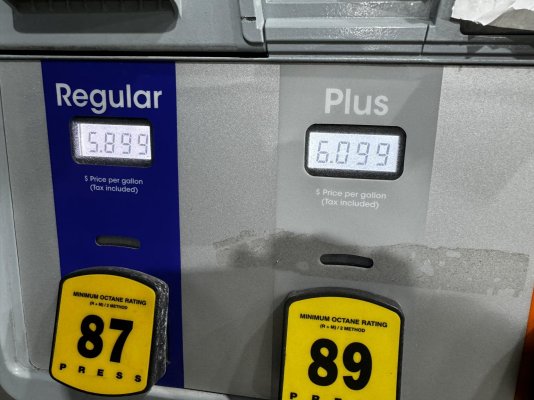
The .50 to upgrade is one issue…..In California the difference Varys but right now it is about .50 per gallon to upgrade even at Sams club.
But it’s California’s $5 is the first numeral that’s the problem….

The .50 to upgrade is one issue…..
But it’s California’s $5 is the first numeral that’s the problem….
I'm sure it will get better once they finish mothballing the refineries.

Marky Dissod
Full Access Member
Because Porsche wants to retard the spark as late as possible, especially over 6000RpM.What I fail to understand is why some direct injected engines, including my Porsche require Premium Fuel today.
I do understand that premium burns more predictable than regular fuel, but with no detonation worry is it really necessary in a direct injected engine?
By delaying spark til the piston is almost done compressing / slowing down, Porsche can inject more fuel during more of the compression stroke.
Note that GM and several other makers use BOTH direct injection AND port injection.



East. Oh, TN, KY, SC, GAEven here on the west coast, I am in Oregon, I do not see $.50 per gallon difference, anywhere. Most I have ever seen is $.20 a gallon. I do know that the diesel can be quite a bit more expensive here.
Where are you seeing $.50 difference per gallon?
West 1
Full Access Member
- Joined
- Jan 20, 2023
- Posts
- 700
- Reaction score
- 1,508
My understanding is the second injectors used in Direct Injected engines is to avoid the carbon build up suffered by the 100% direct injected engines. Carbon builds up like a Tee Pee on the back of the intake valves in DI engines. Dexos oil helps avoid that but it still build s up and you end up needing to walnut shell blast the valves at around 100,000 miles. Tradition injection sprays fuel into the intake charge which washes the intake valves as you run avoiding the build up issue. DI engines spray direct into the chamber and you have the carbon build up issue. Having both types injection avoids this. I have had GM, VW and a Mercedes apart with over 100,000 miles on DI engines and they all suffered the carbon build up issue.
Maybe the second injector enhances performance also, I have read that some of the Audi, GM and Porsche engines do run the second std injector in high demand situations to make more power. Some Turbo engines are doing this. I don't know these newer engines well so still trying to figure out the newer stuff.
The Direct injected engines are not compressing air and fuel, fuel is not introduced until the piston is very near TDC so detonation is not an issue and Timing can be far more aggressive and with std fuel injection.
I should ask my son to explain it to me, he tunes some of the Race Audi and Porsche Turbo engines which run both type injection systems plus turbos. His work is on engines with 600-1300 HP out of 3.8 V6's or 4.2L V8's. He laughs at my 6.2 with only 400 HP.
I bought CA gas this week, 3.85 for regular, premium was 4.45 or so, I may be off 5 cents on premium.
Maybe the second injector enhances performance also, I have read that some of the Audi, GM and Porsche engines do run the second std injector in high demand situations to make more power. Some Turbo engines are doing this. I don't know these newer engines well so still trying to figure out the newer stuff.
The Direct injected engines are not compressing air and fuel, fuel is not introduced until the piston is very near TDC so detonation is not an issue and Timing can be far more aggressive and with std fuel injection.
I should ask my son to explain it to me, he tunes some of the Race Audi and Porsche Turbo engines which run both type injection systems plus turbos. His work is on engines with 600-1300 HP out of 3.8 V6's or 4.2L V8's. He laughs at my 6.2 with only 400 HP.
I bought CA gas this week, 3.85 for regular, premium was 4.45 or so, I may be off 5 cents on premium.
Last edited:
- Joined
- May 9, 2018
- Posts
- 7,217
- Reaction score
- 14,048
I’m glad to hear my friends in California aren’t paying too much.My understanding is the second injectors used in Direct Injected engines is to avoid the carbon build up suffered by the 100% direct injected engines. Carbon builds up like a Tee Pee on the back of the intake valves in DI engines. Dexos oil helps avoid that but it still build s up and you end up needing to walnut shell blast the valves at around 100,000 miles. Tradition injection sprays fuel into the intake charge which washes the intake valves as you run avoiding the build up issue. DI engines spray direct into the chamber and you have the carbon build up issue. Having both types injection avoids this. I have had GM, VW and a Mercedes apart with over 100,000 miles on DI engines and they all suffered the carbon build up issue.
Maybe the second injector enhances performance also, I have read that some of the Audi, GM and Porsche engines do run the second std injector in high demand situations to make more power. Some Turbo engines are doing this. I don't know these newer engines well so still trying to figure out the newer stuff.
The Direct injected engines are not compressing air and fuel, fuel is not introduced until the piston is very near TDC so detonation is not an issue and Timing can be far more aggressive and with std fuel injection.
I should ask my son to explain it to me, he tunes some of the Race Audi and Porsche Turbo engines which run both type injection systems plus turbos. His work is on engines with 600-1300 HP out of 3.8 V6's or 4.2L V8's. He laughs at my 6.2 with only 400 HP.
I bought CA gas this week, 3.85 for regular, premium was 4.45 or so, I may be off 5 cents on premium.
But this is a photo in California, just 2 days ago…..
Attachments
Last edited:
Marky Dissod
Full Access Member
Everything since carburetted up to multi-port fuel injected mixed fuel and air during some portion of a cylinder's intake phase.
Multi-port fuel injection more precisely keeps intake valves cleaner because it sprays fuel directly on the back of the intake valves themselves,
which is one of several reasons why it caught on as long as it did.
Direct injection does not have as long (whether in terms of time, or 'degrees') to get as much fuel into the air/fuel mix as port injection does,
so if there are enough RpMs, or the engine is artificially aspirated, then port fuel injection can supplement direct injection to meet peak power demand ...
but I am frankly flabbergasted that carmakers / engine designers managed to overlook the fact that port fuel injection keeps the back of the intake valve clean.
If anything, I consider it yet another pretty damning piece of evidence that their plan for how well the engine works ceases @ 150,001 miles.
Multi-port fuel injection more precisely keeps intake valves cleaner because it sprays fuel directly on the back of the intake valves themselves,
which is one of several reasons why it caught on as long as it did.
Direct injection does not have as long (whether in terms of time, or 'degrees') to get as much fuel into the air/fuel mix as port injection does,
so if there are enough RpMs, or the engine is artificially aspirated, then port fuel injection can supplement direct injection to meet peak power demand ...
but I am frankly flabbergasted that carmakers / engine designers managed to overlook the fact that port fuel injection keeps the back of the intake valve clean.
If anything, I consider it yet another pretty damning piece of evidence that their plan for how well the engine works ceases @ 150,001 miles.

vcode
Full Access Member
- Joined
- Feb 15, 2015
- Posts
- 788
- Reaction score
- 782
Premium is a buck more here in Wisconsin. Mid-grade 50 cents.Even here on the west coast, I am in Oregon, I do not see $.50 per gallon difference, anywhere. Most I have ever seen is $.20 a gallon. I do know that the diesel can be quite a bit more expensive here.
Where are you seeing $.50 difference per gallon?
I bought an 04 Z71 siz years ago with 208K miles in nice shape from a family in Seattle area. It had all the maintenance logs.I have always used regular in my 2018 but on a road trip last week I had an empty tank and put mid grade and got alot better gas mileage.
Outside of that are there any other benefits or is it a waste of money?
fwiw I'm strictly a chevron guy and use the app/card for discounts.
It seemed a little sluggish so I had a tune up done and it helped alot.
Soon after the tune up I filled up at a casino gas pump. I picked the non-ethanol premium handle because it only had one hose so it didn't have a gallon of regular in the line like the shared hoses.
Anyway, I was back on the highway about 10? minutes later and pulled out to pass and that truck blasted off. Very noticeable power boost!
I think when i stepped on the gas as hard as usual i got so surprises at how smooth and strong it suddenly was.
The Tahoe is now at 250,000 miles and is still like the first time. And much better mileage.
There should be no discussion about gas grade.
You don't have to mortgage the farm to try out a tank full. Even if you haven't had a tune for a while. I think everyone will notice the difference. To hell with the price.
I have to use it in my outboard, lawnmower, etc
Ps. 4.8 EngineI bought an 04 Z71 siz years ago with 208K miles in nice shape from a family in Seattle area. It had all the maintenance logs.
It seemed a little sluggish so I had a tune up done and it helped alot.
Soon after the tune up I filled up at a casino gas pump. I picked the non-ethanol premium handle because it only had one hose so it didn't have a gallon of regular in the line like the shared hoses.
Anyway, I was back on the highway about 10? minutes later and pulled out to pass and that truck blasted off. Very noticeable power boost!
I think when i stepped on the gas as hard as usual i got so surprises at how smooth and strong it suddenly was.
The Tahoe is now at 250,000 miles and is still like the first time. And much better mileage.
There should be no discussion about gas grade.
You don't have to mortgage the farm to try out a tank full. Even if you haven't had a tune for a while. I think everyone will notice the difference. To hell with the price.
I have to use it in my outboard, lawnmower, etc
Another thing, my gen 2 motor was designed to go the distance.
I was told to source the original spark plugs
and that was a really good tip.
You deserve to know for sure. You can wait till the tank is quite
I bought an 04 Z71 siz years ago with 208K miles in nice shape from a family in Seattle area. It had all the maintenance logs.
It seemed a little sluggish so I had a tune up done and it helped alot.
Soon after the tune up I filled up at a casino gas pump. I picked the non-ethanol premium handle because it only had one hose so it didn't have a gallon of regular in the line like the shared hoses.
Anyway, I was back on the highway about 10? minutes later and pulled out to pass and that truck blasted off. Very noticeable power boost!
I think when i stepped on the gas as hard as usual i got so surprises at how smooth and strong it suddenly was.
The Tahoe is now at 250,000 miles and is still like the first time. And much better mileage.
There should be no discussion about gas grade.
You don't have to mortgage the farm to try out a tank full. Even if you haven't had a tune for a while. I think everyone will notice the difference. To hell with the price.
I have to use it in my outboard, lawnmower, etc
A 5.3 is finePs. 4.8 Engine
Another thing, my gen 2 motor was designed to go the distance.
I was told to source the original spark plugs
and that was a really good tip.
You deserve to know for sure. You can wait till the tank is quite
Jetskier77
Member
- Joined
- Apr 8, 2024
- Posts
- 84
- Reaction score
- 80
Yes, top tier fuels have more additives than bargain basement fuel. But Chevron mid grade has the exact same additives as Chevron regular and premium grade fuels.I run the Chevron Mid grade in everything. More additives for cleaner fuel system. I also add Chevron Techron Complete Fuel System Cleaner about every 4th tankful. It was recommended to me by Lake Speed Junior. He recommends keeping the fuel system as clean as you can. Top tier fuels have more additives to help with the cleaning. Bottom tier fuels, like at Jake's Gas Stop, are less expensive for a reason.
Last edited:

Prove that to me. Show me legit documentation that proves that.Yes, top tier fuels have more additives than bargain basement fuel. But Chevron mid grade has the exact same additives as Chevron regular and premium grade fuels.
Jetskier77
Member
- Joined
- Apr 8, 2024
- Posts
- 84
- Reaction score
- 80
Same exact additives... just slightly higher concentrations as you move up the price per gallon scale. Consumer reports did a study on it a ways back and they were not able to find any quantifiable benefit in the higher concentration of additives. It was a no brainer to use premium gas decades ago, but at 40, 50 60 cents a gallon more today, I dont see the value.Prove that to me. Show me legit documentation that proves that.
vcode
Full Access Member
- Joined
- Feb 15, 2015
- Posts
- 788
- Reaction score
- 782
This has been discussed for years. Car and Driver did 2 tests in 2001 and 2019. The results were nearly identical. Cars designed to run on 87 octane saw virtually no performance improvement running premium. Cars designed for premium saw a decrease in performance. But even then acceleration and fuel economy decreases were not that great, 0.5 mpg lower and 0.5 seconds slower in the 1/4 mile or less. So absent any fuel quality debate, there is no reason for me to spend 44% more money on premium when I don't need it.
2022 5.3 calls for 87 octane top tier fuel. That’s what I use.I have always used regular in my 2018 but on a road trip last week I had an empty tank and put mid grade and got alot better gas mileage.
Outside of that are there any other benefits or is it a waste of money?
fwiw I'm strictly a chevron guy and use the app/card for discounts.
- Joined
- Aug 2, 2018
- Posts
- 10,540
- Reaction score
- 15,298
I have to say that "Same exact additives... just slightly higher concentrations as you move up the price per gallon scale" is not exactly the same. That is like saying that 80 proof, 120 proof, and casket proof Bourbon from the same distiller/label are exactly the same.Same exact additives... just slightly higher concentrations as you move up the price per gallon scale. Consumer reports did a study on it a ways back and they were not able to find any quantifiable benefit in the higher concentration of additives. It was a no brainer to use premium gas decades ago, but at 40, 50 60 cents a gallon more today, I dont see the value.


