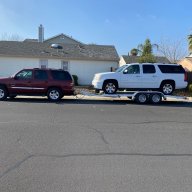
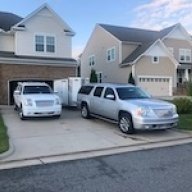
New member here trying to decide if I should delete the AFM or not. Engine is currently apart.

Disclaimer: Links on this page pointing to Amazon, eBay and other sites may include affiliate code. If you click them and make a purchase, we may earn a small commission.

hatinthering

TYF Newbie
Joined
Dec 30, 2023
Posts
23
Reaction score
37
Was AFM active for the 200k?
Sure was...other than the lifter collapsing, engine was running perfect. Was just the single lifter collapse, zero marks on rollers or cam, factory crosshatch still plainly visible on cyl walls. I was really shocked how clean everything was inside, believe these are extremely robust engines, minus the AFM. My non-AFM 05 Z71 just turned 385K, motor never opened...just getting a lifter tick in that now.
 

West 1

Full Access Member
Joined
Jan 20, 2023
Posts
625
Reaction score
1,356
I drive up to South Lake Tahoe often from Sacramento Area. so 500 feet elevation to 6,500 foot elevation with the pass at 7200 foot. This is only a 90 mile drive one way so 180 mile drive round trip. With AFM I would see maybe 19 MPG. round trip. Without AFM I would see 15-16 MPG. I have had many GM LS engines in Tahoe/Yukon chassis, 5.3L, 6.0L and 6.2L engine only so far. That is what I have witnessed. Without the steep climb you may not see that much difference with a functioning AFM. Every truck I replace all the AFM parts on already had 140 - 200 K miles on it so if I install all new AFM parts, lifters, manifold, I see no reason why the car would not run another 150,000 miles with the new AFM parts. At 300K the the car is worn out and who cares if AFM is working or not? I do not like the sound at idle of 4 cylinders running but if AFM works proper and lasts 150,000 miles why delete it? In my experience I witnessed 1-3 MPG difference. 25 gallon tank. 3 MPG = extra 75 miles per tank, why not use that. I agree with the idle sound when AFM is working sucks but the MPG is better. I did also find that when cruising on the HWY, on totally flat ground I travel most times 70-80 mph the AFM advantage is near zero because it never engages above 60 mpg unless going downhill. It is only coming down from high elevation that I see the big gains in MPG because it runs on 4 cylinders all the way down the hill.

 

Geotrash

Dave
Supporting Member
Joined
Feb 16, 2018
Posts
7,843
Reaction score
20,396
Location
Richmond, VA
I drive up to South Lake Tahoe often from Sacramento Area. so 500 feet elevation to 6,500 foot elevation with the pass at 7200 foot. This is only a 90 mile drive one way so 180 mile drive round trip. With AFM I would see maybe 19 MPG. round trip. Without AFM I would see 15-16 MPG. I have had many GM LS engines in Tahoe/Yukon chassis, 5.3L, 6.0L and 6.2L engine only so far. That is what I have witnessed. Without the steep climb you may not see that much difference with a functioning AFM. Every truck I replace all the AFM parts on already had 140 - 200 K miles on it so if I install all new AFM parts, lifters, manifold, I see no reason why the car would not run another 150,000 miles with the new AFM parts. At 300K the the car is worn out and who cares if AFM is working or not? I do not like the sound at idle of 4 cylinders running but if AFM works proper and lasts 150,000 miles why delete it? In my experience I witnessed 1-3 MPG difference. 25 gallon tank. 3 MPG = extra 75 miles per tank, why not use that. I agree with the idle sound when AFM is working sucks but the MPG is better. I did also find that when cruising on the HWY, on totally flat ground I travel most times 70-80 mph the AFM advantage is near zero because it never engages above 60 mpg unless going downhill. It is only coming down from high elevation that I see the big gains in MPG because it runs on 4 cylinders all the way down the hill.
For me at least, the reason I deleted it was more about the uncertainty of *when*, not *if* it would fail. And, I wanted a little more power for towing our camper. For many, a failed AFM system feels like the single biggest risk factor for being stuck in some small town needing major engine work to either continue, or to get back home. Most everything else, from water pumps to alternators feel minor by comparison. The other significant risk factor I could identify was the torque converter. So it was more about mitigating risk than it was about fuel efficiency.

There are plenty of examples of people having AFM failures well below 100K miles here, so the more miles and years the engine accumulates, the more the risk factor moves away from zero.

So, I took care of both risk factors during the course of 2021, and gained better performance in the process.

You may have a different perception of that risk, and there's nothing wrong with that. Just like there are many pilots I know who are willing to fly piston twin aircraft. I'm not one of them.
 

B-train

Full Access Member
Joined
Sep 12, 2022
Posts
2,704
Reaction score
4,910
This was one of my good customers Vehcile. He lives here in MD but lives in CA during the winter months. Cyl number 4 bent a push rod and the roller on the lifter did some damage to the cam shaft lobe. The lifter also came apart in 3 pieces when I removed it. It melted the catalytic converter to the point where the engine would not even run. I found another bent push rod on #1. once I unbolted the exhaust it fired right up and I was able to hear the ticking noise over the loud exhaust. Because the AFM delete requires a new cam shaft and lifters I had to make the choice to repair or delete. Some videos I watched claimed about 8% MPG loss at highway speeds where the engine goes into 4 cylinder mode. is 8% not accurate? someone mentioned this earlier in this thread. I am more concerned with reliability over MPG. I do not want to do the job again. the AMS racing kit includes a Diablo handheld programer which I am familiar with as I have installed super chargers on Jeeps and that is what they often use. It's not bad and it can do some other features. I did not want to invest in HP tuners as they charge for tokens or something like that each time you program a vehicle.
The 8% is calculated in a lab setting on a dyno mode likely. Controlled environments are what OEM use for CAFE numbers. Real world is NOT the same. I've had afm off on my 2017 6.2L since 41k and it has always returned respectable mileage around town and on road trips as a full time V8.

The AFM / DFM gimmick is much like the auto start/stop BS that "claims" savings........but to the ultimate demise of the powetrain itself. I'm sure a quick calculation of how much fuel a guy could buy for the cost of lifter replacement would probably negate any savings with a 2 or 3 digit multiplier attached to it. LOL

Edit: AFM can be a benefit as stated under the right conditions, but a lot of that depends on the terrain you normally drive in. I did get 35 mpg for a stretch with a rental 2020 Escalade driving through NM on a flat road - cool because it wasn't mine long term. Not cool because it has a higher failure rate than the non AFM stuff.
 

ers37

TYF Newbie
Joined
Apr 8, 2021
Posts
7
Reaction score
2
question about [preemptively] doing this DOD/AFM on my own Yukon:

(1) I see there is a physical delete/removal option, and now a software/program option (ex: Texas Speed sells a software tool).... if the software one is so much easier, is there a downside? I'd like to protect my engine from turning into a garage-decoration.

(2) roughly, how much $ to have a local shop do this?... I'm assuming kit/parts $1000.
 

PPV_2018

Molon Labe
Joined
Oct 22, 2024
Posts
413
Reaction score
709
Location
U.S.A.
I do not like the sound at idle of 4 cylinders running but if AFM works proper and lasts 150,000 miles why delete it?

Cause eventually it will fail, so why have that in the back of your head before taking your family on a , let’s say, 1000 mile round trip. A dropped lifter can ruin your day in more ways than one.
 

ers37

TYF Newbie
Joined
Apr 8, 2021
Posts
7
Reaction score
2
Cause eventually it will fail, so why have that in the back of your head before taking your family on a , let’s say, 1000 mile round trip. A dropped lifter can ruin your day in more ways than one.
this is what I'm thinking too (see post prior to yours today)... question: what's the best kit/software/option to do this, and how much should I expect $ to have a shop do that?
 
Joined
Sep 18, 2024
Posts
35
Reaction score
30
This was one of my good customers Vehcile. He lives here in MD but lives in CA during the winter months. Cyl number 4 bent a push rod and the roller on the lifter did some damage to the cam shaft lobe. The lifter also came apart in 3 pieces when I removed it. It melted the catalytic converter to the point where the engine would not even run. I found another bent push rod on #1. once I unbolted the exhaust it fired right up and I was able to hear the ticking noise over the loud exhaust. Because the AFM delete requires a new cam shaft and lifters I had to make the choice to repair or delete. Some videos I watched claimed about 8% MPG loss at highway speeds where the engine goes into 4 cylinder mode. is 8% not accurate? someone mentioned this earlier in this thread. I am more concerned with reliability over MPG. I do not want to do the job again. the AMS racing kit includes a Diablo handheld programer which I am familiar with as I have installed super chargers on Jeeps and that is what they often use. It's not bad and it can do some other features. I did not want to invest in HP tuners as they charge for tokens or something like that each time you program a vehicle.

I disabled mine with HP tuners last year. I couldn't see any noticeable drop in economy on the interstate. I DID see a noticeable drop in economy for city driving, but that is almost certainly due to tuning out the converter clutch until 5th gear. I saw more of an economy drop switching from 0W20 to 5W30 than I did with the AFM disable.

As far as I am concerned this is a useless "feature", and I would completely delete it if I ever have the engine apart for any reason.
 

West 1

Full Access Member
Joined
Jan 20, 2023
Posts
625
Reaction score
1,356
I can’t believe anyone notices a change from 0-20 to 5-30? That change would take a computer to see any difference at all. I bet it is less than .001%. The potential damage to your engine is substantially reduced running 5-30W so it is a very good change to take advantage of. I would even consider 5-40W and on the differentials going back to 140W or maybe 90-140W for the extra protecxtion as we are seening failures from the thin oils. They do help MPG but not longevity.
 
Joined
Sep 18, 2024
Posts
35
Reaction score
30
I can’t believe anyone notices a change from 0-20 to 5-30? That change would take a computer to see any difference at all. I bet it is less than .001%. The potential damage to your engine is substantially reduced running 5-30W so it is a very good change to take advantage of. I would even consider 5-40W and on the differentials going back to 140W or maybe 90-140W for the extra protecxtion as we are seening failures from the thin oils. They do help MPG but not longevity.
I completely understand the skepticism, and I admit fully that I don't have any scientific data, but I did notice a 2-3 MPG loss after the change to 5W30. I fully agree that it is worth the loss of MPG for longevity though, it really isn't even close IMO.
 

Marky Dissod

Full Access Member
Joined
Mar 3, 2023
Posts
4,078
Reaction score
5,886
Location
(718)-
I completely understand the skepticism, and I admit fully that I don't have any scientific data, but I did notice a 2-3 MPG loss after the change to 5W30.
I flat out do NOT get the skepticism, at all, never did.
Use the scientific data collected by every car maker that once spec'd 5W30, and then went on to spec 0W20, or 0W16, or even thinner.

Anyone here under the misconception that any of the automakers went from 5W30 to something thinner for BETTER protection?
 

West 1

Full Access Member
Joined
Jan 20, 2023
Posts
625
Reaction score
1,356
The manufacturers are trying to meet CAFE standards for MPG. Why would they sell the exact same truck outside the USA and recommend 0-40 while inside the USA we get 0-20W. Meeting the CAFE standards is the ONLY reason the engines are not getting better oil here in the USA.

I knew Drag racers that switched from 20-50W to 0 weight and picked up 30 HP but those engines only had to live for 10 seconds at full throttle. Big difference in race engines vs street engines.
 

Marky Dissod

Full Access Member
Joined
Mar 3, 2023
Posts
4,078
Reaction score
5,886
Location
(718)-
The manufacturers are trying to meet CAFE standards for MpG.
Why would they sell the exact same truck outside the USA and recommend 0W40, while inside the USA we get 0W20?
Completely agree with the above; here's what groindz my gearz:
L87 & LT1 literally share more than 94% of their part numbers, specifically ALL of the metallic ones that press up against the other metallic ones,
yet they fear using 'vette spec motor oil (0W40) in their L87s without being instructed.
Meeting the CAFE standards is the ONLY reason the engines are getting worse oil here in the USA.
Fixed.
 

Forum statistics

Threads
137,671
Posts
1,989,103
Members
102,675
Latest member
j_jerry79

Latest posts

Back
Top