Yukon Denali 6.2 towing Travel Trailer

Disclaimer: Links on this page pointing to Amazon, eBay and other sites may include affiliate code. If you click them and make a purchase, we may earn a small commission.

swathdiver

Full Access Member
Joined
May 18, 2017
Posts
21,296
Reaction score
30,248
Location
Treasure Coast, Florida
I’m just going by the legal numbers. The GVWR of my Yuk is 7400. All loaded up with hitch, passengers and 200# of gear/food,etc we are at 67-6800. That leaves roughly 500 or so lbs left for hitch weight of 10% meaning a 5,000lb trailer. I just don’t know how to get past these numbers.

Wanna take a crack at my homemade calculator? Send me an email, it's in Excel format if interested. Open invitation for all.

upload_2020-1-30_13-44-23.png
 
OP
OP
O

optimusprime

Full Access Member
Joined
Jul 15, 2016
Posts
151
Reaction score
59
Yes, that's correct.
Now I’m confused. The post a couple posts up says no, but you’re saying yes?
So to clarify- If my TV is weighing in around 6900lbs loaded up, then I have 500lbs remaining in total payload available (7400GVWR). This 500lbs will be taken up by tongue weight of trailer, which if 10% hitch load is used, will be a 5,000lb trailer fully loaded?


Sent from my iPhone using Tapatalk
 

swathdiver

Full Access Member
Joined
May 18, 2017
Posts
21,296
Reaction score
30,248
Location
Treasure Coast, Florida
Now I’m confused. The post a couple posts up says no, but you’re saying yes?
So to clarify- If my TV is weighing in around 6900lbs loaded up, then I have 500lbs remaining in total payload available (7400GVWR). This 500lbs will be taken up by tongue weight of trailer, which if 10% hitch load is used, will be a 5,000lb trailer fully loaded?

That's right. But if you use a weight distribution hitch, weight will be mechanically transferred off of the rear axle to the front axle (which doesn't make a difference in GVW) and to the trailer's rear axle(s). How much depends on how the bars are adjusted and such is beyond my current knowledge.

In order to haul more weight in your above example, you'll want to move as much weight as possible to the trailer and lighten up the truck.
 

97audia4

Full Access Member
Joined
Jun 19, 2018
Posts
208
Reaction score
190
I use my 09 Yukon denali 6.2 tow a 7.5x16 dual axle extra height enclosed trailer loaded with tools bikes and 30 gallons of fuel, trailer weighs 5,000 loaded for the weekend.

I have 3.08 gears and cruise up hill in 4th at 3k rpm if not too steep and around 3700 if headed up state NY.

Depending on terrain I have gotten 12mpg or 9mpg, and I would not towing with out a trucool 40k.


IMG_20190907_130910.jpg
 
OP
OP
O

optimusprime

Full Access Member
Joined
Jul 15, 2016
Posts
151
Reaction score
59
View attachment 239669

28ft 5500# dry, total loaded weight (no water) via CAT scale is 12,740 lbs, but as mentioned the weak link is likely the rear axle. Upgraded trans cooler is only mod and it pulls great - also pulled this set up with prior 2005 Yukon XL with the 5.3 and 3.42 - it did OK but screamed in 2nd gear up any hill.
Nice! How does your rig handle the trailer on long descents?


Sent from my iPhone using Tapatalk
 

intheburbs

Full Access Member
Joined
Aug 10, 2017
Posts
935
Reaction score
1,861
Location
SE MI
Now I’m confused. The post a couple posts up says no, but you’re saying yes?
So to clarify- If my TV is weighing in around 6900lbs loaded up, then I have 500lbs remaining in total payload available (7400GVWR). This 500lbs will be taken up by tongue weight of trailer, which if 10% hitch load is used, will be a 5,000lb trailer fully loaded?

You are 100% correct. There's some bad information floating around on this thread.

Unfortuntately, what you're finding out is that a half-ton Suburban/Yukon XL is not the towing beast a lot of folks make it out to be. I remember when I bought my first Suburban, a 2001 1500, I drove over to the RV dealer and the salesman came out to me and said, "Great choice. That truck can tow anything. Pick whatever you want on the entire lot." Well, three busted rear axles later and I sold it to a buddy and bought a 2500.

The problem with the half-ton trucks, as you're finding out, is the payload. You have 1500 lbs for you, your other passengers, gear, hitch (don't forget that weighs 20-30 lbs), and trailer tongue. If your passengers and gear weigh a lot, this reduces what you can tow dramatically. When we first started towing, my 3 kids were small. We also had a trailer that was about 4550 dry.

a0XXg09.jpg


Then, as the kids grew, we upgraded to a 7,000-lb trailer. Here's where the problems started. On several long trips, I killed/overheated the rear axle to catastrophic failure.

U9RZTre.jpg


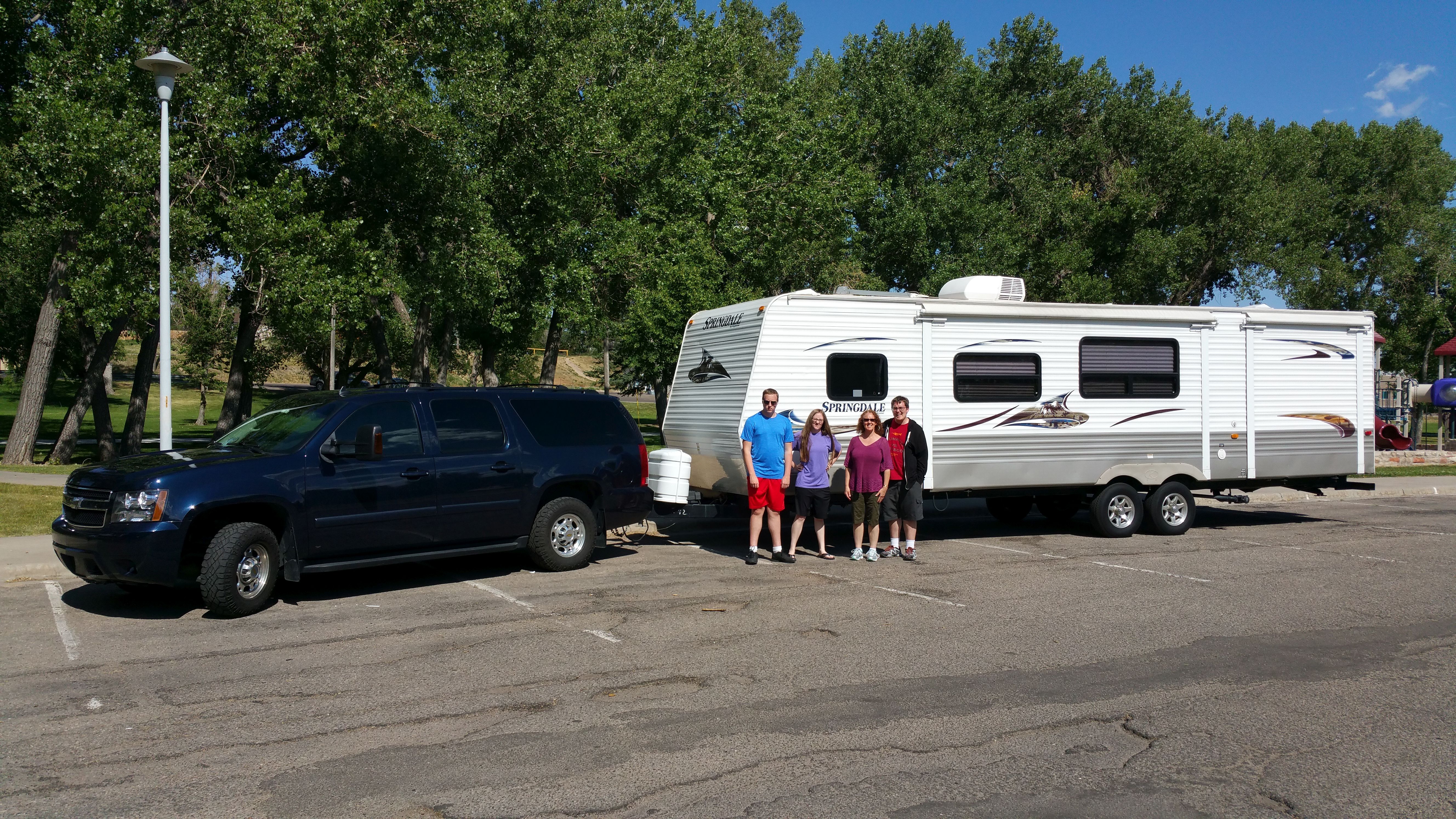
So that's when we bought the 2500. Instead of 1500 lbs of payload, I have 2100. Instead of a 4000-lb rear axle rating, I have 5500. And so now, I tow this (8600 lbs loaded):

OnsFz5d.jpg


When we started towing, our family weighed about 600 lbs, with my fat a$$ being almost half that. Even though I lost a bunch of weight, the kids all grew and now we're 950 lbs.

So here are the critical numbers, this is from my last road trip out to Wyoming last summer:

kZfZS2o.jpg


My vehicles ratings:

GVWR 8600
RAWR 5500
GCWR 16000

My Gross Vehicle Weight? That's easy. That's the weight on the four wheels of the truck. 3080+5500 = 8580
Rear axle weight? Even easier. 5500. Hey, look at that, am I good, or what? Actually, I'm not concerned because the axle in my truck is rated to 8600 lbs by the manufacturer, American Axle, and my tires can each carry a max of 3000 lbs, so I'm not overloading anything.
Gross combined weight? Simple, add them all up. The slip already did that - 16,160. So I'm a bit over on my GCWR. Not a big deal.

And regards to weight distribution - be careful. If you take too much weight off the tongue, it tends to make the trailer more prone to sway. I did that exact thing with my half-ton, trying to get weight off the rear axle. It made the rig much more prone to sway and crosswinds and getting passed by trucks was a constant adventure.

Endeavor to put as much gear in the trailer as possible, but you still want to aim for 13% tongue weight. Anything lower and you increase the likelihood of sway. So if you have 500 lbs for tongue weight, 500/.13 = 3,846. That's not much. But every pound of gear you can move to the trailer gets you seven more pounds of trailer weight. So move 200 lbs into the trailer, and now you can handle a trailer up to 5,385.

Lastly, about that rear axle. It's a semi-floater, as compared to the full-floater in my 2500. You can do some Googling if you don't know the difference, but the main thing is that the semifloater works much harder to do the same job. It has to carry the weight AND transmit the torque to the wheels. In a full-floater, the axle housing carries the weight and all the axle has to do is transmit the torque. Big difference.

 
Last edited:
OP
OP
O

optimusprime

Full Access Member
Joined
Jul 15, 2016
Posts
151
Reaction score
59
You are 100% correct. There's some bad information floating around on this thread.

Unfortuntately, what you're finding out is that a half-ton Suburban/Yukon XL is not the towing beast a lot of folks make it out to be. I remember when I bought my first Suburban, a 2001 1500, I drove over to the RV dealer and the salesman came out to me and said, "Great choice. That truck can tow anything. Pick whatever you want on the entire lot." Well, three busted rear axles later and I sold it to a buddy and bought a 2500.

The problem with the half-ton trucks, as you're finding out, is the payload. You have 1500 lbs for you, your other passengers, gear, hitch (don't forget that weighs 20-30 lbs), and trailer tongue. If your passengers and gear weigh a lot, this reduces what you can tow dramatically. When we first started towing, my 3 kids were small. We also had a trailer that was about 4550 dry.

a0XXg09.jpg


Then, as the kids grew, we upgraded to a 7,000-lb trailer. Here's where the problems started. On several long trips, I killed/overheated the rear axle to catastrophic failure.

U9RZTre.jpg


So that's when we bought the 2500. Instead of 1500 lbs of payload, I have 2100. Instead of a 4000-lb rear axle rating, I have 5500. And so now, I tow this (8600 lbs loaded):

OnsFz5d.jpg


When we started towing, our family weighed about 600 lbs, with my fat a$$ being almost half that. Even though I lost a bunch of weight, the kids all grew and now we're 950 lbs.

So here are the critical numbers, this is from my last road trip out to Wyoming last summer:

kZfZS2o.jpg


My vehicles ratings:

GVWR 8600
RAWR 5500
GCWR 16000

My Gross Vehicle Weight? That's easy. That's the weight on the four wheels of the truck. 3080+5500 = 8580
Rear axle weight? Even easier. 5500. Hey, look at that, am I good, or what? Actually, I'm not concerned because the axle in my truck is rated to 8600 lbs by the manufacturer, American Axle, and my tires can each carry a max of 3000 lbs, so I'm not overloading anything.
Gross combined weight? Simple, add them all up. The slip already did that - 16,160. So I'm a bit over on my GCWR. Not a big deal.

And regards to weight distribution - be careful. If you take too much weight off the tongue, it tends to make the trailer more prone to sway. I did that exact thing with my half-ton, trying to get weight off the rear axle. It made the rig much more prone to sway and crosswinds and getting passed by trucks was a constant adventure.

Endeavor to put as much gear in the trailer as possible, but you still want to aim for 13% tongue weight. Anything lower and you increase the likelihood of sway. So if you have 500 lbs for tongue weight, 500/.13 = 3,846. That's not much. But every pound of gear you can move to the trailer gets you seven more pounds of trailer weight. So move 200 lbs into the trailer, and now you can handle a trailer up to 5,385.

Lastly, about that rear axle. It's a semi-floater, as compared to the full-floater in my 2500. You can do some Googling if you don't know the difference, but the main thing is that the semifloater works much harder to do the same job. It has to carry the weight AND transmit the torque to the wheels. In a full-floater, the axle housing carries the weight and all the axle has to do is transmit the torque. Big difference.

Regarding your 2500 burb, how has the tranny held up with your towing? Did you notice a difference in stability when descending steep grades? And lastly, how is the 6.0 for power on flat and low grade stretches?


Sent from my iPhone using Tapatalk
 

intheburbs

Full Access Member
Joined
Aug 10, 2017
Posts
935
Reaction score
1,861
Location
SE MI
Regarding your 2500 burb, how has the tranny held up with your towing? Did you notice a difference in stability when descending steep grades? And lastly, how is the 6.0 for power on flat and low grade stretches?

Macro view first, regarding durability - I've owned this truck for almost 7 years, put 90k HARD miles on her, and have spent about $300 total in repairs - as in something broke and I had to fix it. Maintenance - fluid changes, plugs/wires, tires - not counted.

Transmission has held up fine. She's at 193k miles, all-original, and still shifts perfectly and smoothly. I do a full flush at the dealer (16 quarts) every 50k.

The 6-speed works well with the 6.0. Usually in 4th or 5th depending on trailer profile/weight and weather (headwinds, etc).

Big Rocky Mountain-type grades are fun, but never scary. I've gone through the Eisenhower Tunnel with it (11,000+ altitude) and Powder River Pass in Wyoming (9,666 feet). Descending is no problem, but you have to be strategic about using engine braking and the brakes.

Funny story - we were descending from Powder River Pass a few summers ago. GVW was about 16,400 lbs. It was hot and we had the A/C on. I was using maximum engine braking, as in spinning the engine at 5500-6000 RPM down long, steep grades. About halfway down, the A/C cuts out. I thought maybe the computer was disabling the compressor to keep it from spinning too fast. But when we hit areas where I could actually upshift and drop the revs, it still wouldn't blow cold. Crap, overspun the compressor and killed it. :(

We get to the bottom and I pull off and pop the hood. I look down, and I see the A/C belt dangling (intact) from the crank pulley. I'd spun the engine so fast that the A/C belt had just enough stretch to walk off the compressor pulley. We were just at the beginning of our trip and didn't want to be without A/C for 2 more weeks. Went to the auto parts store and bought a new one, and found a local mechanic to install it. Wanted to only charge me $50, but I know what a ***** that belt can be so I threw the guy $100. I'm sure he burned himself on the lower radiator hose.
 
OP
OP
O

optimusprime

Full Access Member
Joined
Jul 15, 2016
Posts
151
Reaction score
59
Thanks for all the super helpful info everyone. For those of you who tow with the Denali, how stable do you feel when descending long grades and when being passed by larger vehicles? Big wind gusts?


Sent from my iPhone using Tapatalk
 
Last edited:

Rex Ammerman

TYF Newbie
Joined
Oct 14, 2019
Posts
5
Reaction score
3
20180309_163106.jpg
I have used my 2009 and 2011 Denali's to pull several trailers. The biggest weights in around 8800 Lbs with one of our show cars loaded. That trailer is 24' x 8' and it pulls like a dream. Best tow vehicle I have ever owned. My 2009 has 209000 miles and still will pull your house down. Also with the magnetic air ride they all have, I have never used any kind of equalizer bars or systems
 

Charles Land

TYF Newbie
Joined
Jan 23, 2018
Posts
23
Reaction score
12
We tow a 26 ft Jayco. 6500 gross, 4500 dry with a 2011 Denali xl with 180k miles. Have taken some trips of a couple thousand miles including the Rockies. It tows decently well. We like to cruise at 55 mph when we have a headwind. 65 with a tailwind. We get 8 to 9 mpg towing. Have had one tranny overhaul at 140k. The coolant temp is hotter than I would like in warmer weather.
 

MT Elk Hunter

TYF Newbie
Joined
Oct 10, 2017
Posts
14
Reaction score
9
The 6.2 is a great motor. What will drive you crazy towing any kind of weight is the transmission. It will be downshifting constantly and the motor will wind up pretty high on long hills.

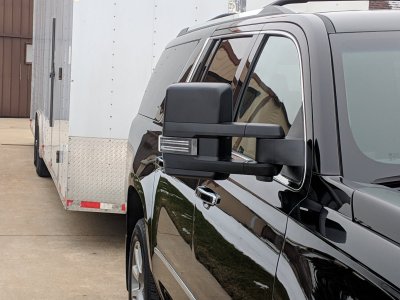
I have a 2017 Denali XL and easily tow and stop my 28' Cargo Mate race trailer (4,500 lbs) which holds a 3,000 lb race car, 800 lb golf cart, tools, and crew of three - 11,000 lbs. total. Previous to that I had a 2007 Denali which towed it with some effort, especially on off-ramp braking. Both rigs utilized weight distribution bars and 2500 series tow mirrors.

2017 Denali XL, 1A Auto Mirror, right - front.jpg
 
OP
OP
O

optimusprime

Full Access Member
Joined
Jul 15, 2016
Posts
151
Reaction score
59
I have a 2017 Denali XL and easily tow and stop my 28' Cargo Mate race trailer (4,500 lbs) which holds a 3,000 lb race car, 800 lb golf cart, tools, and crew of three - 11,000 lbs. total. Previous to that I had a 2007 Denali which towed it with some effort, especially on off-ramp braking. Both rigs utilized weight distribution bars and 2500 series tow mirrors.

View attachment 239904
Wow. I can’t see how you’re not way overloaded, legally speaking.


Sent from my iPhone using Tapatalk
 

jamoody

Member
Joined
Jun 3, 2017
Posts
48
Reaction score
19
Something I didn't see in this thread is to upgrade to an external transmission cooler if your Yukon doesn't have one. The engine is a workhorse and will handle 4000 RPM all day long but generally when towing the transmission will run at a lower numbered gear which will drive up the transmission temperature, especially on hills. You want to keep the transmission temperature around 200F.

A weight distribution hitch is a must.
 

Forum statistics

Threads
137,751
Posts
1,991,192
Members
102,740
Latest member
JeffK
Back
Top