Towing a trailer with automatic leveling system

Disclaimer: Links on this page pointing to Amazon, eBay and other sites may include affiliate code. If you click them and make a purchase, we may earn a small commission.

hailbun

TYF Newbie
Joined
Apr 26, 2023
Posts
11
Reaction score
10
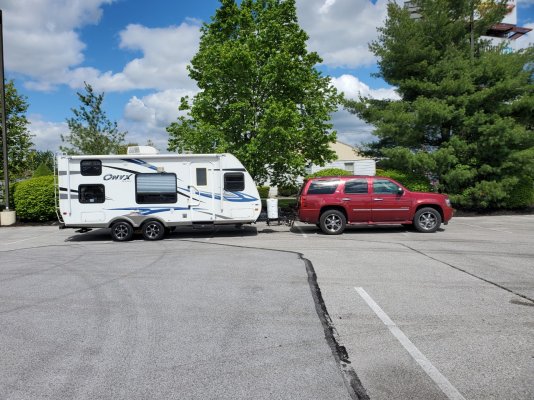
Hello, new member. I have a 2011 LTZ Tahoe with tow package. I bought this in 2020 to tow 4 wheelers and such. I have never had a trailer with brakes. Just bought a 2011 travel trailer, 22" 3900 lbs. Towed it home with just my ball hitch. I purchased a E2 load distribution system. In the instructions it says: Tow vehicle “auto-level” systems should also be disabled or turned off. If your tow vehicle is equipped with air bags, we recommend that you inflate them to the pressure you are expecting to tow with before setting up the hitch. Inflating them after hitch set up changes the relationship between tow vehicle and trailer, and can reduce the amount of weight distribution and sway control you get from your hitch.
I know the Tahoe has a compressor, I can see it and hear it on start-up. It sits so high in the rear I had to buy an extra long shank to get the ball down to the correct height.
I have questions. I'm not sure if it has air shocks or air bags. If it has air bags how do I inflate them to the pressure I am expecting to tow with as indicated in the instructions? How do I even know what the PSI in it is? Do I need to disable the ALS to use the load leveler system? If so, is it possible to just pull the fuse for that? If I do disconnect it, do I leave it disconnected the whole time I'm trailering? Do I need to reconnect it when I unhook the trailer, in case we want to go somewhere? If I disconnect it, how does the air leave the system before I can install the load leveling system? Or, do I just ignore the instructions and hook it up where the ALS has it adjusted? I want myself and everyone else on the road to be safe. Never knew it could get so complicated just to pull a trailer. I will ask Fastway Trailer, the maker of the hitch as well. I'm a Yamaha forum member so I know the type of excellent advice that can come from others. Any Tahoe owners with load leveling systems? Appreciate any and all assistance.

 

B-train

Full Access Member
Joined
Sep 12, 2022
Posts
2,704
Reaction score
4,910
I don't think you have to get too overzealous. If you have a compressor, you have air lift shocks. The truck will auto level with load. Hook up the trailer with you truck running and as you put weight on the compressor will kick in to keep it the same height.

I have 2 vehicles with this system and have towed plenty of things. With the travel trailer and weight distribution hitch, you basically want the truck and trailer to be level when the tongue jack is out of the equation. It'll work fine.

Just note that if your compressor runs non-stop or very frequently, you have a leak in the system - usually the air bladders on the shocks where they fold under and mount. You need to jack up the body of the vehicle to get the axle to relax and extend the shocks. Then you can inspect. Or, use soapy water when they are pumped up and look for bubbles.
 

Geotrash

Dave
Supporting Member
Joined
Feb 16, 2018
Posts
7,843
Reaction score
20,396
Location
Richmond, VA
Hello, new member. I have a 2011 LTZ Tahoe with tow package. I bought this in 2020 to tow 4 wheelers and such. I have never had a trailer with brakes. Just bought a 2011 travel trailer, 22" 3900 lbs. Towed it home with just my ball hitch. I purchased a E2 load distribution system. In the instructions it says: Tow vehicle “auto-level” systems should also be disabled or turned off. If your tow vehicle is equipped with air bags, we recommend that you inflate them to the pressure you are expecting to tow with before setting up the hitch. Inflating them after hitch set up changes the relationship between tow vehicle and trailer, and can reduce the amount of weight distribution and sway control you get from your hitch.
I know the Tahoe has a compressor, I can see it and hear it on start-up. It sits so high in the rear I had to buy an extra long shank to get the ball down to the correct height.
I have questions. I'm not sure if it has air shocks or air bags. If it has air bags how do I inflate them to the pressure I am expecting to tow with as indicated in the instructions? How do I even know what the PSI in it is? Do I need to disable the ALS to use the load leveler system? If so, is it possible to just pull the fuse for that? If I do disconnect it, do I leave it disconnected the whole time I'm trailering? Do I need to reconnect it when I unhook the trailer, in case we want to go somewhere? If I disconnect it, how does the air leave the system before I can install the load leveling system? Or, do I just ignore the instructions and hook it up where the ALS has it adjusted? I want myself and everyone else on the road to be safe. Never knew it could get so complicated just to pull a trailer. I will ask Fastway Trailer, the maker of the hitch as well. I'm a Yamaha forum member so I know the type of excellent advice that can come from others. Any Tahoe owners with load leveling systems? Appreciate any and all assistance.
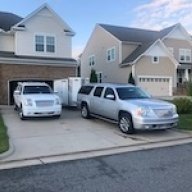
I tow a 7500 lb camper with the Z55 rear air suspension on a Yukon XL Denali and I use a weight distributing hitch. Prior to that I had a 4000 lb (gross) single axle travel trailer that I did not use a weight distributing hitch for because I measured the tongue weight at about 450 lbs. I did the research at the time for both with and without the WDH and GM's guidance was to use the air suspension to take up the remaining squat once the hitch was setup right. That's what it was engineered for and it's fully automated.

3900 lbs for yours is empty, yes? So it's safe to say it's maybe 4500+ loaded up for camping? If so, then you probably have about 500 lbs on the tongue. That's into weight distributing hitch territory, in my opinion. Your Fastway E3 will be just fine. A Camco Recurve R3 is the hitch I use and I have a set of 600 lb bars for it for lighter trailers and a set of 1000 lb bars for the 7500 lb camper. But here's the trick: Set the hitch and weight distributing bars up so that they take as much of the squat out as they can (leaving less than an inch of squat if you can get it that close) with the ignition off, and then start the truck to take out the rest. Pulls great this way because it leaves enough tension on the bars for them to remain effective.
 
Last edited:
OP
OP
H

hailbun

TYF Newbie
Joined
Apr 26, 2023
Posts
11
Reaction score
10
I appreciate everyone's response. It won't be until next week that I can set this up, but my confidence is MUCH higher. Thanks again.
 

petethepug

Michael
Joined
May 4, 2016
Posts
3,788
Reaction score
4,355
Location
SoCal
That’s solid info. You’re gonna look smart having both the trailer and truck level with the right hitch. Anyone using a multi position hitch ball?
 

Art Contoni

Full Access Member
Joined
May 27, 2020
Posts
123
Reaction score
188
Location
Central, IL
My Wifes 2013 Tahoe and my 2017 Yukon compressors both seem to be running quite a bit, I'll have to inspect these. I too, tow with both but do not have the equalizer. Be interesting to see how these work.
 
OP
OP
H

hailbun

TYF Newbie
Joined
Apr 26, 2023
Posts
11
Reaction score
10
Hello, back again. Just hooked up the load distro. Went really smooth. The L brackets are at their lowest point. Probably because it's a fairly light trailer. That seems to be where the previous owner had it as well. He towed with a very similar Chevy pickup, that also had load leveling on it. Drove it around for a while. You can definitely feel the truck and trailer seem as one now. Will take it out in 2 weeks for our first trip. As always, these forums are fantastic, especially when the members are great. Much appreciation!
 

Attachments

  • Tahoe and trailer sway bars attached.jpg
    Tahoe and trailer sway bars attached.jpg
    483.9 KB · Views: 84

RobH

Full Access Member
Joined
Jun 4, 2020
Posts
113
Reaction score
123
Location
San Antonio
I do the same. Hitch and adjust with the ignition off. Your manual should have instructions for hitching with a weight distribution hitch. My 2016 manual says to adjust the weight distribution system to make the front fender opening height the same as when unhitched. This keeps an appropriate amount of weight on the front axle for steering control.

I suggest you monitor your transmission temperature. If you have a 6L80 transmission, the torque converter clutch can be a weak spot and is adversely affected by heat. There is a factory service bulletin to change out the thermal bypass valve (thermostat) for a 70°C (158°F) thermal bypass valve. I lost my transmission recently at 120k miles. I now have a GM reman transmission with the service bulletin valve.

2022_04_22_Bluebonnet.JPG
 
Last edited:

Foggy

Full Access Member
Joined
Jul 25, 2019
Posts
1,402
Reaction score
1,918
Location
KS
Up to 2014 the 6L80E's don't have that thermostat valve.. So you are good there.
The main thing is to keep it in tow/haul mode.
And if you can, get a TUNE ... The torque converter setting stock is what kills these converters
along with just being too weak of course
 

D01R6

TYF Newbie
Joined
May 29, 2024
Posts
1
Reaction score
0
1000006881.jpg
our suburban with auto leveling air ride. Pump runs before we pull out, then looks like this, vehicle is running. So question is why the squat? Max weight of camper is 3500. This should not squat one bit, but there it is. No cargo 250 lbs worth of children in 2nd row. 2013 suburban LTZ
 

j91z28d1

Full Access Member
Joined
Feb 28, 2022
Posts
4,599
Reaction score
5,860
View attachment 429421our suburban with auto leveling air ride. Pump runs before we pull out, then looks like this, vehicle is running. So question is why the squat? Max weight of camper is 3500. This should not squat one bit, but there it is. No cargo 250 lbs worth of children in 2nd row. 2013 suburban LTZ


there's will. know better, but I'd personally hook. up a scanner and see what the pressure in the air bags are doing.

my guess is they aren't holding air and the pump isn't coming on to try and refill.
 

Tim907356

Member
Joined
Jan 17, 2020
Posts
67
Reaction score
45
I'm in a similar situation: 2010 Yukon XL Denali. I've been pulling a 4100# Travel Trailer for 6yrs. or so, and traded for a 6400# T.T., with a ~700# tongue weight. We drove it home for 2hrs. yesterday with the rear suspension waaaaay-low. The load leveling springs were undoubtedly too loose, but I don't think the shocks pumped up much either, although the compressor tried. It looked like the pic. from D01R6, above.
My thought was to add aftermarket air bags, but with the auto-leveling system, it seems redundant, and maybe just a heavy duty set of load leveing shocks would do? Any advice is welcome!!!
 
Last edited:

j91z28d1

Full Access Member
Joined
Feb 28, 2022
Posts
4,599
Reaction score
5,860
I'm in a similar situation: 2010 Yukon XL Denali. I've been pulling a 4100# Travel Trailer for 6yrs. or so, and traded for a 6400# T.T., with a ~700# tongue weight. We drove it home for 2hrs. yesterday with the rear suspension waaaaay-low. The load leveling springs were undoubtedly too loose, but I don't think the shocks pumped up much either, although the compressor tried. It looked like the pic. from D01R6, above.
My thought was to add aftermarket air bags, but with the auto-leveling system, it seems redundant, and maybe just a heavy duty set of load leveing shocks would do? Any advice is welcome!!!


my advice is to check the air pressure in the stock bags to make sure they are working and/or if you're way past max psi and still sagging badly.

if your air bags are holding pressure and pump is able to get them up to the 120-140psi range, that's about as high as you really want to go for long term use. it might be time to look into the weight distribution hitch stuff. I personally don't haven't got into thst yet, but tons of info and guys here that have done and it and have it all sorted out.
 

tagexpcom

Full Access Member
Joined
Aug 12, 2023
Posts
294
Reaction score
275
I tow a 5300lb (650lb tonque) 7 x 14 cargo -> camper with my 2021 Yukon Denali. The trailer has weight front/back but not so much in middle so much so it's not 'the best' for stability.

Without WDH it get's a little squirrely at 60mph+. With WDH it's rock solid.

I don't have air, just magnetic ride.

Without WDH the rear goes down 2" and front up 1" - it's visible in the pic.
1717657783346.png


With WDH the rear goes down 1" and front up 1/2". Since rear is slightly higher than then front in normal mode, it looks more level.
1717657908581.png


With WDH and you're tongue weight, I wouldn't worry :)
 
Last edited:

Forum statistics

Threads
137,671
Posts
1,989,103
Members
102,675
Latest member
j_jerry79

Latest posts

Back
Top