Late Game Transmission Fluid Change Rumors or Fact?

Disclaimer: Links on this page pointing to Amazon, eBay and other sites may include affiliate code. If you click them and make a purchase, we may earn a small commission.

droptopchevy

TYF Newbie
Joined
May 5, 2022
Posts
11
Reaction score
7
Location
Rocket City
I'm sure everyone has heard not to flush the fluid on a high mileage automatic transmission if you don't know the service history. Is this true?

Truck has 275k, bought it around 175k, 5.3 / 4L60E Z code. It's given me 100k absolutely trouble free miles other than the compressor just left the building, but rectifying that.

I have no idea the service history of the truck but it is absolutely 100% stock and more or less not ****** with. Transmission will stumble from time to time, funny shifts mainly, every once in a blue moon it will start in second. I would like to be extend the life of this transmission as long as possible, would new fluid and filter be advantageous, or should I flush? Neither?
Would love to hear some thoughts on this.
 

rockola1971

Full Access Member
Joined
Dec 29, 2016
Posts
2,862
Reaction score
4,085
Location
Indiana (formerly IL)
The info you seek is NO! Do NOT do a flush on a high mileage tranny. Also do NOT do a complete fluid exchange. Here is what happens....The seals inside the tranny will swell when exposed to pure new transmission fluid not to mention the solvents in the flush and you end up with a cracked or cut seal and depending on which seal this happens to determines how your transmission fails. And they all end up with catastrophic failure. Here's a hint. If you absolutely think you need a flush or a complete fluid exchange then ask the shop if they will put it in writing that your transmission is guaranteed for a full year against any failure plus labor costs including all parts costs as well.......

Just drop the pan and filter. Replace the filter. Add as closely as possible the same amount of fluid you removed and doublecheck with vehicle warm and level. Inspect the pan for metal chunks, flakes and excessive clutch material. There is a magnet in the pan that metal is trapped to. Clean it as well.
 

Jonmurphy

Member
Joined
May 25, 2022
Posts
30
Reaction score
13
I'm sure everyone has heard not to flush the fluid on a high mileage automatic transmission if you don't know the service history. Is this true?

Truck has 275k, bought it around 175k, 5.3 / 4L60E Z code. It's given me 100k absolutely trouble free miles other than the compressor just left the building, but rectifying that.

I have no idea the service history of the truck but it is absolutely 100% stock and more or less not ****** with. Transmission will stumble from time to time, funny shifts mainly, every once in a blue moon it will start in second. I would like to be extend the life of this transmission as long as possible, would new fluid and filter be advantageous, or should I flush? Neither?
Would love to hear some thoughts on this.
Hi I'm an old mechanic and I have dealt with these transmissions before in the past. I always change the fluid and I always put an extra filter or 2 in the Cooler lines.. You can use the same filter use on your engine or get 1 of the better filters from Napa I use an adapter so I can run 2 filters Not in series but in parallel as the flow drops in a parallel application you filtrate becomes much fine or down to round 2.o microns. This is ideal ..
NAPA. sells A good filter kit in gaskets for only about $35. I have all t so use doctor -Shift, additive, And that works well it's worth it for about $12. Tell the proofs in the pudding isn't it ? I never had a problem with any of my transmissions, but you never know what the Cheap Former owner has done. Jon Murphy. I don't believe that few Fluid changes can possibly damage your transmission that doesn't make the slightest bit of sense at all swelling to seals ha
I
 

Snowbound

Jim
Joined
Nov 23, 2016
Posts
1,058
Reaction score
2,496
Location
Chicagoland (Lockport)
I’ve seen it both ways. I believe if the trans is on its way out, new filter and fluid isn’t to blame.
I’ve heard it said that when you clean the pan and replace the filter all that thick muck you removed that was taking up the space in the clutch packs is now gone and it starts to slip. I can’t get my head around that theory because none of that “thick muck” should be making it past the clogged filter anyhow unless there’s a hole in the filter. But that being said I had it happen to me on an 86 Regal. Pan was nasty and I changed the filter and cleaned the pan, put in new fluid and it lasted 3 days before it started slipping. But I have to think the trans was on its way out anyway and there’s no way to know if it would have gone out had I not serviced it.

If you’re starting to have problems with it shuttering, a service is not gonna fix it. A high mileage trans which you know hasn’t been serviced in the 100k miles you’ve owned it is either gonna need to be replaced or start thinking about getting a new vehicle. With the prices of vehicles right now, you might be better off replacing the trans.
 

SnowDrifter

Full Access Member
Joined
Sep 5, 2016
Posts
2,492
Reaction score
2,941
Location
Sasquatch Country
The whole high mileage thing is... Not really the whole issue.

If it smells burnt, or has visible floating particulates - don't touch it. Start saving for a new trans. Burnt means sad clutches. Floating particulates are sad clutches.

If its dirty but otherwise serviceable, then go nuts.
 

swathdiver

Full Access Member
Joined
May 18, 2017
Posts
21,321
Reaction score
30,318
Location
Treasure Coast, Florida
I'm sure everyone has heard not to flush the fluid on a high mileage automatic transmission if you don't know the service history. Is this true?

Truck has 275k, bought it around 175k, 5.3 / 4L60E Z code. It's given me 100k absolutely trouble free miles other than the compressor just left the building, but rectifying that.

I have no idea the service history of the truck but it is absolutely 100% stock and more or less not ****** with. Transmission will stumble from time to time, funny shifts mainly, every once in a blue moon it will start in second. I would like to be extend the life of this transmission as long as possible, would new fluid and filter be advantageous, or should I flush? Neither?
Would love to hear some thoughts on this.
Were you in the backseat of that Tomcat?
 

Jonmurphy

Member
Joined
May 25, 2022
Posts
30
Reaction score
13
I’ve seen it both ways. I believe if the trans is on its way out, new filter and fluid isn’t to blame.
I’ve heard it said that when you clean the pan and replace the filter all that thick muck you removed that was taking up the space in the clutch packs is now gone and it starts to slip. I can’t get my head around that theory because none of that “thick muck” should be making it past the clogged filter anyhow unless there’s a hole in the filter. But that being said I had it happen to me on an 86 Regal. Pan was nasty and I changed the filter and cleaned the pan, put in new fluid and it lasted 3 days before it started slipping. But I have to think the trans was on its way out anyway and there’s no way to know if it would have gone out had I not serviced it.

If you’re starting to have problems with it shuttering, a service is not gonna fix it. A high mileage trans which you know hasn’t been serviced in the 100k miles you’ve owned it is either gonna need to be replaced or start thinking about getting a new vehicle. With the prices of vehicles right now, you might be better off replacing the trans.
So true I take care of all vehicles All high performance Keep your Fluid clean and buy good quality filter Napa is good. As I mentioned several times keep your temperature under 200°And add an auxiliary filter at least 1 in your cooling line a 10 micron Mobile 1 filter will filter down to 2 or 3 microns at the low pressure in your cooling line s. JON Murphy From Murphy's law.
 

nonickatall

Full Access Member
Joined
Nov 19, 2022
Posts
864
Reaction score
1,601
Location
Germany
I repair automatic transmissions and all I can say is, that the information that an oil change or flush, which is an oil change, destroy your transmission is incorrect.

New oil, or a flush with new oil specified by the manufacturer cannot harm any transmission!!!

It's absurd to assume that old, used ATF oil with residue floating in it, won't damage transmissions, but new ATF oil made specifically for those gearboxes, should cause damage. And why should that be different on an enginge, a transfer case, a power steering or differential?

The reason many transmissions fail after a transmission flush is this: Most people completely neglect servicing their transmission until the transmission shifts poorly or causes other problems. Then they run into the workshop and the mechanic says: We can try an oil change. But then maybe it's already too late, an oil change is done and shortly afterwards the gearbox fails and then these people claim that the oil change broke the gearbox.

In this area the opposite is true – old oil destroys transmissions. The lubricating effect of oil is based on the fact that there are long carbon-hydrocarbon chains in the oil that can slide past each other. When exposed to mechanical stress, as is naturally the case with transmissions, these chains are destroyed over time. This causes the oil to lose its lubricating effect. Additionally you have wear of the Clutches which contaminates the oil. Depending on the transmission, it is important to change the oil at least every 35,000 miles..

So is it better to do a DIY oil change with removing the pan, change the filter and fill in the drained oil? Or is a professional oil flush necessary, better, or even dangerous?

To make things clear:

In an automatic transmission, two thirds of the oil is usually not in the pan, but somewhere else in the system, for example in the torque converter, the oil pump, or in the oil cooler. If you remove the pan you only get a third of the oil out. That's not a real oil change.

If you want to change the oil properly, you have to flush it, which means you add oil to the gearbox while draining the old oil. It's not magic, it's just replacing the oil that's in the system. There are no cleaning agents used, only old oil is replaced with new oil. That is "flushing the transmission".

Because it's not easy to do that on a not running transmission, Workshops have special flush machines which cost a lot of money. They connect these machines to the transmission, mostly on the oil cooler, push in new oil and suck out the old oil oit, until the complete oil is changed.

And they change the filter

From my experience, most automatic transmissions only have paper filters or even flow filters that are intended to catch large chunks that may have broken off somewhere before they enter the oil circuit.

The normal wear in an automatic transmission is so fine that it's enough to change the oil regularly, they don't have to filter that out. There are no combustion residues like in engine oil, which have to be filtered out with fine filters.

That means for someone who want to do it DIY that the biggest benefit is flushing the oil, a little benefit is to change the filter. Flushing the oil is very easy and done in half an hour, exchange the filter is a little bit more complicated, because you have to remove the oil pan under the car and you have to get that oil pan sealed again.

So my recommendation is as we say in Germany: "Let 5 be equal" and flush your oil and change your filter only when you want to and have the abilities to do it.

Of course, if you buy a used car and don't know the service history and condition of the transmission, it's a good idea to remove the oil pan, put a new filter in it and then flush the system completely.

This is particularly helpful, because you can determine the condition of the gearbox by looking at the adhesion to the magnet, which is normally supposed to catch fine metal debris in the oil pan. No question. It is good to change the filter, especially when you don't know how long the filter is in use, but it's definitely not necessary to change the filter at every oil change.

So, once you've done that, you can do without changing the oil filter the next time when you change the oil.

And here comes the good news:
It's super easy to change the oil on our trucks. You simply remove a line from the oil cooler at the front, near the air filter. There is even a quick coupling for these purposes. And connect an appropriate hose on the cooler, let the engine run briefly until there is no more oil coming out, that's about 4 quarts, then refill the appropriate amount and repeat this three to four times. If you let the engine idle and let spill out oil until nothing comes anymore and directly switch of the engine, there is no danger to make a damage on your transmission. Automatic transmissions do not have thrust bearings that run under oil pressure, like the connecting rod, crankshaft or camshaft bearings in an engine. With an engine you should never do this and let the oil run out until it stops flowing. With an automatic transmission this isn't a problem.

This flushes the gearbox, it takes half an hour and costs maybe 5 Gallon of oil, which is not very expensive. Then you reconnect your oil cooler, check the oil level and you are done. Just to be complete you need to check the oil level when the transmission is on working temperature. So drive and check again.

Basically, relatively normal dexron 6 oil is enough - you don't have to use gold-particled, hand-signed oil from freshly pressed slate layers in the Oil Valley in Dubai. ;)

Better change your oil without filter change every 15,000 miles with normal priced (not the cheapest) oil than: Flush your gearbox in a workshop with filter change and expensive oil, only each 100,000 miles.

Only my 2 cents

 
Last edited:

S33k3r

Elite Member
Supporting Member
Joined
Aug 14, 2017
Posts
2,893
Reaction score
4,189
Location
Dallas, Texas
Nick,

Can you please speak to this:

"When flushing the transmission, you can cause particulates that had settled in one or more places to become free, and it is these particulates that do in your transmission."

I really don't have a dog in this hunt, but it sure would be nice to hear from a real expert for once. Thanks!
 

nonickatall

Full Access Member
Joined
Nov 19, 2022
Posts
864
Reaction score
1,601
Location
Germany
Two forms of deposits can form in a transmission. The first is abrasion of the pressure plates, which are made of steel.

This is very fine metallic abrasion that normally collects on the magnet in the pan.

The second is the friction lining of the friction disks. They have a similar structure to clutch plates in a manual transmission.

This is very fine abrasion that normally remains in suspension and is removed when the oil is changed.

It does happen that there is abrasion from the friction discs or mud in some corners. especially if you don't change the oil for a long time.

But these are usually very small amounts compared to an engine, for example.

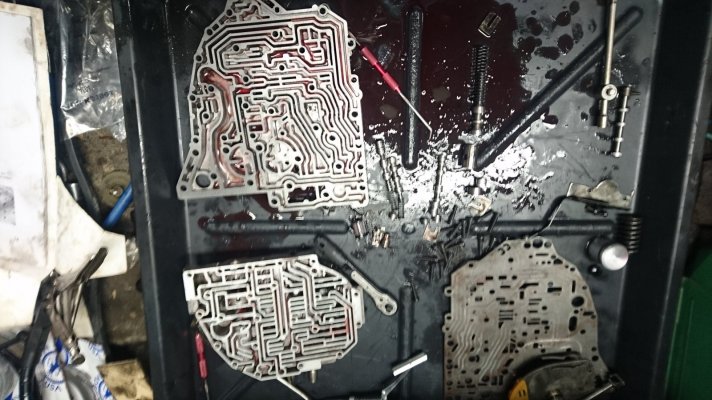
In the attached picture for example you see a vent body of a Chrysler lebaron transmission. If you look very closely you see the small amount of deposit as dark shadows.

But thats it. From a flush, there can not be loosen deposit which damage your unit.

And again: The purpose of a flush is not to get dirt or mud out of the gearbox, but to get the oil out of all channels, oil pump, pistons, torque converter, oil cooler and so on.
 

Attachments

  • DSC_1078.JPG
    DSC_1078.JPG
    303.6 KB · Views: 30
Last edited:

strutaeng

Full Access Member
Joined
Aug 10, 2023
Posts
1,993
Reaction score
4,292
Location
Dallas, Texas
The way I see it is this: the friction material is normally BONDED to backing plate and that's how it allows rotational force transmission with the aid of the clamping pressure. The "bonded" is what people forget here.

Once the material is knocked loose and is suspended in the fluid, it may as well just be a ball bearing. At least that's what picture in my mind are the mechanics of this. I don't see this "grit" being able to transmit any of rotational force anymore. There isn't even that much friction material in a single clutch once it's suspended like 12 quarts of fluid or whatever. Unless you have several clutch assemblies failing, then you have much larger issues.

Bearings, bushings, and races and other precisely machined surfaces are pretty much destroyed if enough clutch material circulates through them, as is the case of the TCC failure of the GM 6L family of transmissions.

I would simply say it's a coincidence that a transmission fails shortly after a fluid change, and those people believe in the old-wives tale to be true, which in their eyes, the fluid change is perceived as the event that caused the tranny to fail.
 
Last edited:

S33k3r

Elite Member
Supporting Member
Joined
Aug 14, 2017
Posts
2,893
Reaction score
4,189
Location
Dallas, Texas
Two forms of deposits can form in a transmission. The first is abrasion of the pressure plates, which are made of steel.

This is very fine metallic abrasion that normally collects on the magnet in the pan.

The second is the friction lining of the friction disks. They have a similar structure to clutch plates in a manual transmission.

This is very fine abrasion that normally remains in suspension and is removed when the oil is changed.

It does happen that there is abrasion from the friction discs or mud in some corners. especially if you don't change the oil for a long time.

But these are usually very small amounts compared to an engine, for example.

In the attached picture for example you see a vent body of a Chrysler lebaron transmission. If you look very closely you see the small amount of deposit as dark shadows.

But thats it. From a flush, there can not be loosen deposit which damage your unit.

And again: The purpose of a flush is not to get dirt or mud out of the gearbox, but to get the oil out of all channels, oil pump, pistons, torque converter, oil cooler and so on.
Thank you for the explanation. Essentially, a flush is good for your transmission, unless it is already on the way out: i.e. If you have larger than expected particles in there already.
 

blackelky

Full Access Member
Joined
Oct 15, 2023
Posts
586
Reaction score
770
At this point I'd drain out what you can and save for a new or used trans
 

denalilex

Full Access Member
Joined
Feb 15, 2021
Posts
108
Reaction score
163
Location
philadelphia, pa
I'm sure everyone has heard not to flush the fluid on a high mileage automatic transmission if you don't know the service history. Is this true?

Truck has 275k, bought it around 175k, 5.3 / 4L60E Z code. It's given me 100k absolutely trouble free miles other than the compressor just left the building, but rectifying that.

I have no idea the service history of the truck but it is absolutely 100% stock and more or less not ****** with. Transmission will stumble from time to time, funny shifts mainly, every once in a blue moon it will start in second. I would like to be extend the life of this transmission as long as possible, would new fluid and filter be advantageous, or should I flush? Neither?
Would love to hear some thoughts on this.
my trans just went @ 304k. i kind of expected it when i changed the fluid like a year + ago… imo, if you are concerned about the trans to the point of being weary of a fluid change - the problems are imminent & will eventually come. transmissions aren’t forever - like i said, mine went 304, it really sucks but at the end of the day, they’re only built for 150-200, i got beyond my moneys worth. just be prepared for it, i think a lot of this concept is mental because personally looking back - i decided on a fluid change because i figured it would help the transmission. there were already issues. this might not be your situation nor might anyone else agree with me & that’s ok.

mine went another year. i can not say that my fluid change caused its failure nor sped it up. i felt like it did improve. but i was at 210k already.


good luck.
 

nonickatall

Full Access Member
Joined
Nov 19, 2022
Posts
864
Reaction score
1,601
Location
Germany
my trans just went @ 304k. i kind of expected it when i changed the fluid like a year + ago… imo, if you are concerned about the trans to the point of being weary of a fluid change - the problems are imminent & will eventually come. transmissions aren’t forever - like i said, mine went 304, it really sucks but at the end of the day, they’re only built for 150-200, i got beyond my moneys worth. just be prepared for it, i think a lot of this concept is mental because personally looking back - i decided on a fluid change because i figured it would help the transmission. there were already issues. this might not be your situation nor might anyone else agree with me & that’s ok.

mine went another year. i can not say that my fluid change caused its failure nor sped it up. i felt like it did improve. but i was at 210k already.


good luck.
You are right, additional i would say:

If you take 100 similar transmissions.
50 never make an oilchange and 50 make regulary all 35.000 Miles an Oil change.

Then i guess 5 of the 50 without oilchange will survive 250.000 Miles.

And propably 25 or more of the 50 with oilchange will reach the 250k.

But there are additional factors which limit the life of a transmission, like permanent kick down, especially when cold.

Short distance drive profile. If you use the car in a big town to go too and from work, its more stress for the transmission, then when you drive only long distance on the highway with rare shift processes.

Or when you pull heavy trailers up the hill.

So the lifetime of your transmission can be extended by your driving behaviour/profile and frequent oil change.
 

Forum statistics

Threads
138,092
Posts
1,998,722
Members
103,016
Latest member
BadDaddy2003
Back
Top