AFM/DOD Good News

Disclaimer: Links on this page pointing to Amazon, eBay and other sites may include affiliate code. If you click them and make a purchase, we may earn a small commission.

fredcook

Member
Joined
Oct 14, 2021
Posts
74
Reaction score
114
Sooo... out of curiosity... Who has not experienced an AFM/DOD lifter failure on our GMT 900 Tahoes and Yukons? Or any GMT 900?

Sure, we hear about the failures all the time. How does the statement go? "It's not IF, but WHEN". But I never hear about those that don't experience it. It's like murders. We hear about the 50 or so daily murders in the U.S. It's all over the news. But we never hear about the 340,000,000 people that aren't murdered every day in the U.S. it's impossible to nail down exact numbers, but the estimates seem to be there were 3.5 to 4 million GMT 900 AFM equipped 5.3L vehicles manufactured with a failure rate estimated to be between 3 and 5%. So, going with 4 million and 5%, that's 200,000. Yeah, that's a lot, but that also means there are an estimated 3,800,000 that didn't fail.

So, how about the good news. Who hasn't experienced an AFD/DOD failure?

My experience...

Out of three GMT Tahoes with AFM, all bought new, currently still own two of them, I have not experienced an AFM failure. We put over 300,000 miles on the first Tahoe. Last I heard, the current own has over 400,000 on it, no failure. The two we still have, one at 160,000, the other at 265,000, no AFM failures. Sometimes I think I'm just lucky, but the reality is there's a 97% chance AFM will not fail. Compare that 3% failure rate to other failures... 4L60E transmissions at 30%. Water pump, 50%. Alternator, 70%.

Some have asked me what I do to prevent the AFM failure. Nothing special really. I change oil when the DIC says it's time, use 5-30 Mobil 1 full synthetic oil, and PPE Micro Pure oil filters. Always run mid grade fuel, top tier if available. I also run a bottle of Red Line fuel cleaner through the engines just prior to oil changes. Not saying this is the answer for preventing AFM failures, it's just what I do.

Who else has put a lot of miles on their 5.2 AFM engines without AFM failures?
 

the 18th letter

Full Access Member
Joined
Feb 14, 2010
Posts
1,077
Reaction score
1,199
Location
Northern New Jersey
Sooo... out of curiosity... Who has not experienced an AFM/DOD lifter failure on our GMT 900 Tahoes and Yukons? Or any GMT 900?

Sure, we hear about the failures all the time. How does the statement go? "It's not IF, but WHEN". But I never hear about those that don't experience it. It's like murders. We hear about the 50 or so daily murders in the U.S. It's all over the news. But we never hear about the 340,000,000 people that aren't murdered every day in the U.S. it's impossible to nail down exact numbers, but the estimates seem to be there were 3.5 to 4 million GMT 900 AFM equipped 5.3L vehicles manufactured with a failure rate estimated to be between 3 and 5%. So, going with 4 million and 5%, that's 200,000. Yeah, that's a lot, but that also means there are an estimated 3,800,000 that didn't fail.

So, how about the good news. Who hasn't experienced an AFD/DOD failure?

My experience...

Out of three GMT Tahoes with AFM, all bought new, currently still own two of them, I have not experienced an AFM failure. We put over 300,000 miles on the first Tahoe. Last I heard, the current own has over 400,000 on it, no failure. The two we still have, one at 160,000, the other at 265,000, no AFM failures. Sometimes I think I'm just lucky, but the reality is there's a 97% chance AFM will not fail. Compare that 3% failure rate to other failures... 4L60E transmissions at 30%. Water pump, 50%. Alternator, 70%.

Some have asked me what I do to prevent the AFM failure. Nothing special really. I change oil when the DIC says it's time, use 5-30 Mobil 1 full synthetic oil, and PPE Micro Pure oil filters. Always run mid grade fuel, top tier if available. I also run a bottle of Red Line fuel cleaner through the engines just prior to oil changes. Not saying this is the answer for preventing AFM failures, it's just what I do.

Who else has put a lot of miles on their 5.2 AFM engines without AFM failures?
.

11’ Tahoe in my brothers possession now has 263k with AFM working. A relative has a 14 Escalade with 178k and no issues. Transmission recently went bad on the Tahoe for the 1st time
 

Marky Dissod

Full Access Member
Joined
Mar 3, 2023
Posts
4,078
Reaction score
5,886
Location
(718)-
Who else has put a lot of miles on their 5.3L Half@$$ engines, without Half@$$ failures?
Technically, me. I put over 200,000 miles on a 2012 Yukon XL SLT (fleet optioned, forgot that RPO), and I did something none of you should ever do:
had ecm tuned to make V4 mode more likely to come on, to come on more often, in 3rd 4th 5th AND 6th, in an attempt to improve MpGs.

Since I was a NYC cabbie, I applied the following skew to the Oil Life monitor (the spirit of the OLM idea is better than plain 'miles', but we're pessimists, so):
Mostly all highway miles (NOT NYC), change oil & filter by 25%, NEVER over 6000 miles.
More highway than local miles, change oil & filter by 33%, NEVER over 5000 miles.
More local than highway miles, change oil & filter by 41%, NEVER over 4000 miles.
Mostly all local miles (Manhattan, 5 boros, stop'n'go, LOTS of idling, also lots of restarts), change oil & filter by 51% - NEVER over 3000 miles.
For this '12 Yukon XL, most oil changes occurred between 2800 - 3200 miles.
Any true GroupIV 5W30 or 0W30 fully synthetic would do, Pennzoil Platinum (natural gas basestock) preferred. NEVER 0W20 or 5W20 of any kind.

Never experienced any lifter failure, which I credit to changing oil early and often with GroupIV oil.
It's also possible that reducing the WOT upshift by 200RpM may have helped (I'm a leadfoot), several failures have been caused or exacerbated by lots of high RpMs.

More to come ...
 

Marky Dissod

Full Access Member
Joined
Mar 3, 2023
Posts
4,078
Reaction score
5,886
Location
(718)-
The good news none of you will ever experience due to my strange tuning parameters:
At some point the radiator developed a very slow leak, undetectable til a dye was used to spot it, so slow it never dripped, never got to run downward.
On an unusually long day, enough coolant had leaked/evaporated to let the engine coolant temp exceed 230F.
At 230F, the ecm tune I spec'd pretty much kept it in V4 mode most of the time to try to keep coolant temps down.
That let me get off the expressway at the next exit so the tow truck driver could reach and assist my XL sooner.
NYC expressways and parkways are only accessible to roadside assistance with special permits - a vestige of the mafia, believe it or not -
whereas anything that isn't an expressway or a parkway is accessible by any roadside assist.
Point is I'm glad that V4 mode gave me enough extra minutes (at least 5 more min) to get off the expressway without worrying about overheating.
If I ever buy another GMT900, I'll disable Half@$$ UNDER 225F. Over 225F I'm afraid it may soon be overheating, so I'll leave it enabled over 225F.

The BAD news some of you may eventually experience:
1. V4 mode as implemented by GM is a bad idea. It's always the same 4 cylinders that get to be part-timers.
The part-time cylinders spend far more time reciprocating BELOW intended operating temp,
which means they wear out sooner/faster than the full-time cylinders that spend far more time AT operating temp.
The result is that as the engine ages, the MpG benefit of Half@$$ing wanes til it eventually saves no fuel vs full-time V8 operation.

First reason why V4 mode should be disabled: even if the lifters haven't failed yet, cylinders 1, 4, 6, & 7 are wearing out faster than 2, 3, 5, & 8.
Eventually V4 mode will not save any fuel vs V8 mode. Many who've disabled Half@$$ with an ecm tune have experienced an MpG improvement.

2. On top of not saving any fuel / money, V4 mode eventually cost money in the form of oil consumption.
Never got to visually scope 1, 4, 6, & 7, but educated guesses taken by several different mechanics all came to the same conclusion:
1, 4, 6, & 7 are more worn out than 2, 3, 5, & 8; the part-time cylinders are responsible for the increased oil consumption. most likely carbon on the rings.
 

Marky Dissod

Full Access Member
Joined
Mar 3, 2023
Posts
4,078
Reaction score
5,886
Location
(718)-
Long story short: disable V4 mode sooner rather than later.
As the engine gets older, Half@$$ saves less fuel.
As the engine gets older, oil consumption becomes more likely until it approaches a certainty.

Even if the two-mode lifters never fail, in and of itself that's not a good enough reason to let the engine continue to Half@$$.

(And we haven't even addressed how disabling Half@$$ reduces the TCC's wear rate yet.)

Long story short: just 'cause it's working fine now, even if the lifters never fail, the sooner you disable Engine Half@$$ the better.
 

alvocado

Allen
Joined
Feb 18, 2025
Posts
249
Reaction score
368
Location
Cincinnati, OH
I went to 234k on a '11 Yukon with the 5.3 before selling in Dec and no issues. I did a 500 mile break in oil change when new and then 10k mile oil changes thereafter with full syn. I used a plug in AFM disabler at around 215k to eliminate the annoying shift between v4 and v8.
 

JJB809

TYF Newbie
Joined
Jul 3, 2017
Posts
28
Reaction score
4
Well, I bought my 2017 Tahoe 5.3 new from dealer and received its whipple 3.0 Supercharger in 2023 with 15,000miles, now almost 30,000 the mechanic screwed up after replacing a faulty MAP which was faulty unbelievably at 30k? with 15k use?
So i ordered a replacement OEM MAP. I had always needed to move a water firewall line 1/2 inch to the drivers side since it would pass on vibration to firewall so what I thought was fixed ended up being a mistake of his since the coolant line clipped off, the chauffer/ driver didn't care or notice until the car overheated and who knows how long he stopped the car.
Had it towed to another shop and engine was smoking, used "FLUSHING" liquid for 15 mins on the engine, then changed the oil to take out all the crap that was all inside walls and valves and then restarted with much like zero smoke. BUT LIFTERS AFM sounding very bad!! so i have to uninstall the SC, and then solve changing all parts pertinent to that of all lifters and do the AFM delete.
Can anyone please share or guide me of all factory parts i should change on this 30,000 mile baby! That's including new water and oil pumps, even thinkinf of adding upgraded camshaft and some head flowing what do u think?
Thanks for helping on this journey , dont trust shops at this time with so many things l will have to be the most prepared i can.
the DOD AFM kit is just a kit or needs ECU programming to also delete de v4/v8 software?
Anyone know website that would have the most complete repair kit after this engine superoverheat that on top of that fixes the lifters and all suggested parts in this?
Cylinder 3 shows low compression at around 120 while other cylinders ar at 180 .
All help appreciated:)
Thanks friends!!
JJB
 

JJB809

TYF Newbie
Joined
Jul 3, 2017
Posts
28
Reaction score
4
I also know now that that afm failure was on its way, I have always had the one catalitic converter after the cooks headers bank warm up later then the other and low/weak/delayed warm/ stable input bla bla bla.
I live in the Caribbean, so i don't have an option of just grabbing a used L83 from a junkyard so easy.
But if your comments tell me its much muss less pain or more of a pain to change the engine rather than repair please could you share.
Thank you
JJB
 

ReaperHWK

Full Access Member
Joined
Oct 14, 2020
Posts
921
Reaction score
1,125
I had a 2015 Tahoe I traded in with 170k miles on it. AFM was never disabled still ran great.
 

alvocado

Allen
Joined
Feb 18, 2025
Posts
249
Reaction score
368
Location
Cincinnati, OH
There is a lot of existing info on this forum regarding AFM deletes including build threads and parts list if you search. My 5.3 had 234k miles and no lifter tick when I sold it.
 

Miami-Dade

Staff member
Moderator Supporting Member
Joined
Dec 8, 2016
Posts
4,205
Reaction score
5,545
I have 210K miles on my 2016 5.3 Tahoe. AFM is still enabled. I only use 87 regular fuel since I bought it new back in 2016. I use Exxon-Mobil 99% of the time. Oil gets changed every 5K miles with 0W20 Mobil 1.
 
Joined
Sep 18, 2024
Posts
35
Reaction score
30
92K miles. AFM disabled via a tune at 70k. Oil changes every 3k with 5w-30 now (was 0w-20). Regular fuel. No lifter failures yet.
 

KC 2013 Tahoe

Member
Joined
Jun 10, 2022
Posts
93
Reaction score
185
Location
Chandler, Arizona
2013 Tahoe 5.3, added a Range disabler around 70K, 146K on the clock now.
Change the oil/filter every 4K miles with Mobil-1, 5W-30 and a fresh Wix filter.
Have always done my own oil changes, good opportunity to spot leaks/drips.
She still runs great!

72.png
 

89Suburban

Bull in the china shop
Space X Supporting Member
Joined
Jan 10, 2013
Posts
17,812
Reaction score
50,741
Location
SE PA
2013 Tahoe 5.3, added a Range disabler around 70K, 146K on the clock now.
Change the oil/filter every 4K miles with Mobil-1, 5W-30 and a fresh Wix filter.
Have always done my own oil changes, good opportunity to spot leaks/drips.
She still runs great!

View attachment 484080
What WIX # do you use?
 

alvocado

Allen
Joined
Feb 18, 2025
Posts
249
Reaction score
368
Location
Cincinnati, OH
I bought my '11 5.3 new and it had 234k on it when I sold it in Dec. AFM was active until about 220k when I used an OBD plug in disabler to eliminate the clunkiness going between modes. I changed oil every 10k with full syn (whatever brand was cheapest from Castrol, Supertech to Kirkland) and it only consumed a about 1/4 quart of oil over the change interval mostly near the end of the 10k period with long highway miles. I did perform a break-in oil change at 700 miles. Here's a pic of the rockers a couple of weeks before it sold-looking pretty clean.
Rockers.jpg


I was running the factory water pump until 211k and despite no issues, I changed it preventatively because I was doing 1000 mile round trips and couldn't believe it was still working.
 

KC 2013 Tahoe

Member
Joined
Jun 10, 2022
Posts
93
Reaction score
185
Location
Chandler, Arizona
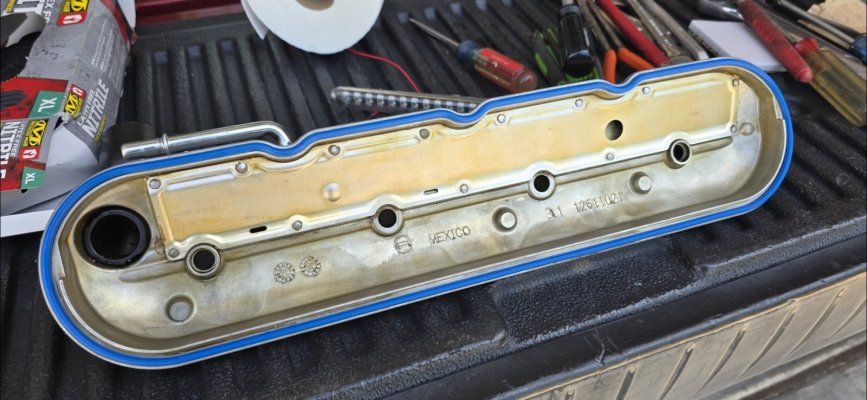
FWIW - Changed the valve cover gaskets this past weekend. Driver's side was starting to leak at the rear of the head. Unbelievable how clean the underside of the valve covers and the exposed valvetrain were for 146K miles. Regular Mobil-1 oil changes certainly do prevent sludge or gum buildup. Also took the time to replace the dry-rotted/missing corrugated tubing on the wire harnesses. Looks much better with the wires again protected and the valve covers, coils & brackets cleaned up.
 

Attachments

  • 3150.jpg
    3150.jpg
    215.8 KB · Views: 10
  • 3154.jpg
    3154.jpg
    205 KB · Views: 6
  • 3152.jpg
    3152.jpg
    233.4 KB · Views: 10
  • 3156.jpg
    3156.jpg
    188.9 KB · Views: 7
  • 3158.jpg
    3158.jpg
    238.7 KB · Views: 8

West 1

Full Access Member
Joined
Jan 20, 2023
Posts
625
Reaction score
1,356
If the engine was overheated you will need to have the heads rebuild and new valve seats installed. One of the few weak points on the LS heads is the valve seats will drop out after the engine is overheated. The valve seats are very hard metal mix while the head is softer aluminum. They tend to work loose after an overheat. I had the heads on my Escalade rebuilt after dropping a valve seat. 2 years ago I paid $700 for both heads full rebuild. I would not consider running heads that had been overheated unless they had the seats replaced. Many times the block is just fine after overheat the cast iron blocks are the safest in overheat. If the block got really hot the cam bearings will melt out since they are much softer material than engine bearings. Maybe your engine did not get this hot???
 

Forum statistics

Threads
137,671
Posts
1,989,103
Members
102,675
Latest member
j_jerry79

Latest posts

Back
Top