Full air-ride on 2004 GMC Yukon XL Denali AWD, GMT800. How?

Disclaimer: Links on this page pointing to Amazon, eBay and other sites may include affiliate code. If you click them and make a purchase, we may earn a small commission.

Johnny_Lee

TYF Newbie
Joined
Jul 3, 2026
Posts
2
Reaction score
1
Full air-ride on 2004 GMC Yukon XL Denali AWD, GMT800 on 17" wheels. How?

My research has led me to believe that a custom top shock mount is needed in order to add 4-corner air-ride due to the AWD. If you have had any experience with this, please respond to this thread.

If any of you have useful information on how to set up the 4-corner air-ride on an AWD Denali that will avoid damaging parts, tires, early wear, and handling, please respond to this thread.

If any of you have alternatives i.e. front lowing control arms, drop spinals etc. please respond to this thread.
 

Joseph Garcia

Elite Member
Supporting Member
Joined
Aug 2, 2018
Posts
10,381
Reaction score
15,059
I have no idea how to achieve your objective, but for sh*ts and giggles, I asked Dr. Google.


Achieving a full four-corner air-ride on a GMT800 AWD 2004 GMC Yukon XL Denali is entirely possible, but you will need to address a few major mechanical challenges—specifically front axle clearance, the Autoride/Auto-leveling sensor system, and a frame notch in the rear.

1. Front Suspension (AWD Clearance)
Because your Denali is All-Wheel Drive, the front CV axles and differential make space incredibly tight.
  • Torsion Bar Delete / Conversion: To get true "air ride," you must eliminate the factory torsion bar system. Kits like the RideTech CoolRide System or custom weld-in coilover brackets by Atomic Fab and Performance are the standard route.
  • Bag-over-Strut/Shock: Custom air springs (like the Air Lift Dominator or Slam Specialties bags) are used here. You will generally need aftermarket tubular upper control arms (e.g., DJM or similar) to allow full articulation and prevent the air spring from rubbing on the CV axle or chassis.

2. Rear Suspension (Laying Frame)
To lay the frame out and get the back down, simple bag replacements won't be enough.
  • C-Notch: You will need a bolt-on and weld-in rear C-notch kit, such as the Ekstensive Metal Works Rear Air Kit. This allows the rear axle to travel upward through the frame rails.
  • Link Conversion: You will need to convert the rear to a 2-link or 3-link suspension setup with a Panhard bar to prevent lateral axle movement when airing up or down.

3. Air Management & Setup
To control your ride, you need a full Air Management Package.
  • Valves and Compressors: A four-corner F.B.S.S. (Front, Back, Side, Side) setup allows you to control each wheel individually. Look into kits paired with high-performance units like VIAIR or airmaxxx compressors and 3/8" or 1/2" air lines for rapid inflation.
  • Digital Management: Brands like Bag Riders Air Ride Kits offer automated height/pressure management systems (like Air Lift 3H or AccuAir) so you can level the SUV on command via a smartphone app or programmed presets.

4. Bypassing Factory Electronics
Your 2004 Denali has an electronic suspension system that will throw a "Service Ride Control" warning if unplugged.
  • You will need to install shock simulators (dummy resistors) into the factory suspension plugs to trick the computer into thinking everything is working normally.

5. Wheel Fitment (17" Wheels)
A full air-ride lets you lay the frame on the ground, but tire-to-fender clearance depends heavily on your 17" wheel offset and tire profile. You will likely need to "tuck" the tires to prevent them from hitting the inside of the wheel wells and fenders when fully aired out.

 
OP
OP
J

Johnny_Lee

TYF Newbie
Joined
Jul 3, 2026
Posts
2
Reaction score
1
I have no idea how to achieve your objective, but for sh*ts and giggles, I asked Dr. Google.


Achieving a full four-corner air-ride on a GMT800 AWD 2004 GMC Yukon XL Denali is entirely possible, but you will need to address a few major mechanical challenges—specifically front axle clearance, the Autoride/Auto-leveling sensor system, and a frame notch in the rear.

1. Front Suspension (AWD Clearance)
Because your Denali is All-Wheel Drive, the front CV axles and differential make space incredibly tight.
  • Torsion Bar Delete / Conversion: To get true "air ride," you must eliminate the factory torsion bar system. Kits like the RideTech CoolRide System or custom weld-in coilover brackets by Atomic Fab and Performance are the standard route.
  • Bag-over-Strut/Shock: Custom air springs (like the Air Lift Dominator or Slam Specialties bags) are used here. You will generally need aftermarket tubular upper control arms (e.g., DJM or similar) to allow full articulation and prevent the air spring from rubbing on the CV axle or chassis.

2. Rear Suspension (Laying Frame)
To lay the frame out and get the back down, simple bag replacements won't be enough.
  • C-Notch: You will need a bolt-on and weld-in rear C-notch kit, such as the Ekstensive Metal Works Rear Air Kit. This allows the rear axle to travel upward through the frame rails.
  • Link Conversion: You will need to convert the rear to a 2-link or 3-link suspension setup with a Panhard bar to prevent lateral axle movement when airing up or down.

3. Air Management & Setup
To control your ride, you need a full Air Management Package.
  • Valves and Compressors: A four-corner F.B.S.S. (Front, Back, Side, Side) setup allows you to control each wheel individually. Look into kits paired with high-performance units like VIAIR or airmaxxx compressors and 3/8" or 1/2" air lines for rapid inflation.
  • Digital Management: Brands like Bag Riders Air Ride Kits offer automated height/pressure management systems (like Air Lift 3H or AccuAir) so you can level the SUV on command via a smartphone app or programmed presets.

4. Bypassing Factory Electronics
Your 2004 Denali has an electronic suspension system that will throw a "Service Ride Control" warning if unplugged.
  • You will need to install shock simulators (dummy resistors) into the factory suspension plugs to trick the computer into thinking everything is working normally.

5. Wheel Fitment (17" Wheels)
A full air-ride lets you lay the frame on the ground, but tire-to-fender clearance depends heavily on your 17" wheel offset and tire profile. You will likely need to "tuck" the tires to prevent them from hitting the inside of the wheel wells and fenders when fully aired out.
Dr Google. Haha never heard of before, I'll have to Google.

Thanks Joseph for all the insightful information.

I will look into "Bag-over-Strut/Shock", via Air Lift Dominator and Slam Specialties.

My objective is to have a level daliy driver on-air closing the wheel to fender gap i.e. maybe like 3/5" drop (not slammed) with the ability to raise if ever needed.

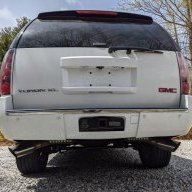
2007 Yukon XL Denali, look'n good.
 

Forum statistics

Threads
137,851
Posts
1,993,646
Members
102,820
Latest member
eegrobert
Back
Top