
You are using an out of date browser. It may not display this or other websites correctly.
You should upgrade or use an alternative browser.
You should upgrade or use an alternative browser.
BREAKING: GM is officially recalling the L87
- Thread starter DontTaseMeBro
- Start date
Disclaimer: Links on this page pointing to Amazon, eBay and other sites may include affiliate code. If you click them and make a purchase, we may earn a small commission.

- Joined
- Dec 23, 2024
- Posts
- 447
- Reaction score
- 382
The oil pump will work same way regardless of what viscosity oil is in it.On the topic of the oil pump, look, the guy took the pump apart and showed how it works. It has an interesting spring that, when the pressure is exceeded, closes the pump, reducing the main channel. Now let's imagine what will happen if we fill it with thicker oil 0-40?
The oil creates more pressure, the oil pump closes the main channel valve, supplying less oil to the engine. This means that by pouring 0-40 oil, you are creating oil starvation of the engine with your own hands, reducing the volume of oil supplied by the pump.
The fundamentals still apply—the higher viscosity, the higher pressure resulting from resistance to flow. I.e. try stirring peanut butter vs water.
From the pump perspective the change is on the discharge side. The oil will be a higher pressure meaning a higher input power to the pump to move the same amount of volume.
The two stage pump design is still a positive displacement, vane style pump. The difference is it changes the volute position such that the inlet side of the pump is pulling in a smaller volume of fluid and it is also not compressing it to the same degree as in it’s default mode of high pressure and high volume.
So the 2 stage pump has a maximum differential pressure across it in default mode, and a minimum differential pressure in its low pressure/economy mode.
It does this by recycling a small pin hole stream of discharge pressure to the stator which not only compresses a return spring, it moves the pump into a low differential pressure and low flow point.
It is like two different pumps altogether in one housing.
So even when the pump is in low differential mode, the pump fundamentals will still apply—the higher viscosity oil will make more pressure relative to the lower viscosity oil in the same pump.
- Joined
- Dec 23, 2024
- Posts
- 447
- Reaction score
- 382
High differential, high flow mode
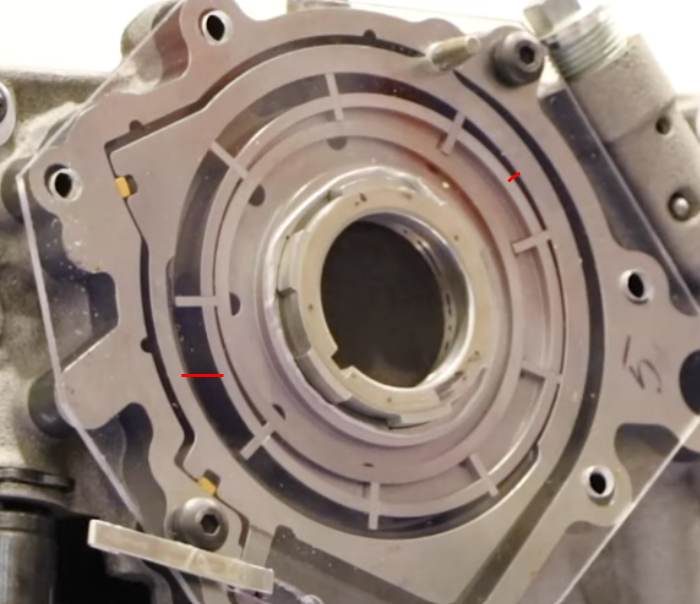
Low Differential, Low Flow mode
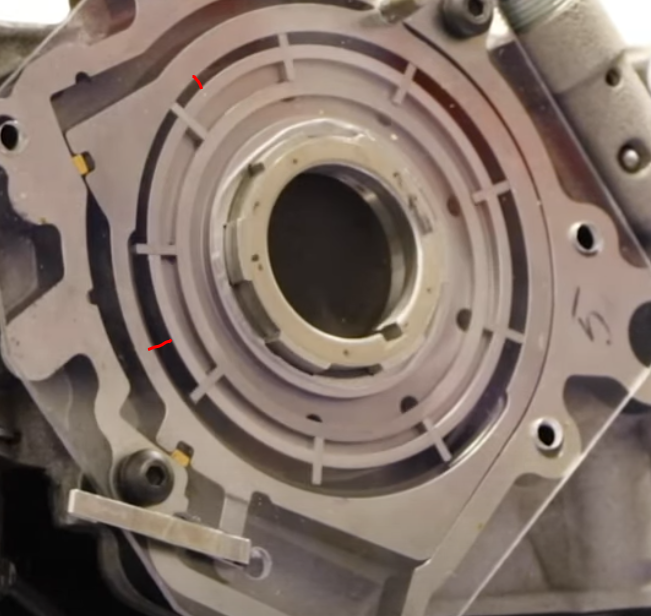
Low Differential, Low Flow mode
Vladimir2306
Full Access Member
- Joined
- May 18, 2023
- Posts
- 1,064
- Reaction score
- 1,250
Camaro and suburban have different engines initially, what does the pump have to do with it?The 2024 Camaro 6.2 and my 2021 6.2 Suburban use the same oil pump. They use 0W40 in the Camaro and 0W20 in my truck. Most of the parts are the same between the 2 engines.
Vladimir2306
Full Access Member
- Joined
- May 18, 2023
- Posts
- 1,064
- Reaction score
- 1,250
You also tie the political background hereVladimir’s Russian disinformation is getting old.

Vladimir,Camaro and suburban have different engines initially, what does the pump have to do with it?
You need to open up your narrow mind a bit.
The L87 and LT1 are pretty much the same engine with a few minor exceptions, intake manifold DFM/No DFM and tuning being the most obvious.
From Google Search AI
"Shared Characteristics
- Engine Family: Both are part of GM's Gen V Small Block engine family.
- Displacement: Both are 6.2-liter V8 engines.
- Architecture: They use an Overhead Valve (OHV), or "pushrod," design with an aluminum block and aluminum cylinder heads.
- Bore and Stroke: Both engines share the same bore (4.065 inches) and stroke (3.622 inches), as well as an 11.5:1 compression ratio.
- Crankshaft: They both feature a super-tough, forged steel crankshaft and an 8-bolt crankshaft flange.
- Camshaft: The LT1 and the truck-based L87 share the same camshaft part number.
- Purpose: The engines share a common DNA with a focus on a powerful, oversquare design for high-rpm horsepower and torque.
- Intake Manifold:
.
The L87 uses a different intake manifold designed to improve low-RPM torque production for use in trucks, whereas the LT1's intake is optimized for higher-RPM performance in sports cars and performance vehicles.
- Vehicle Application:
.
The LT1 is used in performance vehicles like the Corvette and Camaro. The L87 is a truck and SUV engine (part of the EcoTec3 line).
- Fuel Management Systems:
.
The L87 includes Automatic Start/Stop and Dynamic Fuel Management (DFM), an evolution of the older Active Fuel Management (AFM) system that can operate in multiple cylinder deactivation patterns for enhanced fuel economy. The LT1 does not use these systems as its focus is on power delivery.
- Engine Tuning:
.
Tuning differs to suit their intended applications, with the L87 tuned for enhanced low-rpm torque compared to the higher-rpm focus of the LT1."

Chevy LT Engines - The Ultimate Gen V Guide
With the buzz around Chevy LT Engines starting to gain momentum, we decided to put together the ultimate LT engine guide.
 inthegaragemedia.com
Vladimir2306
Full Access Member
- Joined
- May 18, 2023
- Posts
- 1,064
- Reaction score
- 1,250
I have a normal outlook, I have previously posted information that the Escalade V engines, the same as the Camaro, have the same problems without DFM, and on 0-40 oil. But you don't want to perceive this information, you only want to believe in your rainbow unicorns.Vladimir,
You need to open up your narrow mind a bit.
The L87 and LT1 are pretty much the same engine with a few minor exceptions, intake manifold DFM/No DFM and tuning being the most obvious.
From Google Search AI
"Shared Characteristics
Key Differences
- Engine Family: Both are part of GM's Gen V Small Block engine family.
- Displacement: Both are 6.2-liter V8 engines.
- Architecture: They use an Overhead Valve (OHV), or "pushrod," design with an aluminum block and aluminum cylinder heads.
- Bore and Stroke: Both engines share the same bore (4.065 inches) and stroke (3.622 inches), as well as an 11.5:1 compression ratio.
- Crankshaft: They both feature a super-tough, forged steel crankshaft and an 8-bolt crankshaft flange.
- Camshaft: The LT1 and the truck-based L87 share the same camshaft part number.
- Purpose: The engines share a common DNA with a focus on a powerful, oversquare design for high-rpm horsepower and torque.
Also this article the info about the L86/L87
- Intake Manifold:
.
The L87 uses a different intake manifold designed to improve low-RPM torque production for use in trucks, whereas the LT1's intake is optimized for higher-RPM performance in sports cars and performance vehicles.
- Vehicle Application:
.
The LT1 is used in performance vehicles like the Corvette and Camaro. The L87 is a truck and SUV engine (part of the EcoTec3 line).
- Fuel Management Systems:
.
The L87 includes Automatic Start/Stop and Dynamic Fuel Management (DFM), an evolution of the older Active Fuel Management (AFM) system that can operate in multiple cylinder deactivation patterns for enhanced fuel economy. The LT1 does not use these systems as its focus is on power delivery.
- Engine Tuning:
.
Tuning differs to suit their intended applications, with the L87 tuned for enhanced low-rpm torque compared to the higher-rpm focus of the LT1."
Chevy LT Engines - The Ultimate Gen V Guide
With the buzz around Chevy LT Engines starting to gain momentum, we decided to put together the ultimate LT engine guide.
We have a phrase, Arguing with a fool, means to stoop to his level. I'm tired of explaining the same thing to you every time.
- Joined
- Dec 23, 2024
- Posts
- 447
- Reaction score
- 382
Vladimir,I have a normal outlook, I have previously posted information that the Escalade V engines, the same as the Camaro, have the same problems without DFM, and on 0-40 oil. But you don't want to perceive this information, you only want to believe in your rainbow unicorns.
We have a phrase, Arguing with a fool, means to stoop to his level. I'm tired of explaining the same thing to you every time.
@jfoj and myself ( post 2090 post 2090) have posted objective information that shows that the difference in these engines is negligible to none when it comes to the bearings and lube oil interaction.
Last edited:
Vladimir,
You need to understand the failure of your 6.2l was not due to a "Birth defect" or debris in the engine. Your engine failed at 75k miles.
You need to understand the difference between the "Chicken" and "Egg", which came first.
You seem to be convinced your engine failure was due to what you refer to as "Dust" which is probably a translation of debris or metal particles in the engine oil.
Your engine failed not because there was debris or metal particles in the oil, your engine failed due to bearing to crankshaft contact due to an oil related failure. It was also not due to an oil pump failure. You never saw an Low Oil Pressure indication, no different than about 25,000+ other failed 6.2l engines.
The oil related failure was not due to lack or oil pressure, it was either due to the specific oil filter you were running, which is an AC Delco Pro type of oil filter that is more restrictive than the OE standard oil filter and/or the 0W20 oil failed to provide proper oil film strength while you were towing at 105+ MPH for hours on end with a roof top carrier and your family and gear in the vehicle.
Once bearing to crankshaft contact occurred then the bearing started to deteriorate and this is what caused all the metal particles in the crankcase. If the oil pump would have failed you would not have any metal particles in the oil filter.
The "Dust" in your engine was a result of a catastrophic bearing failure due to boundary layer lubrication and rapid heat build up. You can thank your oil filter and the 0W20 oil for protecting your engine so well for you!
You need to understand the failure of your 6.2l was not due to a "Birth defect" or debris in the engine. Your engine failed at 75k miles.
You need to understand the difference between the "Chicken" and "Egg", which came first.
You seem to be convinced your engine failure was due to what you refer to as "Dust" which is probably a translation of debris or metal particles in the engine oil.
Your engine failed not because there was debris or metal particles in the oil, your engine failed due to bearing to crankshaft contact due to an oil related failure. It was also not due to an oil pump failure. You never saw an Low Oil Pressure indication, no different than about 25,000+ other failed 6.2l engines.
The oil related failure was not due to lack or oil pressure, it was either due to the specific oil filter you were running, which is an AC Delco Pro type of oil filter that is more restrictive than the OE standard oil filter and/or the 0W20 oil failed to provide proper oil film strength while you were towing at 105+ MPH for hours on end with a roof top carrier and your family and gear in the vehicle.
Once bearing to crankshaft contact occurred then the bearing started to deteriorate and this is what caused all the metal particles in the crankcase. If the oil pump would have failed you would not have any metal particles in the oil filter.
The "Dust" in your engine was a result of a catastrophic bearing failure due to boundary layer lubrication and rapid heat build up. You can thank your oil filter and the 0W20 oil for protecting your engine so well for you!
Vladimir2306
Full Access Member
- Joined
- May 18, 2023
- Posts
- 1,064
- Reaction score
- 1,250
And so it is, and I have already replied that these engines also break down in the same way as the L87, but on 0-40 oilVladimir,
@jfoj and myself ( post 2090 https://www.tahoeyukonforum.com/thr...icially-recalling-the-l87.154084/post-1995502) have posted objective information that shows that the difference in these engines is negligible to none when it comes to the bearings and lube oil interaction.
Vladimir2306
Full Access Member
- Joined
- May 18, 2023
- Posts
- 1,064
- Reaction score
- 1,250
Again, you can continue to believe in your rainbow unicornsVladimir,
You need to understand the failure of your 6.2l was not due to a "Birth defect" or debris in the engine. Your engine failed at 75k miles.
You need to understand the difference between the "Chicken" and "Egg", which came first.
You seem to be convinced your engine failure was due to what you refer to as "Dust" which is probably a translation of debris or metal particles in the engine oil.
Your engine failed not because there was debris or metal particles in the oil, your engine failed due to bearing to crankshaft contact due to an oil related failure. It was also not due to an oil pump failure. You never saw an Low Oil Pressure indication, no different than about 25,000+ other failed 6.2l engines.
The oil related failure was not due to lack or oil pressure, it was either due to the specific oil filter you were running, which is an AC Delco Pro type of oil filter that is more restrictive than the OE standard oil filter and/or the 0W20 oil failed to provide proper oil film strength while you were towing at 105+ MPH for hours on end with a roof top carrier and your family and gear in the vehicle.
Once bearing to crankshaft contact occurred then the bearing started to deteriorate and this is what caused all the metal particles in the crankcase. If the oil pump would have failed you would not have any metal particles in the oil filter.
The "Dust" in your engine was a result of a catastrophic bearing failure due to boundary layer lubrication and rapid heat build up. You can thank your oil filter and the 0W20 oil for protecting your engine so well for you!
- Joined
- Dec 23, 2024
- Posts
- 447
- Reaction score
- 382
And so it is, and I have already replied that these engines also break down in the same way as the L87, but on 0-40 oil
Let's open the venn diagram up a bit here: all engines can fail the same way with the wrong oil in it.
Vladimir2306
Full Access Member
- Joined
- May 18, 2023
- Posts
- 1,064
- Reaction score
- 1,250
Catch my prediction... in about six months, a maximum of a year, there will be cases of breakdown of engines that have passed the pico test, and switched to 0-40 oil.Let's open the venn diagram up a bit here: all engines can fail the same way with the wrong oil in it.
All engines are not driven under the same conditions and maintained the same, sure there will be engines failing on 0W40, 5W30, 10W40, 20W50, you name it. Some recalled, some not. Lots of variables here.
But the thing that SO MANY fail to understand is the bearing surface loading of the 6.2l exceeds the protection that 0W20 can provide under many operating conditions. So what do you expect when you exceed limits?
As I have stated time and time again, GM did not spec 0W20 for the long term reliability of these engines.
But the thing that SO MANY fail to understand is the bearing surface loading of the 6.2l exceeds the protection that 0W20 can provide under many operating conditions. So what do you expect when you exceed limits?
As I have stated time and time again, GM did not spec 0W20 for the long term reliability of these engines.
DuraYuk
Full Access Member
- Joined
- Sep 17, 2022
- Posts
- 1,111
- Reaction score
- 884
Some of yall need to stop what your doing and apply to General Motors to be engineers. Whether you have the credentials or not yall are convinced you know better.
Hurry and on board so we can fix the issues the engineers they have seemingly dont understand.
Seems like we have 100 pages of waste here. Just back and forth..
It will be interesting to see what happens in the next year or so. Whether the 0w40 switched engines fail or not. I bet at least 25% do within that extended warranty period.
Hurry and on board so we can fix the issues the engineers they have seemingly dont understand.
Seems like we have 100 pages of waste here. Just back and forth..
It will be interesting to see what happens in the next year or so. Whether the 0w40 switched engines fail or not. I bet at least 25% do within that extended warranty period.
Yes, that is the correctjust took my 23 Z71 in for the PICO test yesterday, and passed.
31k on the odom
curious about the extended warrantry i read about vehicles that apss will get the 10yr 150k warrantry.
hopefully it will update in the app soon
warranty extension..from date of purchase
- Joined
- Dec 23, 2024
- Posts
- 447
- Reaction score
- 382
I'm sure there will be a case or two. Plenty of failure modes to take out an engine catastrophically.Catch my prediction... in about six months, a maximum of a year, there will be cases of breakdown of engines that have passed the pico test, and switched to 0-40 oil.
But if you are speaking of specifically a catastrophic engine bearing failure, then your prediction is bold.
- Joined
- Dec 23, 2024
- Posts
- 447
- Reaction score
- 382
With all these predictions I was thinking a few folks here should apply to be an actuarial analyst.
Similar threads

- Replies
- 23
- Views
- 2K


- Locked
- Replies
- 9
- Views
- 10K

- Replies
- 0
- Views
- 1K

- Replies
- 22
- Views
- 8K


