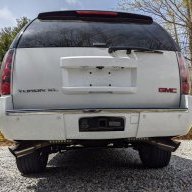
I did an AI query on your issue, since I don't know how to do any tuning work, and this was the response. Hopefully, it gives you a starting point.
To correct the rich condition and starting issues, you need to recalibrate your engine controller for the new airflow and fueling mechanics using HP Tuners. Because you changed the intake manifold and likely swapped the injectors, fuel rails, or throttle body to make it fit, the engine controller is working with inaccurate data.
Before making any changes, ensure your battery is connected to a charger and save a copy of your stock tune file as a backup.
Step 1: Correct the Injector Flow Rate (If Injectors Were Changed)
If you used the injectors that came with the TBSS intake, or any injectors other than your stock 2004 5.3L units, your ECU is scaling fuel completely wrong.
- Open your current tune file in VCM Editor.
- Click the Edit menu at the top and select Advanced view to ensure all parameters are visible.
- Navigate to Engine > Fuel > General.
- Locate the Injector Flow Rate vs. KPA (or vs. Manifold Vacuum) table.
- The Fix: If you used TBSS injectors, you must copy the exact data from a stock TrailBlazer SS file (or the specific data sheet for your aftermarket injectors) and paste it into this table. If you kept your stock 2004 injectors but changed the fuel pressure regulator setup, you must adjust this curve to match your actual rail pressure (e.g., 58 PSI constant if using a Corvette regulator).
Step 2: Calibrate the Volumetric Efficiency (VE) Table
The TBSS intake moves significantly more air at mid-to-high RPMs and changes air velocity at idle compared to your stock intake. This throws off the Primary VE table, causing the engine to miscalculate how much fuel to inject.
- Open VCM Scanner and connect to your vehicle's OBD-II port using the MPVI3.
- Open VCM Editor, go to Engine > Fuel > Open & Closed Loop, and temporarily disable closed loop by setting the STFT Open Loop to disabled and raising the Closed Loop Enable Temp to its maximum value.
- Go to Engine > Fuel > COT/Lean Cruise and disable Catalytic Converter Protection (COT) to prevent unmetered fueling spikes.
- Set up a graph in VCM Scanner to track LTFT + STFT (if tuning in closed loop) or EQ Ratio Error (if using a wideband O2 sensor) plotted against Engine RPM vs. Manifold Absolute Pressure (MAP).
- Open your tune in VCM Editor and go to Engine > Airflow > General > Main VE.
- The Fix: Drive the truck smoothly, capturing data across as many cells as possible. In VCM Editor, highlight your Main VE table, right-click, and use Paste Special > Multiply by % (or Half %) using the error data compiled from your scanner logs. Repeat this process until your fuel trims or wideband error margins sit between 0% and -3%.
Step 3: Fix the Hard Starting (Cranking & Startup Airflow)
Your hard starting is caused by two conflicting issues: the engine is likely flooding from incorrect injector data, and the larger/different intake plenum requires a different volume of air to catch smoothly.
- Open VCM Editor and go to Engine > Airflow > Electronic Throttle (or Idle depending on your exact OS).
- Locate the Base Running Airflow (RAF) table (sometimes listed as Idle Airflow vs. Coolant Temp).
- The Fix: Because the TBSS plenum volume is larger, the engine needs slightly more startup air. Increase the values in the colder regions of this table (from freezing up to operating temperature) by 5% to 10% to help the truck catch cleanly.
- Navigate to Engine > Fuel > Startup > Cranking Fuel.
- Adjust the Cranking VE or Cranking FA Time table down by 5% if the truck continues to stumble and smell heavily of raw fuel immediately upon key-turn, assuming your primary injector data from Step 1 is already corrected.
Step 4: Write the New Calibration
- Re-enable any Closed Loop or COT settings you disabled for tuning in Step 2.
- Save your new tune file under a distinct name (e.g., Yukon_TBSS_Tune_V1.hpt).
- Click the Write Vehicle icon in VCM Editor.
- Select Write Calibration Only (do not do a "Write Entire" unless changing operating systems).
- Turn the key off for 10 seconds, then start the truck to test the changes.
To narrow down the exact math for your tune:
Which injectors are you currently running (your stock 2004 ones or Gen IV/TBSS ones), and are you using a
returnless Corvette filter/regulator or the stock
return-style fuel rail loop?