Welcome to the Forum from NH.
Lots of knowledgeable folks here who freely share their knowledge, experiences, and perspectives. Knowledge is power.
I hope that you will become a participating member in the Forum's discussions.
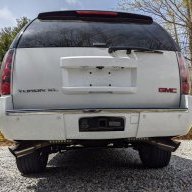
Pics of the truck, please. If we can't see it, it does not exist.
Grok suggests the following:
The most likely root cause is a problem in the vehicle speed signal (VSS) circuit from the PCM to the EBCM (erratic/poor rear wheel speed signal), often combined with or triggering internal EBCM faults—or a poor EBCM ground/power connection that makes the (new) module set multiple internal codes. The cluster of codes and the exact symptoms (lights + speedometer bounce starting around 30 mph) match this pattern closely on these GMT800 trucks.
What the codes mean
- C0237: Erratic rear wheel speed signal. On the 2002 Yukon Denali (and similar), the EBCM does not use dedicated rear wheel speed sensors for this. It receives a 128k pulses/mile vehicle speed signal generated by the PCM from the transfer-case (or transmission) VSS. C0237 sets when that signal is erratic for ~105 ms once vehicle speed exceeds roughly 12–20 mph (depending on brake application).
- C0265: EBCM relay circuit (internal malfunction).
- C0241, C0242, C0245, C0246, C0251, C0252 (and related C024x/C025x): EBCM internal solenoid circuit faults. These commonly appear together when the EBCM detects an internal problem (or when power/ground is marginal and the module misbehaves). Service information treats many of them as internal EBCM issues.
The ABS and brake lights coming on near 30 mph, with the speedometer starting to bounce at the same time, is classic for an intermittent or noisy VSS-derived signal that the EBCM flags once speed rises. The transfer-case VSS has already been replaced, so the sensor itself is less likely the sole culprit.
Why this persists after EBCM + transfer-case VSS replacement
- The rear-speed input the EBCM uses is the PCM-conditioned VSS signal, not a raw sensor on the axle. Wiring, connectors, grounds, or the PCM output itself can still be faulty.
- Multiple simultaneous “internal solenoid” + relay codes after an EBCM swap frequently trace to a poor ground or power feed to the EBCM (or a marginal connection that lets the module set false internal DTCs). GM had bulletins for exactly this on these trucks—poor EBCM ground causing C0265 and related codes, leading to unnecessary module replacements.
- A noisy or intermittent class-2 data / VSS circuit can also crash communications or make the speedometer bounce while the EBCM disables ABS/DRP and lights the warning lamps.
Recommended diagnostic path (in order)
- Clean and load-test the EBCM ground (frame rail under the driver’s side, typically). Remove the bolt, clean to bare metal, re-torque, and verify with a load (headlamp or equivalent) that voltage drop is minimal under load. Also confirm battery voltage and the EBCM power feed.
- Scope or monitor the VSS signal circuit that the PCM sends to the EBCM (the 128k pulses/mile line). Look for dropouts, noise, or erratic frequency once speed exceeds ~20 mph. Check the circuit for opens, shorts, corrosion, or chafing (common near the transfer case, frame, and connectors).
- Verify the new transfer-case VSS installation and its connector/wiring all the way to the PCM. Confirm correct sensor (there can be multiple sensors on active transfer cases) and good pin tension/no corrosion.
- Check for related PCM codes (P050x family) and bidirectional data: compare PCM vehicle speed vs. what the EBCM reports as rear speed.
- If the above is clean and the internal codes immediately return, the replacement EBCM may be defective, improperly programmed/configured for the vehicle, or the BPMV/pump circuit needs resistance checks (service information requires this when C0265 is present after module replacement).
These trucks are known for EBCM ground issues and for the rear-speed signal path (PCM → EBCM) causing exactly the C0237 + multiple internal codes + speedometer bounce you describe. Start with the ground and the VSS signal circuit; that is the highest-probability fix given what has already been replaced. If you have live data or can scope the signal, that will quickly confirm or rule out the circuit.